
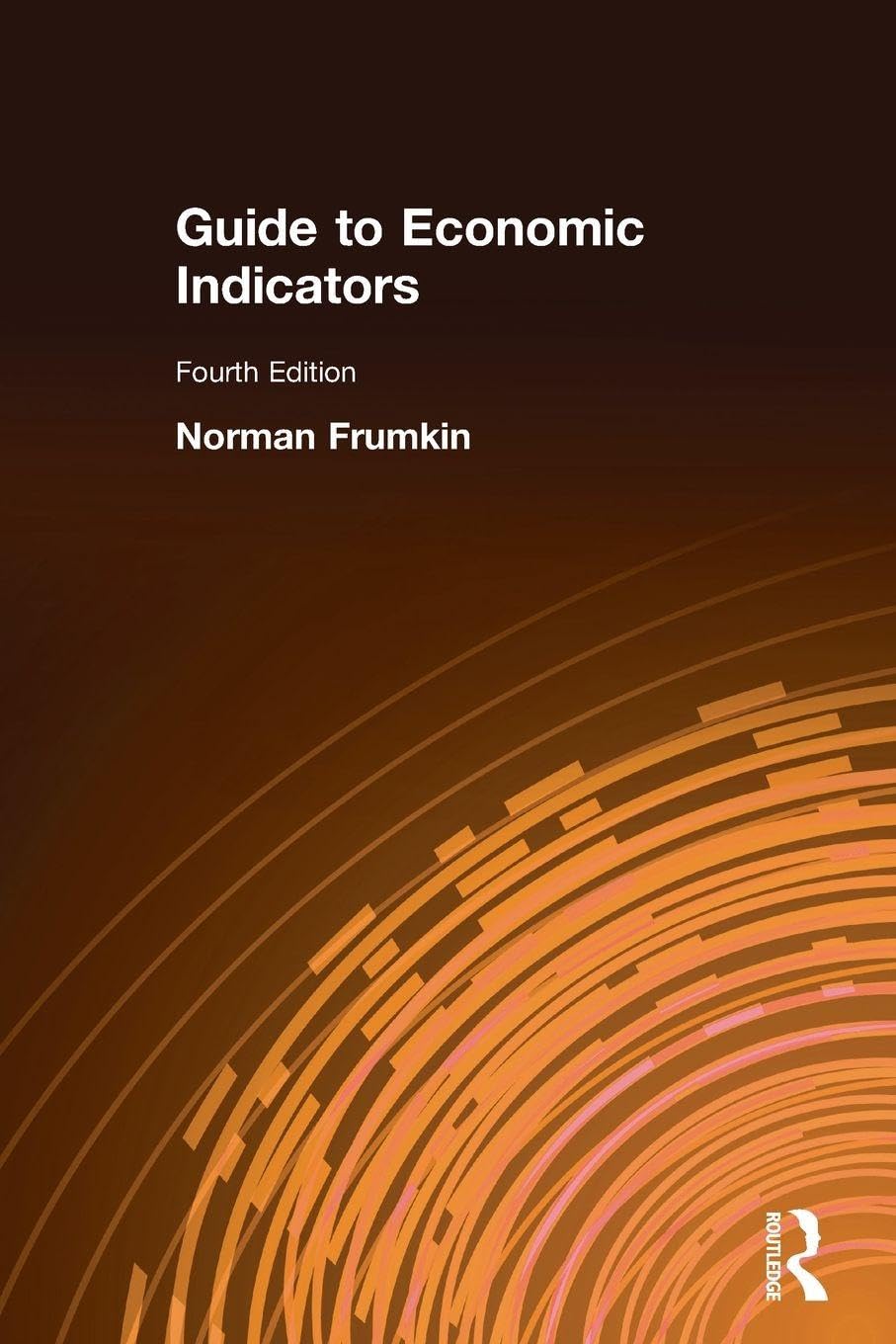
Guide to Economic Indicators: A Practical Reference for Understanding US Macroeconomic Data by Norman Frumkin
Inclusive of all applicable taxes. FREE shipping on all orders.
Available Offers
- 🚚Free Delivery — Free shipping on all orders
- 💵Cash on Delivery — Pay when your order arrives
- ↩️15-Day Easy Returns — Hassle-free return policy
- 🔒Cash on Delivery — Pay safely when your order arrives
Check Delivery
Product Description
Introduction
In an era where economic shifts influence everything from household budgets to national policies, understanding the numbers behind the headlines has never been more critical. Norman Frumkin’s Guide to Economic Indicators serves as an indispensable compass for anyone seeking to decode the complex language of economic data. This meticulously revised and expanded hardcover edition offers Indian readers—students, professionals, and curious minds alike—a clear, jargon-free pathway to mastering over seventy key macroeconomic indicators that shape our world.
Book Overview
Originally published by Routledge, this comprehensive reference work demystifies the major statistical measures that define the U.S. economy. Unlike dense academic texts, Frumkin’s guide is designed for practical, everyday use. It provides concise explanations of what each indicator means, how it is calculated, where to find reliable data, and how recent trends impact decision-making. Whether you are tracking inflation, employment, or trade balances, this book equips you with the tools to interpret economic signals with confidence.
Key Highlights
- Expanded and Updated Content: The revised edition includes new indicators and the latest data trends, ensuring relevance for contemporary analysis.
- Jargon-Free Explanations: Complex concepts are broken down into simple, accessible language, making economics understandable for non-specialists.
- Practical Data Sources: Each chapter includes direct references to authoritative websites and publications, enabling readers to access current information.
- User-Friendly Structure: Organized alphabetically and thematically, the book allows quick lookup of specific indicators without wading through extraneous material.
- Global Relevance: While focused on the U.S. economy, the principles and analytical methods apply directly to Indian and global economic contexts.
Inside the Book
This guide covers more than seventy macroeconomic indicators, from Gross Domestic Product (GDP) and Consumer Price Index (CPI) to lesser-known measures like the Index of Leading Indicators and the Employment Cost Index. Each entry follows a consistent format: a clear definition, the methodology behind the statistic, its significance in economic analysis, and a discussion of recent trends. Readers will also find a rich appendix with historical data tables, a glossary of key terms, and a guide to navigating government and international databases.
Key Topics
- National income and output indicators (GDP, GNP, personal income)
- Employment and unemployment statistics
- Inflation measures (CPI, PPI, GDP deflator)
- Consumer spending and retail sales
- Housing and construction data
- Industrial production and capacity utilization
- Trade and international finance (exports, imports, balance of payments)
- Financial market indicators (interest rates, stock indices, money supply)
- Leading, coincident, and lagging indicators
- Productivity and earnings data
Reader Benefits
By reading this book, you gain the ability to critically evaluate economic news, understand policy debates, and make informed decisions in your personal and professional life. It saves hours of research by condensing vast amounts of data into digestible insights. For students, it bridges the gap between textbook theory and real-world application. For investors, it offers a robust framework for assessing market conditions. For journalists and analysts, it provides a reliable fact-checking resource. Above all, it empowers you to think like an economist—without needing a degree in the subject.
Learning Outcomes
- Identify and interpret the most important economic indicators used by governments and financial institutions.
- Understand how each indicator is constructed and what it truly reflects about economic health.
- Analyze trends and correlations between different indicators to forecast potential economic shifts.
- Locate up-to-date data from official sources and apply it to real-world scenarios.
- Differentiate between short-term fluctuations and long-term economic cycles.
- Communicate economic concepts clearly to colleagues, clients, or classmates.
Who Should Read
This book is ideal for undergraduate and postgraduate students of economics, business, and finance; professionals in banking, investment, and corporate strategy; journalists covering economic affairs; policy analysts and government officials; and self-taught learners with a curiosity about how economies work. It is equally valuable for Indian readers preparing for competitive exams such as UPSC, RBI Grade B, or NABARD, where a solid grasp of economic indicators is essential.
About the Author
Norman Frumkin is a respected economist and author with decades of experience in analyzing economic data. He has served as a senior economist at the U.S. government’s Bureau of Economic Analysis and has contributed to numerous publications on economic measurement. His writing is known for its clarity, accuracy, and accessibility, making complex subject matter approachable for a broad audience.
About the Publisher
Routledge is a premier global academic publisher, renowned for its high-quality books in the social sciences, humanities, and business. With a history spanning over 150 years, Routledge is committed to advancing knowledge through authoritative and well-researched publications. This hardcover edition reflects the publisher’s dedication to producing durable, reference-grade works that stand the test of time.
Conclusion
Guide to Economic Indicators is more than a reference book—it is a key that unlocks the language of modern economies. Whether you are a student preparing for exams, a professional navigating financial markets, or a reader who simply wants to understand the forces shaping our world, this book offers the clarity and depth you need. Add this essential volume from Bookshops.in to your library and gain the confidence to interpret economic data with skill and insight.
Quick Summary
Guide to Economic Indicators by Norman Frumkin is a comprehensive, easy-to-understand reference that demystifies over 70 major US macroeconomic indicators. Designed for students, analysts, journalists, and investors, this revised edition provides clear explanations of each indicator—from GDP and inflation to employment and trade—along with recent trends and online data sources. The book requires no prior economics knowledge, making it accessible to anyone who wants to interpret economic news and data confidently. Indian readers will find it especially useful for understanding the US economy's influence on global markets and investment decisions. By bridging the gap between raw statistics and real-world meaning, Frumkin empowers readers to analyse economic health, spot trends, and make informed choices. Whether you are a university student in Delhi, a financial analyst in Mumbai, or a business owner in Bangalore, this book serves as your go-to desk reference. Buy your copy from Bookshops.in, India's trusted bookstore for premium academic and professional titles, and enjoy fast delivery across the country.
Book Highlights
Book Specifications
| ISBN-13 | 9780765616470 |
| ISBN-10 | 0765616475 |
| Publisher | Routledge |
| Language | English |
| Dimensions | 15.19 x 1.75 x 22.91 cm |
| Weight | 408 g |
| Category | Economics › Macroeconomics |
| Genre | Nonfiction |
| Original Language | English |
Frequently Asked Questions
What is Guide to Economic Indicators about?
Who is the author of this book?
Is this book suitable for beginners?
Does the book include recent data?
Can Indian students use this book?
Are online resources provided?
What indicators are covered?
Is this book technical?
How is this book different from other economic references?
What format is the book?
Does it cover global indicators?
Can investors benefit from this book?
Is there a glossary?
Where can I buy this book in India?
Readers Also Search For
Customers Also Bought

Entrepreneurship
Chinese Economic Revolution (English, Linda Grove)

Entrepreneurship
Engines of Innovation: The Entrepreneurial University in the Twenty-First Century by Holden Thorp

Entrepreneurship
Invention to Innovation (English, PhD Marshall Larry | Jenna Daroczy)

Entrepreneurship
Database Management Systems by Raghu Ramakrishnan – DBMS Textbook

Entrepreneurship
Decision-making for Technology Executives by Harold A. Linstone

Entrepreneurship
The Business Innovation Audit (English, William Tate)
Related Products
View All
Economics
Political Economy from Pufendorf to Marx (English, István Hont | Lasse S. Andersen | Béla Kapossy)
Economics
Women's Entrepreneurship and Economics (English, Miguel-Angel Galindo | Domingo Ribeiro)

Economics
Trade Policy and Industrialization in Turbulent Times | by Gerry Helleiner | Routledge | by Gerry Helleiner | Routledge | by Gerry Helleiner | Routledge | by Gerry Helleiner | Routledge | by Gerry Helleiner | Routledge | by Gerry Helleiner | Routledge | by Gerry Helleiner | Routledge | by Gerry Helleiner | Routledge | by Gerry Helleiner | Routledge | by Gerry Helleiner | Routledge | by Gerry Helleiner | Routledge | by Gerry Helleiner | Routledge | by Gerry Helleiner | Routledge | by Gerry Hellei

Economics
History of Economic Analysis | by Schumpeter Joseph A. | Taylor & Francis Ltd | by Schumpeter Joseph A. | Taylor & Francis Ltd | by Schumpeter Joseph A. | Taylor & Francis Ltd | by Schumpeter Joseph A. | Taylor & Francis Ltd | by Schumpeter Joseph A. | Taylor & Francis Ltd | by Schumpeter Joseph A. | Taylor & Francis Ltd | by Schumpeter Joseph A. | Taylor & Francis Ltd | by Schumpeter Joseph A. | Taylor & Francis Ltd | by Schumpeter Joseph A. | Taylor & Franci

Economics
OECD Compendium of Productivity Indicators 2015 | by Organization for Economic Cooperation an | Organization for Economic Co-Operation & Deve | by Organization for Economic Cooperation an | Organization for Economic Co-Operation & Deve | by Organization for Economic Cooperation an | Organization for Economic Co-Operation & Deve | by Organization for Economic Cooperation an | Organization for Economic Co-Operation & Deve | by Organization for Economic Cooperation an | Organization

Economics