
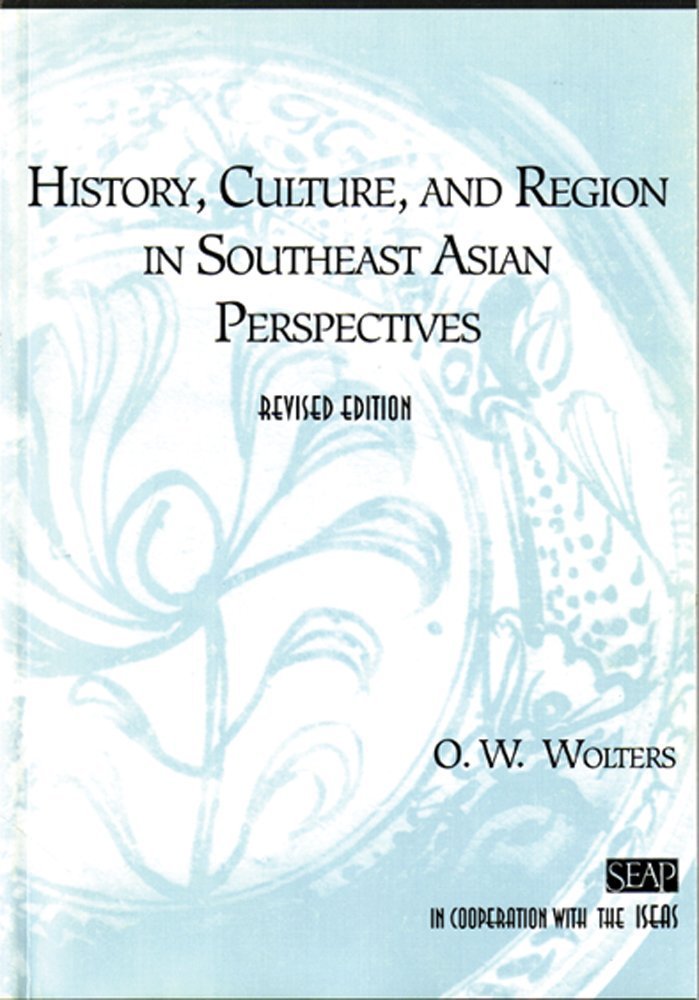
History, Culture, and Region in Southeast Asian Perspectives by O. W. Wolters – A Revised Classic on Mandala Southeast A
Inclusive of all applicable taxes. FREE shipping on all orders.
Available Offers
- 🚚Free Delivery — Free shipping on all orders
- 💵Cash on Delivery — Pay when your order arrives
- ↩️15-Day Easy Returns — Hassle-free return policy
- 🔒Cash on Delivery — Pay safely when your order arrives
Check Delivery
Product Description
Introduction
In the vast and complex tapestry of Southeast Asian studies, few works have achieved the enduring relevance of O. W. Wolters' History, Culture, and Region in Southeast Asian Perspectives. This hardcover edition, published by the distinguished Southeast Asia Program Publications, offers students and scholars a profound exploration of the region's historical dynamics, cultural frameworks, and spatial identities. Written with remarkable depth and clarity, the book remains an essential resource for anyone seeking to understand the pre-colonial and early modern patterns that shaped Southeast Asia's unique civilizational character.
Book Overview
Originally published as a pathbreaking study, this updated edition includes a substantial retrospective postscript that engages with contemporary scholarship since 1982. Wolters' central thesis revolves around the concept of the 'mandala'—a fluid, overlapping system of political and cultural influence that defined Southeast Asian kingdoms long before the arrival of European colonialism. The book challenges linear, Western-centric models of state formation and instead presents a nuanced vision of power, religion, and identity as they evolved across the region. With meticulous attention to epigraphic evidence, indigenous texts, and anthropological insights, Wolters reconstructs a world where boundaries were porous and cultures were constantly in dialogue.
Key Highlights
- Revised and Expanded Edition: Contains a new, comprehensive postscript that reflects on three decades of scholarly developments in Southeast Asian studies.
- Mandala Framework: Pioneering analysis of the mandala polity model, which remains a cornerstone of Southeast Asian historiography.
- Interdisciplinary Approach: Blends history, cultural anthropology, and political geography to create a holistic understanding of the region.
- Primary Source Integration: Draws extensively on ancient inscriptions, chronicles, and local narratives from across mainland and island Southeast Asia.
- Critical Reflections: Engages with debates on nationalism, colonialism, and the construction of regional identity.
Inside the Book
The volume is organized into thematic chapters that examine the interplay between local cultures and external influences—particularly from India and China—without reducing Southeast Asia to a mere recipient of foreign ideas. Wolters emphasizes the agency of Southeast Asian societies in selectively adapting and transforming these influences to suit their own social and political needs. The postscript is particularly valuable, as it revisits earlier arguments in light of new archaeological discoveries, theoretical shifts, and postcolonial critiques. Readers will find detailed discussions on topics such as the role of women in pre-modern societies, the significance of trade networks, and the spiritual dimensions of kingship. The book also includes extensive footnotes and a bibliography that serve as a gateway to further research.
Key Topics
- The mandala polity and its application to Southeast Asian history
- Cultural localization and the indigenization of Hindu-Buddhist traditions
- Regional variations in political organization from the early centuries CE to the colonial period
- The relationship between geography, ecology, and historical development
- Oral traditions, chronicles, and the writing of history in Southeast Asia
- Comparative perspectives on Southeast Asia, China, and India
Reader Benefits
This book offers more than historical facts; it provides a conceptual toolkit for analyzing power, culture, and space in non-Western contexts. Indian readers, in particular, will find the discussions on cross-cultural exchanges with the Indian subcontinent both enlightening and relevant. The writing is rigorous yet accessible, making it suitable for both advanced undergraduate students and seasoned academics. By reading this work, one gains a deeper appreciation for the resilience and creativity of Southeast Asian civilizations, as well as a critical perspective on how history itself is narrated. The postscript also helps readers understand how scholarship evolves over time, encouraging a reflective approach to historical study.
Learning Outcomes
- Understand the mandala model as an alternative to Western notions of territorial statehood
- Analyze the processes of cultural borrowing and adaptation in pre-colonial Asia
- Critically evaluate primary sources such as inscriptions and court chronicles
- Identify key historiographical debates in Southeast Asian studies
- Develop a comparative framework for studying region, culture, and power
- Appreciate the role of indigenous agency in shaping historical outcomes
Who Should Read
This book is indispensable for students and researchers in history, Asian studies, political science, and cultural anthropology. It is especially valuable for Indian scholars interested in the historical connections between South Asia and Southeast Asia. University libraries, history departments, and academic book clubs will find this edition a lasting addition to their collections. General readers with a serious interest in world history or the civilisations of Asia will also find the book richly rewarding, provided they are prepared for an intellectually engaging journey.
About the Author
O. W. Wolters (1915–2000) was a distinguished historian and one of the foremost scholars of Southeast Asian history. He spent much of his career at Cornell University, where he was a professor of history and a key figure in the development of Southeast Asian studies in the United States. His work combined rigorous philological analysis with broad theoretical vision, and he is best known for his studies on early Southeast Asian polities, the mandala concept, and the history of the Malay world. Wolters' scholarship continues to influence generations of historians across the globe.
About the Publisher
Southeast Asia Program Publications (SEAP) is an academic imprint based at Cornell University, dedicated to publishing high-quality works on the history, culture, politics, and societies of Southeast Asia. With a reputation for scholarly excellence, SEAP has been instrumental in bringing critical research to a global audience. This edition of Wolters' classic work upholds the program's commitment to rigorous scholarship and accessible presentation.
Conclusion
History, Culture, and Region in Southeast Asian Perspectives is not merely a book; it is a landmark in the intellectual history of a region. For students in India and beyond, it opens a window onto a world where cultures met, merged, and remade themselves on their own terms. Whether you are beginning your journey into Southeast Asian history or deepening an existing expertise, this revised hardcover edition belongs on your shelf. Order your copy today from Bookshops.in and explore the rich, layered past of one of the world's most dynamic regions.
Quick Summary
History, Culture, and Region in Southeast Asian Perspectives by O. W. Wolters is a seminal work that redefines how we understand Southeast Asia's past. The book introduces the mandala political model—a fluid, overlapping system of power—to explain the region's historical geography and cultural interactions. This revised edition (1999) adds a comprehensive postscript that engages with scholarly developments since the original 1982 publication, making it relevant for contemporary readers. The book is ideal for Indian students and scholars of Asian history, as it highlights the deep historical ties between India and Southeast Asia through trade, religion, and art. Readers will gain a nuanced understanding of how regions like Angkor, Sri Vijaya, and Majapahit functioned. They will also learn about the cultural continuities that shape modern Southeast Asia. Purchasing from Bookshops.in ensures you receive a genuine hardcover edition with fast delivery across India. This book is a must-have for any serious student of Asian civilizations, offering timeless insights into a dynamic and diverse part of the world.
Book Highlights
Book Specifications
| ISBN-13 | 9780877277255 |
| ISBN-10 | 0877277257 |
| Publisher | Southeast Asia Program Publications, Cornell University |
| Language | English |
| Dimensions | 17.78 x 1.52 x 25.4 cm |
| Weight | 590 g |
| Country | USA |
| Category | Region & Countries › Asia |
| Genre | Non-fiction |
| Reading Age | Adult |
| Original Language | English |
Frequently Asked Questions
What is the main focus of this book?
Who is the author O. W. Wolters?
Is this book suitable for Indian students?
What is new in this revised edition?
What is the binding of this book?
Can I use this book for my university course?
Does the book include maps or illustrations?
Is the language English?
What is the ISBN-13?
How does this book help in understanding Southeast Asia?
Is there a digital version available?
What is the price of the book?
Where can I buy this book in India?
Readers Also Search For
Related Products
View All
History
The Information Revolution: Transforming the World Through Technology (World History)
History
Human Nature and the French Revolution: From the Enlightenment to the Napoleonic Code: 3 (Polygons: Cultural Diversities and Intersections, 3)
History
The Unmaking of Home in Contemporary Art (Cultural Spaces)

History
Handbook to Life in Medieval and Early Modern Japan | by William E. Deal | Oxford University Press | by William E. Deal | Oxford University Press | by William E. Deal | Oxford University Press | by William E. Deal | Oxford University Press | by William E. Deal | Oxford University Press | by William E. Deal | Oxford University Press | by William E. Deal | Oxford University Press | by William E. Deal | Oxford University Press | by William E. Deal | Oxford University Press | by William E. Deal | Ox

History
The Narrators of Barbarian History (A.D. 550-800) | by Walter Goffart | University of Notre Dame Press | by Walter Goffart | University of Notre Dame Press | by Walter Goffart | University of Notre Dame Press | by Walter Goffart | University of Notre Dame Press | by Walter Goffart | University of Notre Dame Press | by Walter Goffart | University of Notre Dame Press | by Walter Goffart | University of Notre Dame Press | by Walter Goffart | University of Notre Dame Press | by Walter Goffart | Univ

History