
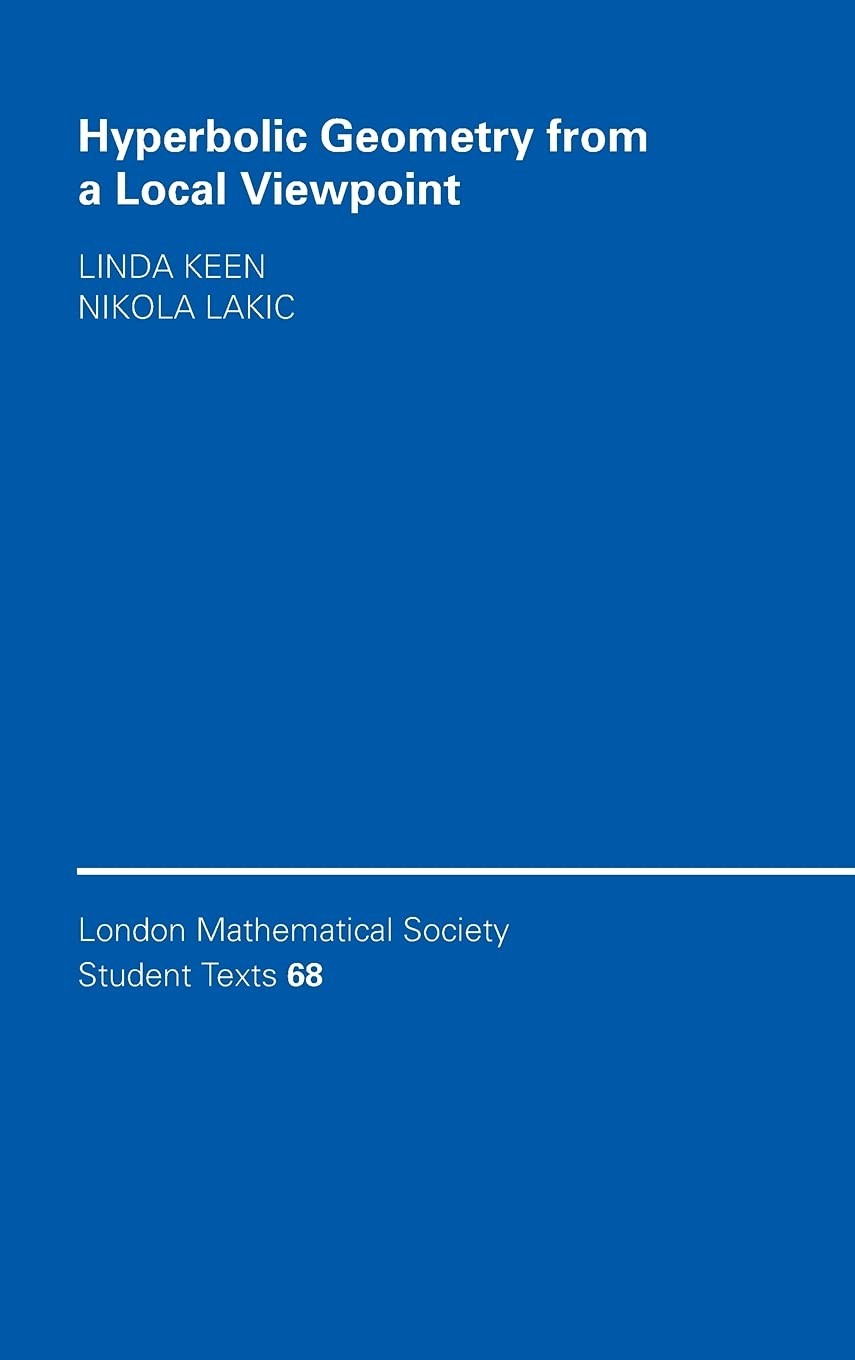
Hyperbolic Geometry from a Local Viewpoint
Inclusive of all applicable taxes. FREE shipping on all orders.
Available Offers
- 🚚Free Delivery — Free shipping on all orders
- 💵Cash on Delivery — Pay when your order arrives
- ↩️15-Day Easy Returns — Hassle-free return policy
- 🔒Cash on Delivery — Pay safely when your order arrives
Check Delivery
Product Description
Introduction
Hyperbolic geometry, a non-Euclidean realm where parallel lines diverge and triangles have angle sums less than 180 degrees, holds a central place in modern mathematics. For graduate students and researchers seeking a rigorous yet accessible entry point, Hyperbolic Geometry from a Local Viewpoint by Linda Keen offers a masterful guide. Published by Cambridge University Press, this hardcover volume approaches the subject from an infinitesimal perspective—starting with local metrics and building upward to global structures. It is an essential resource for anyone working in complex analysis, dynamical systems, or geometric theory.
Book Overview
This book systematically develops two-dimensional hyperbolic geometry by first grounding readers in rigid motions of the Euclidean plane. From there, it transitions into a full treatment of hyperbolic geometry within the unit disk, using a metric defined through a density function and integration. The text then expands into arbitrary plane domains, introducing surfaces, covering spaces, uniformization, and Fuchsian groups. A significant portion is dedicated to hyperbolic and hyperbolic-like metrics—generalizations of the Kobayashi and Carathéodory metrics—with applications to holomorphic dynamics, including recent results and open problems. The approach is both theoretical and practical, making complex ideas tangible.
Key Highlights
- Infinitesimal approach: Metrics are introduced locally via density, then integrated to form global distances—a modern and intuitive method.
- Comprehensive coverage: From basic rigid motions to advanced topics like Fuchsian groups and uniformization.
- Original research: Includes new material on hyperbolic-like metrics and their applications in dynamics.
- Open problems: Concludes with accessible unsolved questions, encouraging further exploration.
- Graduate-level rigor: Perfect for students and researchers in mathematics and theoretical physics.
Inside the Book
The volume begins with Euclidean rigid motions as motivation, then introduces the hyperbolic plane via the Poincaré disk model. Each chapter builds sequentially: first defining densities and metrics, then exploring geodesics, isometries, and curvature. Later chapters tackle covering spaces and the uniformization theorem, leading to a detailed discussion of Fuchsian groups. The latter half presents cutting-edge work on hyperbolic and hyperbolic-like metrics for plane domains, drawing connections to the Kobayashi and Carathéodory metrics. The final chapter applies these ideas to holomorphic dynamics, offering new results and inviting readers to tackle open problems. Numerous exercises and examples reinforce understanding throughout.
Key Topics
- Rigid motions in the Euclidean plane
- Hyperbolic geometry in the unit disk
- Metrics defined via density and integration
- Geodesics, isometries, and curvature
- Surfaces, covering spaces, and uniformization
- Fuchsian groups and their properties
- Hyperbolic metrics for arbitrary plane domains
- Kobayashi and Carathéodory metrics
- Applications to holomorphic dynamics
- Open problems and current research directions
Reader Benefits
- Builds strong foundations: The local-to-global approach ensures deep conceptual understanding.
- Bridges theory and application: Connects abstract geometry to real-world dynamics.
- Prepares for research: Open problems and new results make it ideal for thesis work.
- Self-contained: Assumes only basic complex analysis and topology, with all advanced concepts developed.
- Indian context: Suitable for university courses across India, especially in mathematics and physics departments.
Learning Outcomes
By the end of this book, readers will be able to define and work with hyperbolic metrics using infinitesimal methods, understand the role of Fuchsian groups in uniformization, and apply hyperbolic geometry to holomorphic dynamics. They will gain proficiency in constructing metrics on arbitrary plane domains and be equipped to explore open problems in the field. The book also sharpens skills in rigorous proof-writing and geometric reasoning.
Who Should Read
This book is designed for graduate students in mathematics, particularly those specializing in geometry, complex analysis, or dynamical systems. It is also valuable for researchers in theoretical physics who require a deep understanding of hyperbolic spaces. Advanced undergraduates with a strong background in real and complex analysis will find it challenging but rewarding. Indian students preparing for competitive exams or pursuing PhDs will benefit from its clarity and depth.
About the Author
Linda Keen is a distinguished mathematician known for her contributions to complex analysis, hyperbolic geometry, and Teichmüller theory. A professor emerita at the City University of New York, she has authored numerous influential papers and books. Her teaching experience shines through in this text, which balances rigor with accessibility. Keen’s work has shaped modern understanding of geometric structures on Riemann surfaces.
About the Publisher
Cambridge University Press is one of the world’s oldest and most respected academic publishers. Renowned for its high-quality mathematics and science titles, it ensures that every book meets exacting standards of scholarship and production. This hardcover edition is built to last, with clear typesetting and durable binding—ideal for years of study and reference.
Conclusion
Hyperbolic Geometry from a Local Viewpoint is an indispensable text for anyone serious about mastering hyperbolic geometry. Its unique infinitesimal perspective, combined with modern applications and open problems, makes it both a thorough textbook and a research companion. Whether you are a student in India embarking on graduate studies or a mathematician seeking fresh insights, this book will illuminate the beauty and power of hyperbolic spaces. Add it to your library from Bookshops.in today.
Quick Summary
Hyperbolic Geometry from a Local Viewpoint by Linda Keen is a rigorous graduate-level textbook that explores two-dimensional hyperbolic geometry through an innovative infinitesimal lens. Instead of starting with global models, the book begins with rigid motions in the Euclidean plane and uses them to motivate the development of hyperbolic metrics defined by density functions integrated over paths. This local approach leads naturally to the Poincaré disk model and then extends to arbitrary plane domains, requiring concepts like covering spaces, uniformization, and Fuchsian groups. The authors provide a thorough treatment of these ideas, culminating in a discussion of hyperbolic and hyperbolic-like metrics, including generalizations of the Kobayashi metric. This material is particularly valuable for researchers and advanced students working in complex analysis, Riemann surfaces, and geometric topology. The book is published by Cambridge University Press, ensuring high editorial and production quality. For Indian students and mathematicians seeking a deep understanding of hyperbolic geometry from a modern perspective, this hardcover edition from Bookshops.in offers an authoritative and accessible resource. By purchasing from Bookshops.in, you support a trusted Indian bookstore that delivers genuine academic titles across the country.
Book Highlights
Book Specifications
| ISBN-13 | 9780521863605 |
| ISBN-10 | 0521863600 |
| Publisher | Cambridge University Press |
| Language | English |
| Dimensions | 15.24 x 1.91 x 22.86 cm |
| Weight | 532 g |
| Country | India |
| Category | Mathematics › Geometry |
| Genre | Non-fiction |
| Reading Age | Adult |
| Original Language | English |
Frequently Asked Questions
What is the main focus of this book?
Is this book suitable for self-study?
What prerequisites are needed?
Does the book cover the Poincaré disk model?
Are there exercises in the book?
What is unique about the infinitesimal approach?
Who are the authors?
Can I use this book for a course on Riemann surfaces?
What is the Kobayashi metric?
Is the book available in hardcover?
Is this book suitable for Indian students?
Where can I buy this book in India?
Readers Also Search For
Customers Also Bought
Mathematics
Stereotype Spaces and Algebras: 73 (De Gruyter Expositions in Mathematics, 73)

Mathematics
Semigroups in Algebra, Geometry and Analysis: 20 (De Gruyter Expositions in Mathematics, 20)
Mathematics
Geometry from the Pacific Rim: Proceedings of the Pacific Rim Geometry Conference held at National University of Singapore, Republic of Singapore, ... 1994 (De Gruyter Proceedings in Mathematics)

Mathematics
First International Tainan-Moscow Algebra Workshop: Proceedings of the International Conference held at National Cheng Kung University Tainan, Taiwan, ... 1994 (De Gruyter Proceedings in Mathematics)

Mathematics
Differential Geometry - Proceedings of the VIII International Colloquium (English, Jesus A. Alvarez Lopez | Eduardo Garcia-Rio)

Mathematics
Mathematical Theory of Optimal Processes (Classics of Soviet Mathematics)
Related Products
View AllMathematics
Stereotype Spaces and Algebras: 73 (De Gruyter Expositions in Mathematics, 73)
Mathematics
Semigroups in Algebra, Geometry and Analysis: 20 (De Gruyter Expositions in Mathematics, 20)
Mathematics
Geometry from the Pacific Rim: Proceedings of the Pacific Rim Geometry Conference held at National University of Singapore, Republic of Singapore, ... 1994 (De Gruyter Proceedings in Mathematics)
Mathematics
First International Tainan-Moscow Algebra Workshop: Proceedings of the International Conference held at National Cheng Kung University Tainan, Taiwan, ... 1994 (De Gruyter Proceedings in Mathematics)
Mathematics
Differential Geometry - Proceedings of the VIII International Colloquium (English, Jesus A. Alvarez Lopez | Eduardo Garcia-Rio)
Mathematics