
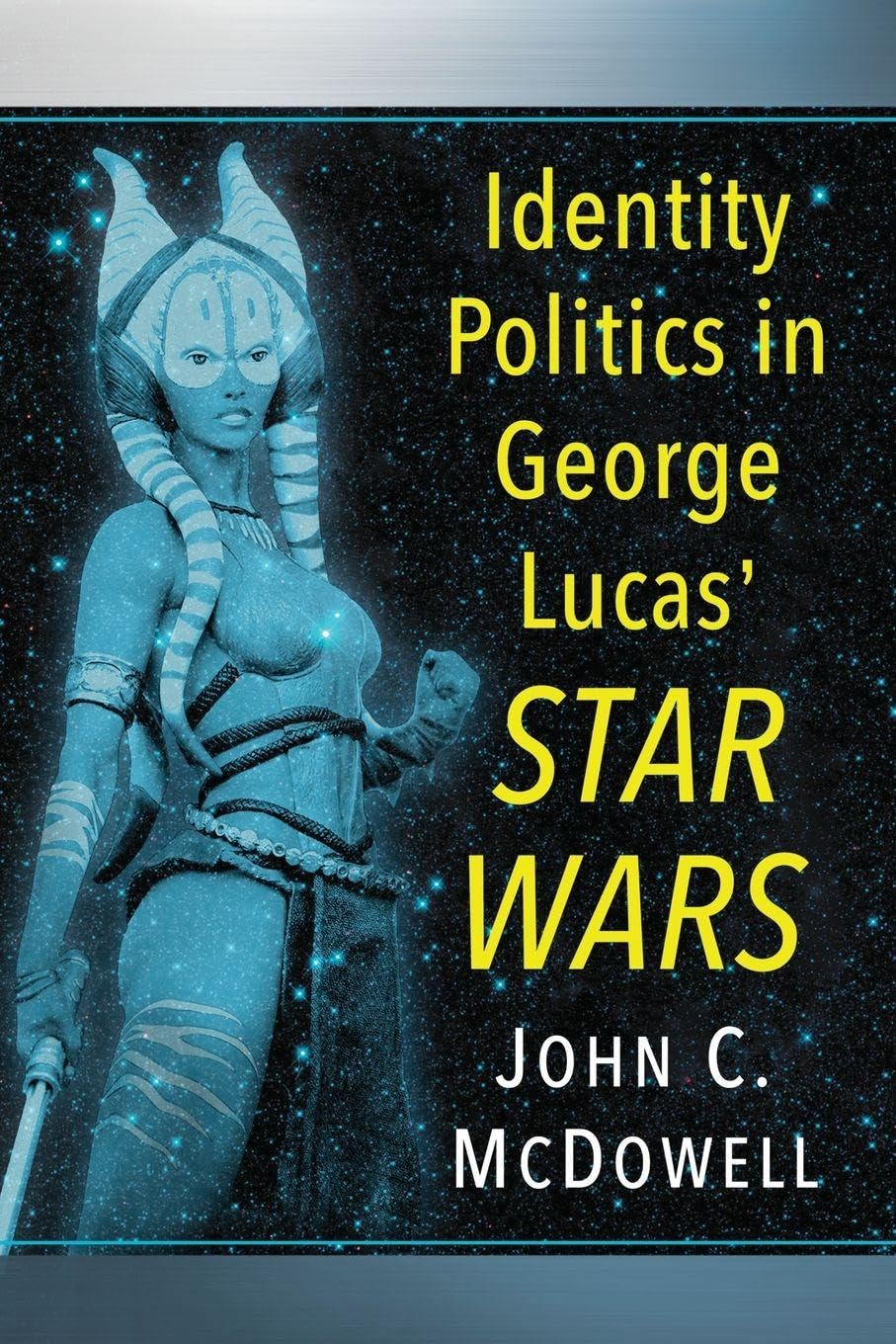
Identity Politics in George Lucas' Star Wars: Race, Gender, and Ideology in the Saga by John C. McDowell
Inclusive of all applicable taxes. FREE shipping on all orders.
Available Offers
- 🚚Free Delivery — Free shipping on all orders
- 💵Cash on Delivery — Pay when your order arrives
- ↩️15-Day Easy Returns — Hassle-free return policy
- 🔒Cash on Delivery — Pay safely when your order arrives
Check Delivery
Product Description
Introduction
In the vast universe of Star Wars scholarship, few books dare to challenge the dominant narrative as boldly as Identity Politics in George Lucas' Star Wars by John C. McDowell. This hardcover volume, published by McFarland & Company, offers a fresh and nuanced reading of the iconic space opera. For Indian students and readers interested in political theory, cultural studies, and film analysis, this book provides a rigorous yet accessible exploration of how race, gender, and ideology shape one of the most beloved franchises in cinema history. It is an essential addition to any serious library on popular culture and politics.
Book Overview
This book systematically deconstructs the popular assumption that the Star Wars saga is a straightforward endorsement of neoconservative values. Instead, McDowell argues that George Lucas' work is ideologically complex, drawing on multiple political and philosophical traditions. By focusing on identity politics—particularly representations of race and gender—the author reveals how the films engage with questions of power, resistance, and moral ambiguity. The book covers all six original films, from The Phantom Menace to Return of the Jedi, and situates them within broader American cultural debates from the late 1970s onward.
Key Highlights
- Challenges the neo-conservative label often attached to Star Wars, offering a more balanced critique.
- Examines race and gender through characters like Padmé Amidala, Lando Calrissian, and the Jedi Order.
- Draws on Lucas' own statements about cinema as a “moral megaphone” to explore didactic storytelling.
- Contextualizes the saga in American political history, including the Reagan era and post-9/11 shifts.
- Uses a multidisciplinary approach combining film studies, political theory, and cultural criticism.
Inside the Book
The book is structured into thematic chapters that move from broad ideological analysis to close readings of specific films and characters. McDowell opens with a discussion of Lucas' stated intentions and the reception of Star Wars in conservative circles. Subsequent chapters explore the representation of the Empire as a fascist state, the role of the Rebel Alliance as a multi-ethnic coalition, and the ambiguous portrayal of the Force as both a spiritual and political tool. The author also dedicates significant space to female characters, critiquing both the limitations and progressive elements in their depiction. Each chapter ends with a summary that ties the analysis back to larger questions of identity and power.
Key Topics
- Ideology and the “moral megaphone” in George Lucas' cinema
- Race and representation in the Star Wars universe
- Gender dynamics and the portrayal of female leadership
- Fascism, rebellion, and the politics of the Empire
- The Force as a metaphor for political and spiritual agency
- American neoconservatism and its critics in popular culture
- Postcolonial readings of the galaxy far, far away
Reader Benefits
Readers will gain a deeper understanding of how popular cinema can reflect and shape political ideologies. This book is not just for Star Wars fans—it is for anyone who wants to think critically about the stories we consume. Indian readers, in particular, will find parallels with debates about identity, nationalism, and resistance in their own context. The clear writing style makes complex theories accessible, while the rigorous scholarship ensures that the book can serve as a reference for academic work.
Learning Outcomes
- Understand the relationship between film and political ideology in American culture.
- Identify key themes of race and gender in the Star Wars saga.
- Critically evaluate claims about the franchise's political leanings.
- Apply concepts from identity politics to other works of popular culture.
- Develop a nuanced perspective on the role of storytelling in social change.
Who Should Read
This book is ideal for undergraduate and postgraduate students in political science, film studies, cultural studies, and sociology. It is also highly recommended for educators teaching courses on popular culture and politics. Star Wars enthusiasts who want to move beyond fan debates and engage with serious analysis will find it rewarding. Additionally, readers interested in American studies, postcolonial theory, or feminist criticism will discover valuable insights.
About the Author
John C. McDowell is a respected scholar in the fields of theology, ethics, and cultural criticism. He has written extensively on the intersection of religion and popular culture, with a particular focus on film. His academic work is known for its intellectual rigor and its ability to engage with contemporary political issues. McDowell brings a unique perspective to Star Wars studies, combining deep knowledge of political theory with a passion for the films themselves.
About the Publisher
McFarland & Company is a leading independent publisher of academic and scholarly books, with a strong focus on film, history, and popular culture. Based in the United States, McFarland is known for producing high-quality hardcover editions that are built to last. Their catalog includes many titles that challenge conventional wisdom and open up new areas of inquiry. This book upholds McFarland's reputation for rigorous, thought-provoking scholarship.
Conclusion
Identity Politics in George Lucas' Star Wars is a vital contribution to the study of one of the most influential film series of all time. By moving beyond simplistic political labels, John C. McDowell invites readers to see Star Wars as a site of ideological struggle, where questions of race, gender, and power are constantly negotiated. For Indian readers who value critical thinking and cultural analysis, this hardcover edition from Bookshops.in is a must-have. Order your copy today and explore the galaxy through a new lens.
Quick Summary
Identity Politics in George Lucas' Star Wars by John C. McDowell is a scholarly work that re-examines the political dimensions of the iconic space opera. Contrary to popular belief that the saga is a straightforward vehicle for neoconservative values, McDowell argues that the films are ideologically complex, engaging with issues of race, gender, and power in nuanced ways. The book draws on Lucas' own statements about cinema as a 'moral megaphone' and applies postcolonial and feminist theory to uncover progressive critiques within the narrative. Readers will learn how Star Wars reflects and shapes American cultural debates about identity, otherness, and heroism. This hardcover edition from McFarland & Company is ideal for students of film studies, political theory, and popular culture, as well as fans seeking a deeper understanding of the franchise. By purchasing from Bookshops.in, Indian readers get a premium imported edition with reliable delivery and excellent customer service.
Book Highlights
Book Specifications
| ISBN-13 | 9781476662862 |
| ISBN-10 | 147666286X |
| Publisher | McFarland Publishing |
| Language | English |
| Dimensions | 15.24 x 1.07 x 22.86 cm |
| Weight | 295 g |
| Country | India |
| Category | Performing Arts › Film & Television |
| Genre | Non-fiction |
| Original Language | English |
Frequently Asked Questions
What is this book about?
Who is the author?
Is this book only for academics?
Does the book cover all Star Wars films?
What makes this book different from other Star Wars analyses?
Can I use this book for my university course?
Does the book discuss the sequel trilogy?
What theoretical frameworks does the book use?
Is this book available in India?
What is the price?
Does the book have any reviews?
Is the book written in English?
Readers Also Search For
Customers Also Bought
International Relations
Clients, Rivals, and Rogues: Why Great Powers Intervene in Revolutionary Civil Wars
International Relations
Foreign Ministries and the Information Revolution: Going Virtual?: 2 (Diplomatic Studies)
International Relations
From Pki to Comintern, 1924-1941: The Apprenticeship of the Malayan Communist Party: 8 (Southeast Asia Program Series, 8)
International Relations
The Evolving Terrorist Threat to Southeast Asia: A Net Assessment
International Relations
The Naval Policy of Austria-Hungary 1867-1918: Navalism, Industrial Development, and the Politics of Dualism (Central European Studies)

International Relations
New Technologies and Law of the Marine Environment: Nouvelles Technologies Et Droit De L'Environment Marin: 55 (International Enviornmental Law and Policy, 55)
Related Products
View All
Politics
Chicano Politics | by Juan Gómez-Quiñones | Unm Press | by Juan Gómez-Quiñones | Unm Press | by Juan Gómez-Quiñones | Unm Press | by Juan Gómez-Quiñones | Unm Press | by Juan Gómez-Quiñones | Unm Press | by Juan Gómez-Quiñones | Unm Press | by Juan Gómez-Quiñones | Unm Press | by Juan Gómez-Quiñones | Unm Press | by Juan Gómez-Quiñones | Unm Press | by Juan Gómez-Quiñones | Unm Press | by Juan Gómez-Quiñones | Unm Press | by Juan Gómez-Quiñones | Unm Press | by Juan Gómez-Quiñones | Unm Press |
Politics
Political Humor in a Changing Media Landscape | by Jody C. Baumgartner | Amy B. Becker | Jody C. Baumgartner | Lexington Books | by Jody C. Baumgartner | Amy B. Becker | Jody C. Baumgartner | Lexington Books | by Jody C. Baumgartner | Amy B. Becker | Jody C. Baumgartner | Lexington Books | by Jody C. Baumgartner | Amy B. Becker | Jody C. Baumgartner | Lexington Books | by Jody C. Baumgartner | Amy B. Becker | Jody C. Baumgartner | Lexington Books | by Jody C. Baumgartner | Amy B. Becker | Jody C
Politics
Political Satire, Postmodern Reality, and the Trump Presidency | by Mehnaaz Momen | Lexington Books | by Mehnaaz Momen | Lexington Books | by Mehnaaz Momen | Lexington Books | by Mehnaaz Momen | Lexington Books | by Mehnaaz Momen | Lexington Books | by Mehnaaz Momen | Lexington Books | by Mehnaaz Momen | Lexington Books | by Mehnaaz Momen | Lexington Books | by Mehnaaz Momen | Lexington Books | by Mehnaaz Momen | Lexington Books | by Mehnaaz Momen | Lexington Books | by Mehnaaz Momen | Lexington
Politics
The Paradox of Political Philosophy | by Jacob Howland | Rowman & Littlefield Publishers | by Jacob Howland | Rowman & Littlefield Publishers | by Jacob Howland | Rowman & Littlefield Publishers | by Jacob Howland | Rowman & Littlefield Publishers | by Jacob Howland | Rowman & Littlefield Publishers | by Jacob Howland | Rowman & Littlefield Publishers | by Jacob Howland | Rowman & Littlefield Publishers | by Jacob Howland | Rowman & Littlefield Publishers | by Jac
Politics
Odyssey of Political Theory | by Patrick J. Deneen | Rowman & Littlefield Publishers | by Patrick J. Deneen | Rowman & Littlefield Publishers | by Patrick J. Deneen | Rowman & Littlefield Publishers | by Patrick J. Deneen | Rowman & Littlefield Publishers | by Patrick J. Deneen | Rowman & Littlefield Publishers | by Patrick J. Deneen | Rowman & Littlefield Publishers | by Patrick J. Deneen | Rowman & Littlefield Publishers | by Patrick J. Deneen | Rowman & Littlef
Politics