
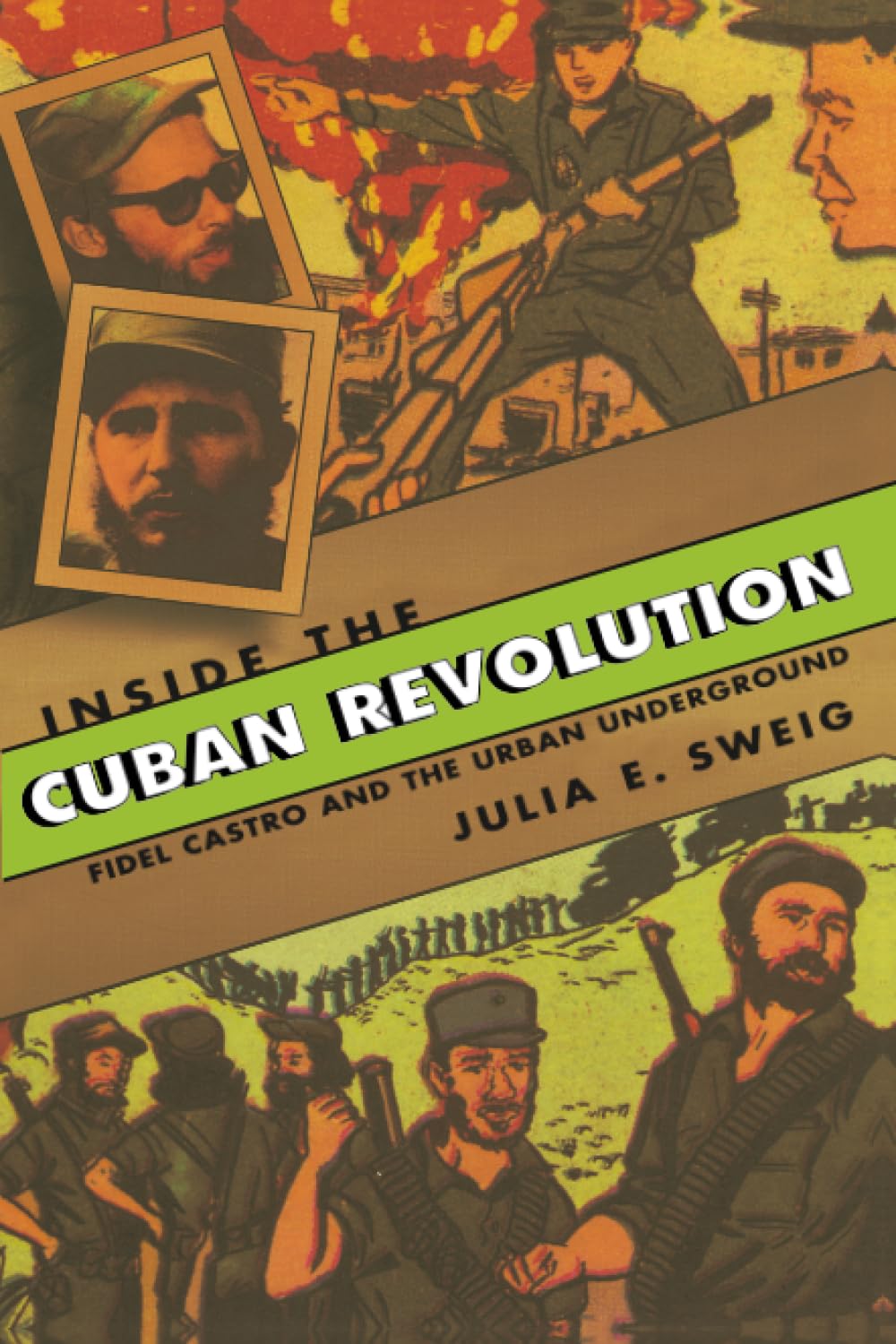
Inside the Cuban Revolution: Fidel Castro and the Urban Underground by Julia E. Sweig – A Revisionist History of the 26t
Inclusive of all applicable taxes. FREE shipping on all orders.
Available Offers
- 🚚Free Delivery — Free shipping on all orders
- 💵Cash on Delivery — Pay when your order arrives
- ↩️15-Day Easy Returns — Hassle-free return policy
- 🔒Cash on Delivery — Pay safely when your order arrives
Check Delivery
Product Description
Introduction
In the vast landscape of revolutionary history, few narratives have been as carefully curated as that of the Cuban Revolution. Julia E. Sweig’s Inside the Cuban Revolution: Fidel Castro and the Urban Underground offers a groundbreaking reassessment that challenges decades of mythmaking. This meticulously researched work, published by Harvard University Press, pulls back the curtain on the urban revolutionaries—the Llano—whose sacrifices and strategic brilliance have long been overshadowed by the iconic imagery of Castro and Che Guevara in the Sierra Maestra. For students of political science, history, and Latin American studies in India, this hardcover edition is an essential addition to any serious library.
Book Overview
Based on unprecedented access to classified records of Castro’s 26th of July Movement, this revisionist history restores the urban underground to its rightful place at the center of the revolutionary struggle. Sweig, the only scholar granted full access to the Cuban Council of State’s Office of Historic Affairs archives, reconstructs the intense ideological and strategic debates that shaped the movement between November 1956 and July 1958. The book reveals how the urban underground—operating in Havana, Santiago, and other cities—dominated the revolution’s early phase, challenging the popular notion that guerrilla warfare alone brought down the Batista regime.
Key Highlights
- Unprecedented archival access: Exclusive use of classified documents from Castro’s movement, never before seen by outside researchers.
- Revisionist perspective: Shifts focus from the charismatic mountain guerrillas to the disciplined urban cadres who risked everything.
- Strategic debates: Detailed analysis of the tension between rural guerrilla warfare and urban insurrection.
- Fifteen-month timeframe: A close study of the crucial period when the Llano held the reins of leadership.
- Scholarly yet accessible: Written for both academics and general readers interested in revolutionary movements.
Inside the Book
Sweig’s narrative is built on a wealth of primary sources, including internal memos, personal letters, and organizational records. She reconstructs the daily lives of urban revolutionaries—their clandestine meetings, fundraising efforts, arms smuggling, and acts of sabotage. The book also explores the fraught relationship between the urban leadership and Castro’s mountain-based group, revealing how personal ambitions, ideological differences, and tactical disagreements nearly fractured the movement. Readers will encounter figures like Frank País, Armando Hart, and Faustino Pérez, whose contributions have been largely erased from popular memory. The author’s balanced approach does not glorify the urban underground but presents their struggles and compromises with unflinching honesty.
Key Topics
- The urban underground (Llano) vs. the rural guerrillas (Sierra): A comparative study of two revolutionary strategies.
- Internal politics of the 26th of July Movement: Factions, alliances, and power struggles.
- Role of students and workers: How urban youth and labour unions mobilized for revolution.
- Intelligence and counterintelligence: The underground’s efforts to evade Batista’s police and military.
- Economic sabotage and propaganda: The practical tactics of urban insurrection.
- The making of revolutionary mythology: How history is written by the victors—and what gets left out.
Reader Benefits
- Critical thinking: Learn to question dominant historical narratives and examine evidence from multiple perspectives.
- Deep historical insight: Understand the Cuban Revolution beyond the iconic photographs and slogans.
- Comparative framework: Draw parallels with other revolutionary movements in Asia, Africa, and Latin America.
- Rich contextual knowledge: Gain a nuanced view of Cold War geopolitics and US-Cuba relations.
- Academic excellence: A rigorously sourced work that sets a high standard for historical research.
Learning Outcomes
By reading this book, you will be able to analyse the Cuban Revolution as a complex, multi-layered phenomenon rather than a simple tale of heroic guerrillas. You will understand the strategic dilemmas faced by revolutionary movements, the importance of urban networks, and the ways in which historical memory is shaped by political interests. The book also equips you with tools to critique popular histories and to appreciate the contributions of lesser-known actors in major historical events.
Who Should Read
- History students specializing in Latin America, revolutionary studies, or Cold War history.
- Political science scholars interested in insurgency, state repression, and social movements.
- Journalists and writers seeking a deeper understanding of Cuba’s past and present.
- General readers with a passion for well-researched, revisionist history.
- Indian academics comparing revolutionary strategies across the Global South.
About the Author
Julia E. Sweig is a senior fellow at the Council on Foreign Relations and an expert on Latin America and US foreign policy. Her work has been widely praised for its archival depth and analytical rigour. She has written extensively on Cuba, Brazil, and the international relations of the Western Hemisphere. Inside the Cuban Revolution won the 2003 Latin American Studies Association’s Bryce Wood Book Award and remains a seminal text in the field.
About the Publisher
Harvard University Press, based in Cambridge, Massachusetts, is one of the world’s most prestigious academic publishers. Established in 1913, it is known for producing authoritative works across the humanities, social sciences, and sciences. This hardcover edition reflects the Press’s commitment to durable, beautifully produced books that stand the test of time.
Conclusion
Inside the Cuban Revolution: Fidel Castro and the Urban Underground is not merely a history book—it is an act of historical restoration. By bringing the urban underground out of the shadows, Julia E. Sweig challenges us to rethink everything we thought we knew about one of the 20th century’s most iconic revolutions. For Indian readers who seek a deeper, more honest engagement with world history, this volume is indispensable. Order your hardcover copy from Bookshops.in today and add a work of lasting scholarly value to your collection.
Quick Summary
Inside the Cuban Revolution: Fidel Castro and the Urban Underground by Julia E. Sweig is a groundbreaking revisionist history that challenges traditional narratives of the Cuban Revolution. Drawing on exclusive access to the classified archives of Castro's 26th of July Movement, Sweig restores the urban underground—the Llano—to its rightful central role. The book meticulously examines the fifteen months from November 1956 to July 1958, revealing intense ideological, political, and strategic debates between Castro's mountain-based guerrilla forces and urban revolutionaries in Havana, Santiago, and other cities. Readers will learn how the revolution was not solely a rural insurgency but a complex, factional struggle. This book is ideal for students, scholars, and history enthusiasts seeking a deeper, archive-based understanding of Cuban politics. By purchasing from Bookshops.in, Indian readers receive a premium hardcover edition with free shipping, supporting a trusted local bookstore.
Book Highlights
Book Specifications
| ISBN-13 | 9780674016125 |
| ISBN-10 | 0674016122 |
| Publisher | Harvard Univ Pr |
| Language | English |
| Dimensions | 15.6 x 1.65 x 23.39 cm |
| Weight | 408 g |
| Country | USA |
| Category | Americas › United States |
| Genre | History |
| Original Language | English |
Frequently Asked Questions
What is Inside the Cuban Revolution about?
Who is the author of this book?
Is this book suitable for academic use?
What makes this book different from other Cuban Revolution histories?
Does the book cover Che Guevara?
What time period does the book focus on?
Is this a hardcover or paperback?
What language is the book in?
What is the price of the book?
Is this book good for Indian readers?
Does the book include maps or illustrations?
Why should I buy from Bookshops.in?
Readers Also Search For
Related Products
View All
History
The Information Revolution: Transforming the World Through Technology (World History)
History
Human Nature and the French Revolution: From the Enlightenment to the Napoleonic Code: 3 (Polygons: Cultural Diversities and Intersections, 3)
History
The Unmaking of Home in Contemporary Art (Cultural Spaces)

History
Handbook to Life in Medieval and Early Modern Japan | by William E. Deal | Oxford University Press | by William E. Deal | Oxford University Press | by William E. Deal | Oxford University Press | by William E. Deal | Oxford University Press | by William E. Deal | Oxford University Press | by William E. Deal | Oxford University Press | by William E. Deal | Oxford University Press | by William E. Deal | Oxford University Press | by William E. Deal | Oxford University Press | by William E. Deal | Ox

History
The Narrators of Barbarian History (A.D. 550-800) | by Walter Goffart | University of Notre Dame Press | by Walter Goffart | University of Notre Dame Press | by Walter Goffart | University of Notre Dame Press | by Walter Goffart | University of Notre Dame Press | by Walter Goffart | University of Notre Dame Press | by Walter Goffart | University of Notre Dame Press | by Walter Goffart | University of Notre Dame Press | by Walter Goffart | University of Notre Dame Press | by Walter Goffart | Univ

History