
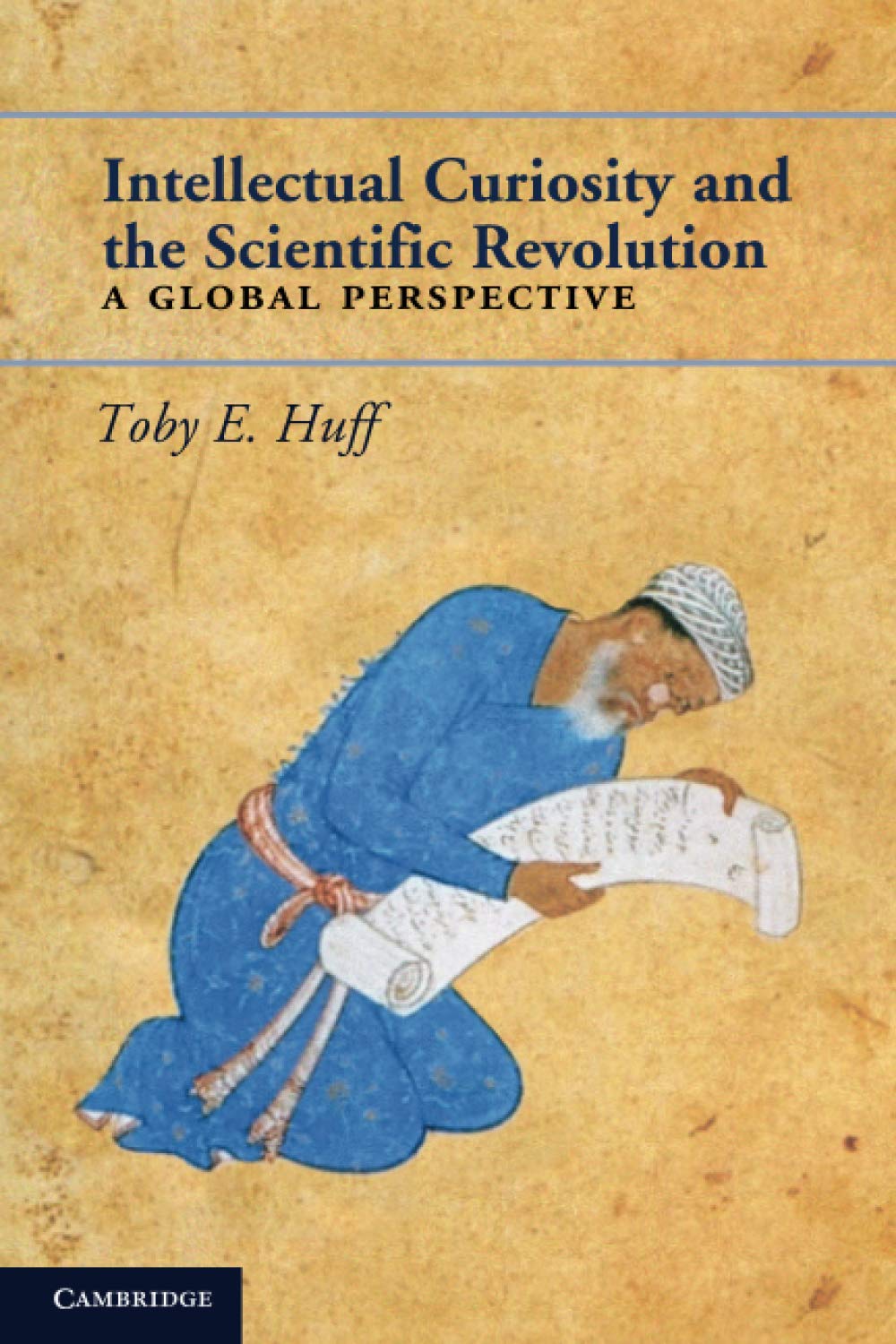
Intellectual Curiosity and the Scientific Revolution: A Global Perspective by Toby E. Huff – How the Telescope Changed t
Inclusive of all applicable taxes. FREE shipping on all orders.
Available Offers
- 🚚Free Delivery — Free shipping on all orders
- 💵Cash on Delivery — Pay when your order arrives
- ↩️15-Day Easy Returns — Hassle-free return policy
- 🔒Cash on Delivery — Pay safely when your order arrives
Check Delivery
Product Description
Introduction
In the vast landscape of world history, few periods have shaped our modern understanding of science and technology as profoundly as the Scientific Revolution. But why did this revolution happen in Europe and not elsewhere? Toby E. Huff’s Intellectual Curiosity and the Scientific Revolution: A Global Perspective offers a compelling answer by examining the role of curiosity, institutions, and cross-cultural encounters. Published by Cambridge University Press, this hardcover edition is an essential read for Indian students, researchers, and anyone fascinated by the roots of modern science.
Book Overview
This book takes you on a journey through the seventeenth century, a time when Europe witnessed an extraordinary flowering of discoveries. Huff begins with the Dutch invention of the telescope in 1608 and traces how this single instrument sparked a cascade of innovations in microscopy, anatomy, optics, pneumatics, and mechanics. Unlike other studies, Huff places these developments in a truly global framework, comparing the European response to the telescope with those in China, Mughal India, and the Ottoman Empire. The result is a rich, nuanced picture of why the West experienced a singular scientific and economic ascendancy.
Key Highlights
- Global Perspective: Examines how the telescope was received in different civilizations, from China to India.
- Institutional Insights: Explores how European universities, academies, and legal systems fostered intellectual freedom.
- Newtonian Synthesis: Details how discoveries in multiple fields led to Newton’s law of universal gravitation.
- Economic Implications: Concludes with an epilogue linking science to modern economic development.
- Accessible Scholarship: Written for both specialists and curious general readers.
Inside the Book
Huff’s narrative is structured around key breakthroughs and the people behind them. You will meet Galileo, Kepler, Hooke, and Newton, but also lesser-known figures from Asia and the Middle East. The book includes detailed discussions of early telescopes, the microscope’s impact on biology, experiments with air pumps, and the study of electricity. Each chapter builds toward the grand synthesis of Newtonian physics, showing how curiosity-driven research transformed into practical technology.
Key Topics
- The invention and spread of the telescope (1608–1650)
- Galileo’s discoveries and their global reception
- Microscopy and the discovery of microorganisms
- Human anatomy and the circulation of blood
- Optics and the nature of light
- Pneumatics and the vacuum
- Electrical studies in the seventeenth century
- The science of mechanics and motion
- Newton’s unification of terrestrial and celestial physics
- Comparative responses in China, Mughal India, and the Ottoman Empire
Reader Benefits
- Deepen Your Understanding: Gain a fresh perspective on why Europe surged ahead in science.
- Think Globally: Learn how different cultures reacted to the same technological innovations.
- Connect Past and Present: See how seventeenth-century curiosity fuels today’s technology-driven world.
- Enhance Academic Knowledge: Perfect for history, philosophy, and science students.
- Enjoy Engaging Writing: Huff’s style is clear, rigorous, and free of unnecessary jargon.
Learning Outcomes
By reading this book, you will be able to explain the key factors behind the Scientific Revolution, compare the European scientific trajectory with those of Asian empires, and analyze how institutional frameworks—such as universities and patent laws—encouraged innovation. You will also understand the economic consequences of scientific progress and why curiosity remains a driving force in human achievement.
Who Should Read
- Students of history, science, and philosophy
- Teachers and professors seeking a global perspective on the Scientific Revolution
- General readers with an interest in why the West rose to global dominance
- Indian readers curious about the historical interactions between Europe and Asia
- Anyone who loves a good story about discovery, invention, and human ingenuity
About the Author
Toby E. Huff is a renowned scholar of science and society. He has taught at Harvard University and the University of Massachusetts Dartmouth, and his research focuses on the comparative history of science, technology, and institutions. Huff’s earlier works, including The Rise of Early Modern Science, have been widely praised for their interdisciplinary approach. In this book, he brings decades of expertise to bear on one of history’s most intriguing questions.
About the Publisher
Cambridge University Press is one of the oldest and most respected academic publishers in the world. Founded in 1534, it has a long tradition of publishing groundbreaking works in science, history, and the humanities. This hardcover edition reflects the Press’s commitment to quality scholarship and durable design, making it a valuable addition to any library.
Conclusion
Intellectual Curiosity and the Scientific Revolution: A Global Perspective is more than a history book—it is an invitation to think about how curiosity, culture, and institutions shape human progress. For Indian readers, it offers a unique chance to explore the scientific heritage of Europe alongside the responses of Mughal India and other Asian civilizations. Whether you are a student, a teacher, or a lifelong learner, this book will deepen your appreciation for the power of asking questions. Order your copy from Bookshops.in today and embark on a journey through the birth of modern science.
Quick Summary
Intellectual Curiosity and the Scientific Revolution: A Global Perspective by Toby E. Huff is a landmark study that reexamines the birth of modern science through a cross-cultural lens. Beginning with the Dutch invention of the telescope in 1608, Huff traces how this remarkable instrument spread to China, Mughal India, and the Ottoman Empire—yet only in Europe did it ignite an extraordinary burst of discoveries in microscopy, anatomy, optics, pneumatics, electrical studies, and mechanics. The book argues that Europe's unique institutional culture—universities, scientific societies, and a tradition of open debate—fostered the intellectual curiosity necessary to exploit the telescope's potential. Huff contrasts this with the responses of other advanced civilizations, showing how they possessed the tools but lacked the same ecosystem for transformative science. The narrative culminates in Newton's grand synthesis, unifying terrestrial and celestial physics under universal gravitation, an achievement that reshaped all of modern science. Written for students, researchers, and general readers, this book offers a fresh, global perspective on one of history's most pivotal eras. By purchasing from Bookshops.in, Indian readers gain access to a premium hardcover edition with fast delivery and trusted service.
Book Highlights
Book Specifications
| ISBN-13 | 9780521170529 |
| ISBN-10 | 0521170524 |
| Publisher | Cambridge University Press |
| Language | English |
| Dimensions | 15.24 x 2.36 x 22.86 cm |
| Weight | 500 g |
| Country | India |
| Category | Region & Countries › Asia |
| Genre | Nonfiction |
| Reading Age | 18+ |
| Original Language | English |
Frequently Asked Questions
What is the main thesis of Intellectual Curiosity and the Scientific Revolution?
Who is the author Toby E. Huff?
Does the book cover Indian science history?
Is this book suitable for Indian students?
What time period does the book focus on?
Does the book discuss Newton's laws?
Is this a technical science book or a history book?
What makes this book different from other books on the scientific revolution?
What is the ISBN of this book?
Is the book available in hardcover?
Can I use this book for my university course?
Does the book include illustrations?
Where can I buy this book in India?
Readers Also Search For
Related Products
View All
History
The Information Revolution: Transforming the World Through Technology (World History)
History
Human Nature and the French Revolution: From the Enlightenment to the Napoleonic Code: 3 (Polygons: Cultural Diversities and Intersections, 3)

History
The Unmaking of Home in Contemporary Art (Cultural Spaces)

History
Handbook to Life in Medieval and Early Modern Japan | by William E. Deal | Oxford University Press | by William E. Deal | Oxford University Press | by William E. Deal | Oxford University Press | by William E. Deal | Oxford University Press | by William E. Deal | Oxford University Press | by William E. Deal | Oxford University Press | by William E. Deal | Oxford University Press | by William E. Deal | Oxford University Press | by William E. Deal | Oxford University Press | by William E. Deal | Ox

History
The Narrators of Barbarian History (A.D. 550-800) | by Walter Goffart | University of Notre Dame Press | by Walter Goffart | University of Notre Dame Press | by Walter Goffart | University of Notre Dame Press | by Walter Goffart | University of Notre Dame Press | by Walter Goffart | University of Notre Dame Press | by Walter Goffart | University of Notre Dame Press | by Walter Goffart | University of Notre Dame Press | by Walter Goffart | University of Notre Dame Press | by Walter Goffart | Univ

History