
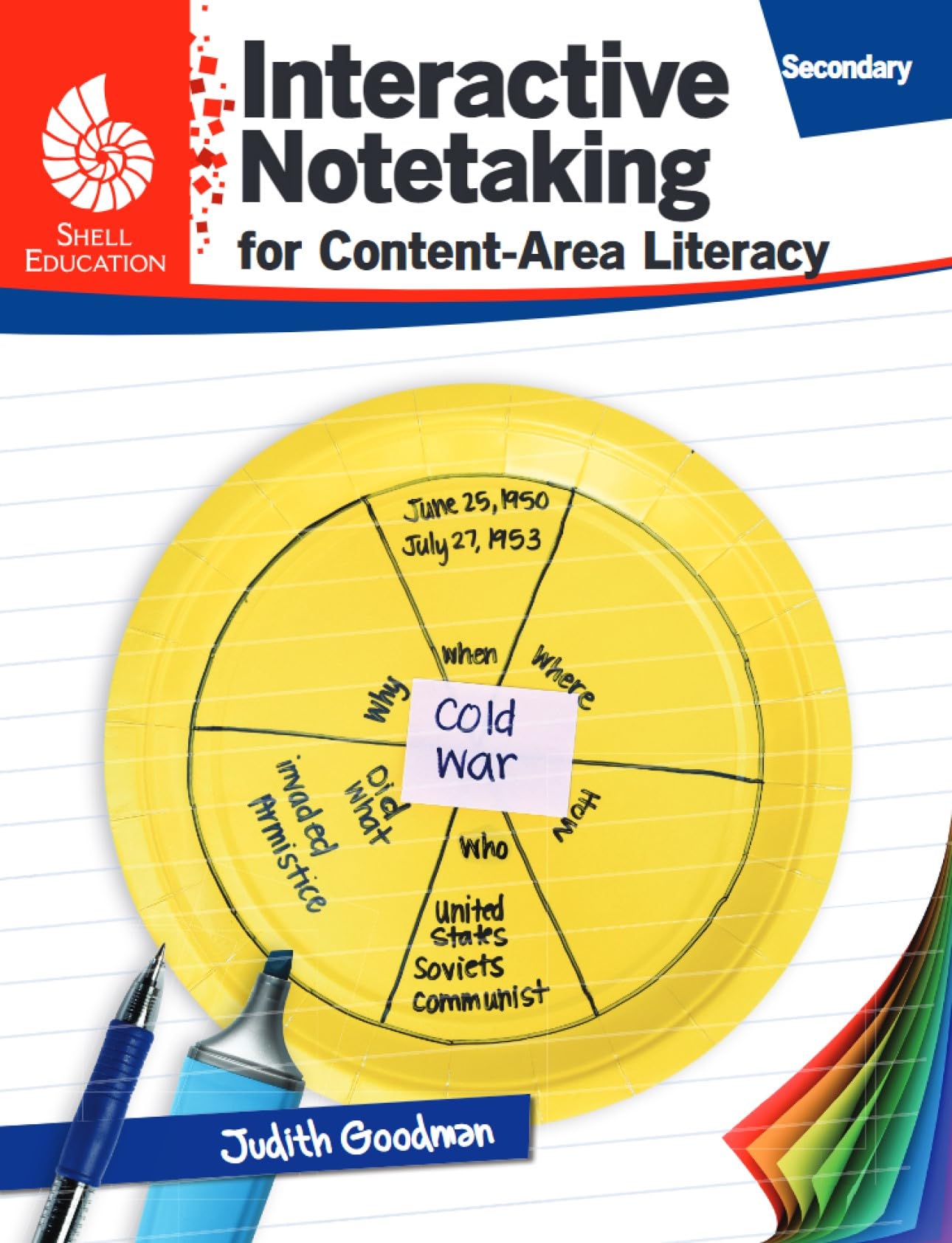
Interactive Notetaking for Content-Area Literacy, Secondary: A Complete Guide for Teachers by Judith Goodman
Inclusive of all applicable taxes. FREE shipping on all orders.
Available Offers
- 🚚Free Delivery — Free shipping on all orders
- 💵Cash on Delivery — Pay when your order arrives
- ↩️15-Day Easy Returns — Hassle-free return policy
- 🔒Cash on Delivery — Pay safely when your order arrives
Check Delivery
Product Description
Introduction
In the modern classroom, students are expected not just to read and memorize, but to think critically, analyze deeply, and retain information across subjects. Interactive Notetaking for Content-Area Literacy, Secondary by Judith Goodman is a practical, research-backed guide designed to help secondary-level students master the art of interactive notetaking. Published by Shell Education Pub, this hardcover resource equips educators with strategies that turn passive note-taking into an active, engaging process that boosts comprehension and long-term retention. Whether you teach mathematics, language arts, social studies, or science, this book offers tools to transform how students interact with content.
Book Overview
This book is a comprehensive resource for teachers working with students in grades 6 through 12. It focuses on building content-area literacy by teaching students how to take notes that are meaningful, organized, and personal. The strategies presented go beyond simple outlining or copying from the board—they encourage students to summarize, question, connect ideas, and reflect. The book is aligned to educational standards and is designed to support differentiated instruction, making it suitable for diverse classrooms across India and beyond. Each chapter provides step-by-step guidance, classroom-tested examples, and ready-to-use templates that save preparation time.
Key Highlights
- Research-Based Strategies: Every technique is grounded in cognitive science and proven to improve retention and understanding.
- Grade-Specific Approach: Tailored specifically for secondary students, with activities that match their developmental stage and learning needs.
- Cross-Curricular Applicability: Works seamlessly across math, language arts, social studies, and science classrooms.
- Aligned to Standards: Helps teachers meet curriculum requirements while fostering critical thinking and analysis.
- Ready-to-Use Resources: Includes reproducible templates, graphic organizers, and lesson plans that can be implemented immediately.
Inside the Book
Readers will find a well-organized structure that progresses from foundational concepts to advanced applications. The book begins with an introduction to the theory behind interactive notetaking and its impact on literacy. Subsequent chapters dive into specific techniques such as two-column notes, concept mapping, sketch-noting, and Cornell notes. Each chapter includes clear objectives, step-by-step instructions, examples from real classrooms, and tips for adapting activities for different learners. The final chapters address assessment, student reflection, and how to integrate notetaking into daily routines. The hardcover binding ensures durability for frequent classroom use.
Key Topics
- Partner work and collaborative notetaking strategies
- Vocabulary development through interactive notes
- Comprehension and summarization techniques
- Critical thinking and analysis prompts
- Differentiating instruction for varied learning levels
- Using graphic organizers and visual tools
- Assessing notetaking skills and providing feedback
- Integrating notetaking with digital and traditional tools
Reader Benefits
Teachers who use this book will notice a marked improvement in student engagement and understanding. Students become active participants in their own learning, moving from passive listeners to curious explorers. The strategies help reduce cognitive overload by teaching students how to filter key information and organize it logically. This leads to better performance in exams, more meaningful class discussions, and increased confidence. For educators, the book offers a treasure trove of time-saving resources that can be adapted to any curriculum. It also provides a common language for notetaking across subjects, making it easier for students to transfer skills from one class to another.
Learning Outcomes
- Students will develop the ability to identify main ideas and supporting details in complex texts.
- Students will learn to synthesize information from multiple sources and create cohesive notes.
- Students will improve their vocabulary retention and usage through contextual note-making.
- Students will enhance their summarization skills, enabling them to condense lengthy content into concise, meaningful notes.
- Students will cultivate critical thinking by asking questions, making connections, and reflecting on their learning.
- Teachers will gain a repertoire of strategies to differentiate instruction and support all learners.
Who Should Read
This book is ideal for secondary school teachers in India and around the world who teach subjects like English, mathematics, science, social studies, or any content-area discipline. It is also valuable for curriculum coordinators, instructional coaches, teacher trainers, and student teachers who want to incorporate evidence-based notetaking practices into their pedagogy. School librarians and reading specialists will find the book useful for supporting literacy across the curriculum. Parents who homeschool their secondary-level children can also benefit from the clear, practical strategies outlined in this guide.
About the Author
Judith Goodman is an experienced educator and literacy specialist with a deep understanding of how students learn across content areas. She has spent years working with secondary teachers to develop effective instructional strategies that promote active learning and critical thinking. Her work is informed by classroom practice and current research in cognitive psychology and literacy development. In this book, she shares her expertise in a clear, accessible manner, making complex ideas easy to implement. Judith Goodman is committed to helping every student become a confident, independent learner.
About the Publisher
Shell Education Pub is a respected publisher of professional development resources for educators. They specialize in creating practical, standards-aligned materials that support teachers in improving student achievement. Their books are known for being research-based, classroom-tested, and easy to use. Shell Education Pub focuses on areas such as literacy, mathematics, science, and social studies, providing tools that help teachers meet the diverse needs of today's learners. This commitment to quality makes them a trusted name in educational publishing worldwide.
Conclusion
Interactive Notetaking for Content-Area Literacy, Secondary is more than a teaching guide—it is a gateway to transforming how students engage with knowledge. By equipping educators with proven strategies, Judith Goodman empowers students to take ownership of their learning, think critically, and succeed across all subjects. Whether you are a veteran teacher or just starting your career, this book will become an indispensable part of your professional library. Order your hardcover copy today from Bookshops.in and start building a classroom where every student becomes an active, confident learner.
Quick Summary
Interactive Notetaking for Content-Area Literacy, Secondary by Judith Goodman is a practical resource designed for Indian secondary school teachers who want to enhance their students' literacy skills across subjects like mathematics, science, social studies, and language arts. The book offers a range of creative strategies focused on interactive notetaking, including partner work, vocabulary building, comprehension techniques, and summarization methods. These approaches encourage critical thinking and deeper analysis, helping students retain information more effectively. The content is differentiated to support learners at various levels and aligned with educational standards, making it easy to integrate into existing curricula. Teachers will find ready-to-use activities that save preparation time while promoting active learning. By purchasing from Bookshops.in, Indian educators get a high-quality, physical hardcover book delivered to their doorstep, ensuring a reliable and premium reading experience. This book is ideal for professional development, lesson planning, and fostering a classroom culture of engagement and achievement.
Book Highlights
Book Specifications
| ISBN-13 | 9781425817343 |
| ISBN-10 | 1425817343 |
| Publisher | Shell Educational Publishing |
| Language | English |
| Dimensions | 21.59 x 1.09 x 27.94 cm |
| Weight | 408 g |
| Category | Education & Reference › Reading & Writing |
| Genre | Educational |
| Original Language | English |
Frequently Asked Questions
What is Interactive Notetaking for Content-Area Literacy, Secondary about?
Who is the author of this book?
Is this book suitable for Indian classrooms?
What age group does this book target?
What subjects does the book cover?
Does the book include ready-to-use activities?
How does interactive notetaking help students?
Is this book aligned with educational standards?
Can this book be used for professional development?
What makes this book different from other notetaking guides?
Does the book cover partner work?
Is there a focus on vocabulary building?
How does the book address summarization?
What is the price of the book?
Where can I buy this book in India?
Readers Also Search For
Related Products
View All
Children's Books
Activism: The Ultimate Teen Guide: 47 (It Happened to Me, 47)

Children's Books
Chemistry You Can Chomp (Super Simple Science You Can Snack on)

Children's Books
Children's Stories From Japanese Fairy Tales & Legends

Children's Books
Loch Ness Monster (English, Christopher Bahn)

Children's Books
Overwatch (English, Mari Bolte)

Children's Books