
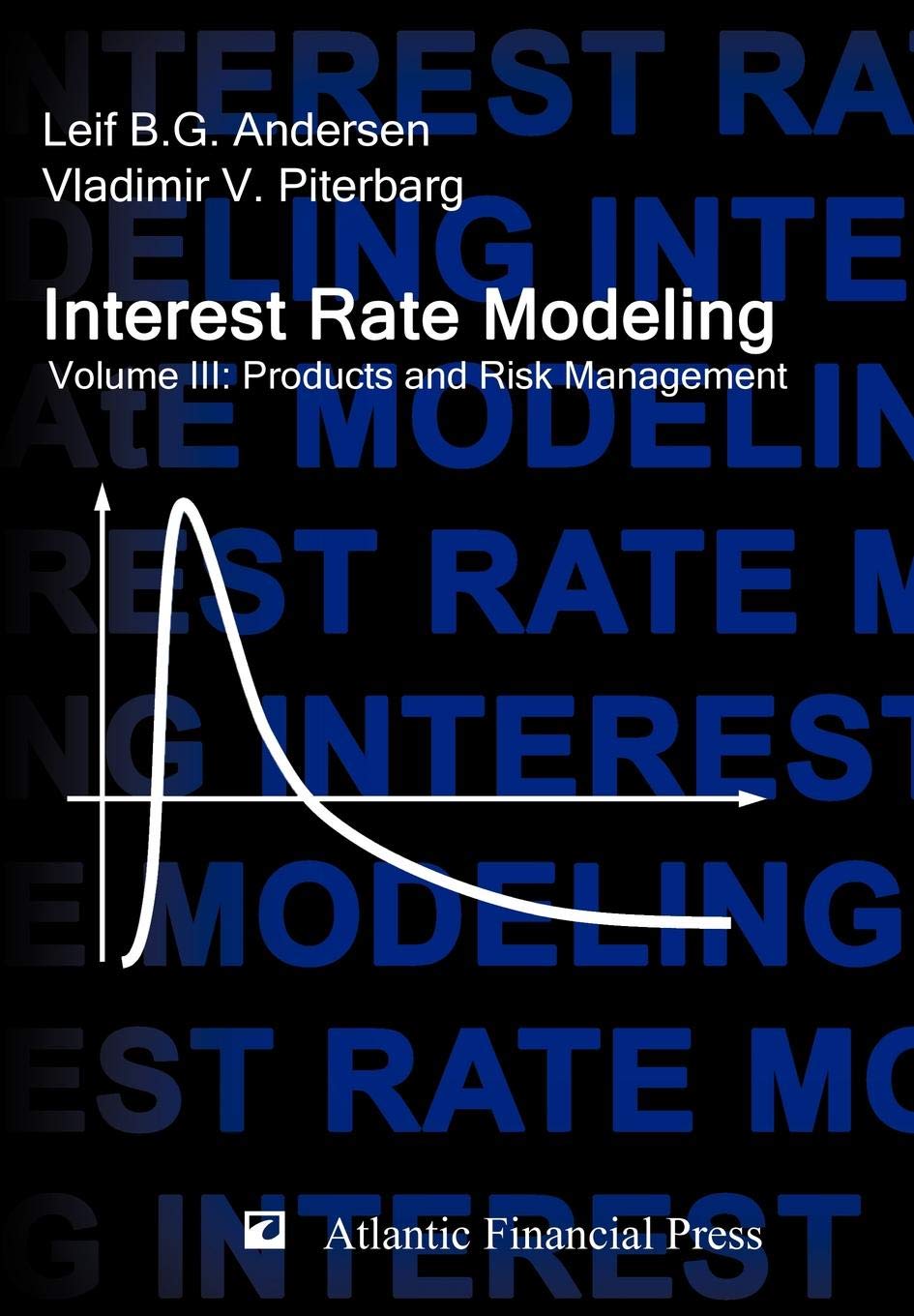
Interest Rate Modeling: Products and Risk Management – A Practical Guide for Fixed Income Professionals
Inclusive of all applicable taxes. FREE shipping on all orders.
Available Offers
- 🚚Free Delivery — Free shipping on all orders
- 💵Cash on Delivery — Pay when your order arrives
- ↩️15-Day Easy Returns — Hassle-free return policy
- 🔒Cash on Delivery — Pay safely when your order arrives
Check Delivery
Product Description
Introduction
In the complex world of quantitative finance, mastering the art of pricing and risk management for fixed income securities is both a challenge and a necessity. Interest Rate Modeling. Volume 3: Products and Risk Management, authored by the renowned Leif B. G. Andersen, stands as an authoritative resource for practitioners, academics, and students alike. Published by Atlantic Financial Press, this hardcover volume is the third instalment in a celebrated series that bridges the gap between advanced theoretical models and real-world trading applications. For Indian readers and professionals working in banking, asset management, or financial engineering, this book offers a rigorous yet practical approach to understanding interest rate derivatives and the tools needed to manage associated risks.
Book Overview
This volume focuses squarely on the products and risk management aspects of fixed income markets. It provides an in-depth examination of a wide range of securities—from plain vanilla options to highly exotic cancelable and path-dependent derivatives. The author combines finance theory with numerical methods and approximation techniques, offering an integrated framework for designing and implementing industrial-strength models. Whether you are a student preparing for a career in quantitative finance or a seasoned professional seeking to refine your skills, this book delivers actionable insights backed by mathematical precision.
Key Highlights
- Comprehensive coverage of fixed income securities, including vanilla options, cancelable swaps, and path-dependent instruments.
- Rigorous yet pragmatic approach that balances theoretical foundations with practical implementation.
- Detailed treatment of risk management techniques, including hedging, calibration, and scenario analysis.
- Numerical methods such as finite difference schemes, Monte Carlo simulation, and lattice models explained in depth.
- Real-world examples drawn from the author's extensive industry experience, making concepts accessible.
Inside the Book
The first half of Volume III is dedicated to a product-specific analysis of fixed income derivatives. Each product class is examined with a focus on valuation, Greeks, and hedging strategies. The second half delves into risk management frameworks, covering topics like interest rate risk, credit risk, and model risk. The book also includes advanced topics such as stochastic volatility models, multi-curve frameworks, and collateralization. Appendices provide essential mathematical background, ensuring that readers have the tools needed to follow the more complex derivations.
Key Topics
- Vanilla interest rate options: caps, floors, and swaptions
- Cancelable swaps and Bermudan swaptions
- Path-dependent derivatives: range accruals, TARNs, and target redemption notes
- Callable and puttable bonds
- LMM (Libor Market Model) and its extensions
- Multi-curve and collateral-aware modeling
- Risk metrics: DV01, convexity, vega, and gamma
- Hedging under model uncertainty
- Scenario generation and stress testing
- Calibration techniques for yield curves and volatility surfaces
Reader Benefits
- Build a solid foundation in interest rate modeling from one of the industry's leading experts.
- Bridge theory and practice with concrete examples and code-friendly explanations.
- Enhance risk management skills by learning how to design robust hedging strategies.
- Stay current with modern approaches, including post-crisis multi-curve frameworks.
- Prepare for professional certifications like CFA, FRM, or PRM with advanced quantitative content.
Learning Outcomes
After studying this book, readers will be able to: value and hedge a wide spectrum of fixed income derivatives; implement numerical methods for pricing exotic instruments; construct and calibrate interest rate models using market data; assess and manage interest rate risk in a portfolio context; and understand the limitations and pitfalls of various modeling approaches. These skills are directly applicable to roles in trading desks, risk management departments, and quantitative research teams.
Who Should Read
- Quantitative analysts and financial engineers working in banks, hedge funds, or insurance companies.
- Risk managers responsible for fixed income portfolios and derivative exposures.
- Graduate students in finance, mathematics, or computational finance seeking advanced knowledge.
- Academics researching interest rate modeling and derivative pricing.
- Practitioners in the Indian financial markets who need to navigate complex fixed income products.
About the Author
Leif B. G. Andersen is a highly respected figure in quantitative finance, with decades of experience at leading investment banks and financial institutions. He is known for his pioneering work on interest rate models, numerical methods, and credit derivatives. His writing is characterized by clarity, depth, and a strong focus on practical implementation. This Volume 3, part of his acclaimed trilogy, reflects his commitment to educating the next generation of quants.
About the Publisher
Atlantic Financial Press is a specialized publisher dedicated to producing high-quality books on quantitative finance, risk management, and financial engineering. Their titles are known for their rigorous content, professional production, and relevance to both academic and industry audiences. This hardcover edition is built to last, making it a valuable addition to any serious finance professional's library.
Conclusion
Interest Rate Modeling. Volume 3: Products and Risk Management is an indispensable resource for anyone serious about fixed income derivatives. With its blend of theory, numerics, and real-world application, it equips readers with the knowledge and tools to excel in today's dynamic financial markets. For Indian students and professionals aiming to deepen their expertise, this book is a worthy investment. Order your copy from Bookshops.in today and take a decisive step toward mastering interest rate modeling.
Quick Summary
Interest Rate Modeling Volume 3: Products and Risk Management by Leif B. G. Andersen is an authoritative guide for professionals and students in quantitative finance. This hardcover book dives deep into the pricing and hedging of fixed income products such as swaps, caps, floors, and swaptions. It bridges the gap between theoretical models and real-world trading applications, offering practical calibration techniques, numerical methods, and risk management frameworks. Written by a seasoned industry practitioner, the book is ideal for Indian readers aiming to excel in derivatives trading, risk analysis, or financial engineering. Readers will learn to implement interest rate models, understand yield curve dynamics, and manage portfolio risk effectively. By choosing Bookshops.in, you get a genuine, well-bound hardcover delivered across India, backed by our commitment to quality and customer satisfaction. Whether you are a CFA/FRM candidate or a working quant, this volume is an indispensable addition to your library.
Book Highlights
Book Specifications
| ISBN-13 | 9780984422128 |
| ISBN-10 | 0984422129 |
| Publisher | Atlantic Financial Press |
| Language | English |
| Dimensions | 15.6 x 3.02 x 23.39 cm |
| Weight | 1 kg 50 g |
| Country | United Kingdom |
| Category | Mathematics › Algebra & Trigonometry |
| Series | Interest Rate Modeling |
| Genre | Nonfiction |
| Reading Age | Adult |
| Original Language | English |
Frequently Asked Questions
Is this book suitable for beginners in interest rate modeling?
Does the book cover Indian market instruments?
What is the binding of this book?
Can I use this book for FRM exam preparation?
Who is the publisher?
What is the ISBN?
Does the book include exercises and solutions?
Is this book used in Indian universities?
What is the publication date?
What is the price in INR?
Can I return the book if damaged?
Does the book require programming knowledge?
Readers Also Search For
Customers Also Bought

Mathematics
Stereotype Spaces and Algebras: 73 (De Gruyter Expositions in Mathematics, 73)

Mathematics
Semigroups in Algebra, Geometry and Analysis: 20 (De Gruyter Expositions in Mathematics, 20)

Mathematics
Geometry from the Pacific Rim: Proceedings of the Pacific Rim Geometry Conference held at National University of Singapore, Republic of Singapore, ... 1994 (De Gruyter Proceedings in Mathematics)

Mathematics
First International Tainan-Moscow Algebra Workshop: Proceedings of the International Conference held at National Cheng Kung University Tainan, Taiwan, ... 1994 (De Gruyter Proceedings in Mathematics)

Mathematics
Differential Geometry - Proceedings of the VIII International Colloquium (English, Jesus A. Alvarez Lopez | Eduardo Garcia-Rio)

Mathematics
Mathematical Theory of Optimal Processes (Classics of Soviet Mathematics)
Related Products
View AllMathematics
Mathematical Theory of Optimal Processes (Classics of Soviet Mathematics)
Mathematics
Stereotype Spaces and Algebras: 73 (De Gruyter Expositions in Mathematics, 73)
Mathematics
Semigroups in Algebra, Geometry and Analysis: 20 (De Gruyter Expositions in Mathematics, 20)
Mathematics
Geometry from the Pacific Rim: Proceedings of the Pacific Rim Geometry Conference held at National University of Singapore, Republic of Singapore, ... 1994 (De Gruyter Proceedings in Mathematics)
Mathematics
First International Tainan-Moscow Algebra Workshop: Proceedings of the International Conference held at National Cheng Kung University Tainan, Taiwan, ... 1994 (De Gruyter Proceedings in Mathematics)
Mathematics