
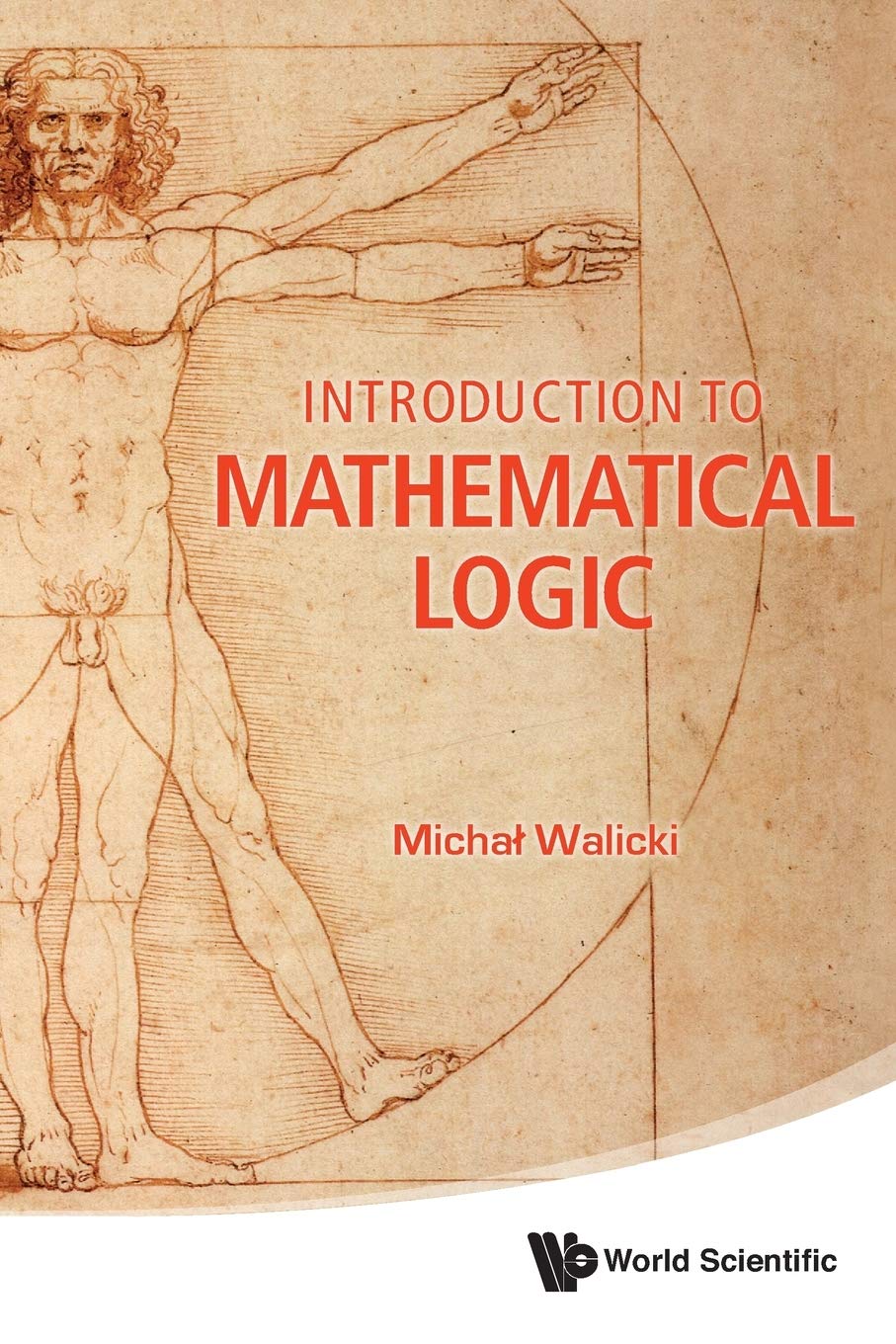
Introduction to Mathematical Logic: A Systematic Textbook on Propositional and First-Order Logic by Michal Walicki
Inclusive of all applicable taxes. FREE shipping on all orders.
Available Offers
- 🚚Free Delivery — Free shipping on all orders
- 💵Cash on Delivery — Pay when your order arrives
- ↩️15-Day Easy Returns — Hassle-free return policy
- 🔒Cash on Delivery — Pay safely when your order arrives
Check Delivery
Product Description
Introduction
Mathematical logic forms the bedrock of modern computing, artificial intelligence, and rigorous mathematical reasoning. For Indian students and self-learners navigating the intricate pathways of logic, Introduction to Mathematical Logic by Michal Walicki offers a systematic and accessible entry point. Published by World Scientific Publishing Company, this hardbound edition is designed to serve both as a classroom textbook and a companion for ambitious self-study. Whether you are preparing for competitive exams, pursuing a degree in mathematics or computer science, or simply curious about the foundations of logical thought, this book provides a clear, well-paced journey from basic set theory to advanced semantic completeness.
Book Overview
This volume is a comprehensive yet approachable guide to mathematical logic. Unlike many texts that plunge into abstract semantics first, Walicki adopts a unique pedagogical approach: syntactic reasoning systems are introduced before semantic explanations. This order helps students build confidence with concrete rules and derivations before tackling more complex conceptual issues. The book covers propositional and first-order logic, including their syntax, reasoning systems, and semantics. Soundness and completeness results for both Hilbert's and Gentzen's systems are presented with clarity, alongside simple decidability arguments. The consistent reuse of core concepts across different contexts demonstrates the general applicability of logical techniques, making the material cohesive and deeply instructive.
Key Highlights
- No prior knowledge assumed: Starts from the basics of set theory, induction, and computability, making it ideal for beginners.
- Pedagogically innovative: Syntactic systems precede semantics, simplifying the learning curve for complex topics.
- Dual-system coverage: Detailed treatment of both Hilbert's and Gentzen's proof systems with soundness and completeness proofs.
- Self-contained and practical: Suitable for classroom use as well as independent study by motivated learners.
- Conceptual consistency: Key ideas are revisited in different contexts, reinforcing understanding and highlighting their broad applicability.
Inside the Book
The book is structured to guide readers step by step through the landscape of mathematical logic. It begins with foundational chapters on set theory, induction, and computability, ensuring that even students with minimal mathematical background can follow along. From there, it moves into propositional logic, covering syntax, natural deduction, and semantic tableaux. The middle sections delve into first-order logic, including quantifier rules, models, and interpretations. Later chapters present the soundness and completeness theorems in both Hilbert-style and Gentzen-style systems, along with discussions on decidability and undecidability. Each chapter includes worked examples and exercises that reinforce learning.
Key Topics
- Set theory basics and mathematical induction
- Computability and recursive functions
- Propositional logic: syntax, semantics, and proof systems
- First-order logic: syntax, semantics, and completeness
- Hilbert's axiomatic system and Gentzen's natural deduction
- Soundness, completeness, and compactness theorems
- Decidability and undecidability results
- Applications of logical concepts across different domains
Reader Benefits
Readers will gain a solid, intuitive grasp of logical reasoning that is directly applicable to fields like computer science, mathematics, philosophy, and artificial intelligence. The book's emphasis on syntactic reasoning first reduces the intimidation factor, allowing students to master the mechanics before tackling deeper semantic questions. By the end, readers will be able to construct formal proofs, evaluate logical arguments, and understand the limitations of formal systems. The clear explanations and systematic progression make it an excellent resource for Indian university courses and competitive exam preparation.
Learning Outcomes
- Understand the fundamental concepts of set theory, induction, and computability.
- Proficiently manipulate propositional and first-order logical formulas.
- Construct proofs using Hilbert's and Gentzen's systems.
- Explain and apply soundness and completeness theorems.
- Analyze decidability and undecidability in logical systems.
- Recognize the uniform applicability of logical principles across diverse problems.
Who Should Read
This book is ideal for undergraduate and postgraduate students in mathematics, computer science, and philosophy. It is also highly recommended for self-learners who wish to explore logic without a formal instructor. Indian students preparing for exams like GATE, NET, or university entrance tests will find the structured approach particularly beneficial. Additionally, educators looking for a clear, example-rich textbook for their courses will appreciate Walicki's methodical presentation.
About the Author
Michal Walicki is a respected academic and researcher in the field of mathematical logic and computer science. With years of teaching experience at the university level, he brings a deep understanding of how students learn complex logical concepts. His writing style is clear, precise, and student-friendly, reflecting his commitment to making logic accessible without sacrificing rigor. Walicki's expertise ensures that the book is both authoritative and pedagogically sound.
About the Publisher
World Scientific Publishing Company is a leading international academic publisher with a strong reputation for high-quality books in science, technology, and mathematics. Their titles are widely used in universities and research institutions across India and the globe. This hardcover edition reflects their commitment to durable, well-produced academic texts that stand the test of time.
Conclusion
Introduction to Mathematical Logic is more than just a textbook; it is a thoughtfully crafted guide that transforms a challenging subject into an engaging and rewarding journey. With its unique order of presentation, comprehensive coverage, and practical focus, it equips readers with the logical tools essential for advanced study and research. Whether you are a student, a teacher, or a lifelong learner, this book is a valuable addition to your library. Order your copy from Bookshops.in today and take the first step toward mastering the language of reason.
Quick Summary
Introduction to Mathematical Logic by Michal Walicki is a comprehensive and accessible textbook designed for students and self-learners who want to master the fundamentals of mathematical logic. Published by World Scientific Publishing Company, this hardcover edition covers essential topics such as set theory, induction, computability, propositional logic, and first-order logic. The book uniquely presents syntactic reasoning systems before semantic explanations, helping readers understand how logical concepts are reused across different contexts. With clear, step-by-step explanations, it covers soundness and completeness results for Hilbert's and Gentzen's systems, along with simple decidability arguments. No prior knowledge of logic is required, making it ideal for beginners. Indian students in mathematics and computer science will find this book particularly valuable for building a strong logical foundation. By purchasing from Bookshops.in, you get a high-quality physical copy delivered to your doorstep, supporting your academic journey with a trusted Indian bookstore.
Book Highlights
Book Specifications
| ISBN-13 | 9789814343879 |
| ISBN-10 | 9814343870 |
| Publisher | World Scientific Publishing Company |
| Language | English |
| Dimensions | 15.24 x 1.63 x 22.86 cm |
| Weight | 408 g |
| Category | Science & Mathematics › Mathematics |
| Genre | Non-fiction |
| Original Language | English |
Frequently Asked Questions
What is the primary focus of Introduction to Mathematical Logic?
Who is the author of this book?
What is the ISBN for this hardcover edition?
Is any prior knowledge of logic required to read this book?
Can this book be used for self-study?
What topics are covered in the book?
How is this book different from other logic textbooks?
Who is the publisher of this book?
Is this book available in hardcover?
What is the price of this book in India?
Does the book include exercises?
Is this book suitable for Indian university curricula?
What language is the book written in?
Where can I buy this book in India?
Readers Also Search For
Customers Also Bought
Mathematics
Stereotype Spaces and Algebras: 73 (De Gruyter Expositions in Mathematics, 73)
Mathematics
Semigroups in Algebra, Geometry and Analysis: 20 (De Gruyter Expositions in Mathematics, 20)
Mathematics
Geometry from the Pacific Rim: Proceedings of the Pacific Rim Geometry Conference held at National University of Singapore, Republic of Singapore, ... 1994 (De Gruyter Proceedings in Mathematics)
Mathematics
First International Tainan-Moscow Algebra Workshop: Proceedings of the International Conference held at National Cheng Kung University Tainan, Taiwan, ... 1994 (De Gruyter Proceedings in Mathematics)
Mathematics
Differential Geometry - Proceedings of the VIII International Colloquium (English, Jesus A. Alvarez Lopez | Eduardo Garcia-Rio)
Mathematics
Mathematical Theory of Optimal Processes (Classics of Soviet Mathematics)
Related Products
View AllMathematics
Mathematical Theory of Optimal Processes (Classics of Soviet Mathematics)
Mathematics
Stereotype Spaces and Algebras: 73 (De Gruyter Expositions in Mathematics, 73)
Mathematics
Semigroups in Algebra, Geometry and Analysis: 20 (De Gruyter Expositions in Mathematics, 20)
Mathematics
Geometry from the Pacific Rim: Proceedings of the Pacific Rim Geometry Conference held at National University of Singapore, Republic of Singapore, ... 1994 (De Gruyter Proceedings in Mathematics)
Mathematics
First International Tainan-Moscow Algebra Workshop: Proceedings of the International Conference held at National Cheng Kung University Tainan, Taiwan, ... 1994 (De Gruyter Proceedings in Mathematics)
Mathematics