
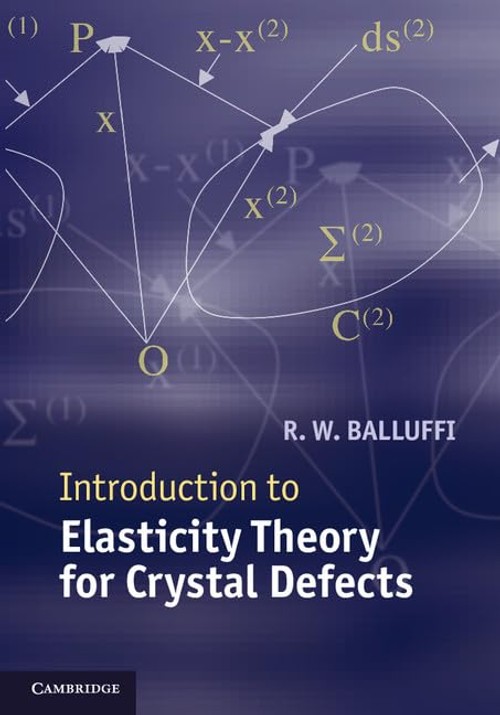
Introduction to Elasticity Theory for Crystal Defects by R. W. Balluffi – A Self-Sufficient Textbook on Anisotropic Elas
Inclusive of all applicable taxes. FREE shipping on all orders.
Available Offers
- 🚚Free Delivery — Free shipping on all orders
- 💵Cash on Delivery — Pay when your order arrives
- ↩️15-Day Easy Returns — Hassle-free return policy
- 🔒Cash on Delivery — Pay safely when your order arrives
Check Delivery
Product Description
Introduction
For students and researchers delving into the physics of crystalline solids, understanding how defects behave under stress is crucial. Introduction to Elasticity Theory for Crystal Defects by R. W. Balluffi offers a rigorous yet accessible gateway into the anisotropic elasticity theory that governs point, line, planar, and volume defects in crystals. Published by Cambridge University Press, this hardbound volume is an indispensable reference for graduate students and professionals in materials science, solid-state physics, and mechanical engineering across Indian universities and research institutes.
Book Overview
This self-contained textbook bridges the gap between basic continuum mechanics and the specialized elasticity required to model crystal imperfections. Starting from fundamental mathematical tools, the author systematically builds up to complex defect configurations—vacancies, dislocations, grain boundaries, inclusions, and inhomogeneities. Each concept is reinforced with worked examples and exercises, making the book ideal for both classroom instruction and self-study. The focus remains firmly on anisotropic elasticity, which is essential for accurate predictions in real crystals where properties vary with direction.
Key Highlights
- Comprehensive coverage of all major defect types: point, line, planar, and volume defects.
- Step-by-step approach from basic mathematics to advanced applications, ensuring clarity for beginners.
- Numerous solved exercises with fully worked solutions to strengthen problem-solving skills.
- First comprehensive review of anisotropic elasticity theory specifically tailored for crystal defects.
- Cambridge University Press quality in a durable hardcover edition suitable for years of reference.
Inside the Book
The book is organized into logical sections that guide the reader from foundational principles to specialized topics. Early chapters cover vector and tensor algebra, stress and strain in anisotropic media, and the generalized Hooke's law. Later chapters explore the elastic fields of point defects like vacancies and interstitials, the intricate theory of dislocations including line forces and image stresses, planar defects such as grain boundaries and twin interfaces, and volume defects like inclusions and inhomogeneities. Interaction energies and forces between defects are treated in depth, providing a complete picture of defect mechanics.
Key Topics
- Basic mathematical techniques: tensors, coordinate transformations, and differential operators
- Anisotropic elasticity: stiffness and compliance tensors, symmetry reductions
- Point defects: elastic dipoles, relaxation volumes, and interaction with stress fields
- Dislocations: Burgers vectors, stress fields, line tension, and image forces near surfaces
- Planar defects: grain boundaries, stacking faults, and their elastic interactions
- Volume defects: inclusions, precipitates, and voids under applied loads
- Defect interactions: elastic coupling, stability, and migration barriers
Reader Benefits
By working through this text, readers gain a deep, intuitive understanding of how defects distort a crystal lattice and how those distortions influence material properties such as strength, ductility, and fracture toughness. The solved exercises allow for immediate application of theory, building confidence in handling real-world problems. Researchers will appreciate the comprehensive treatment of anisotropic effects often overlooked in isotropic approximations, enabling more accurate modeling of actual materials like silicon, gallium arsenide, and advanced alloys.
Learning Outcomes
- Master the tensor mathematics required for anisotropic elasticity calculations
- Compute elastic fields around point, line, planar, and volume defects
- Analyze defect interactions and image stresses in finite bodies
- Apply elasticity theory to predict defect stability and mobility
- Interpret experimental observations of defect structures using quantitative models
Who Should Read
This book is tailored for graduate students in materials science, solid-state physics, and mechanical engineering who are beginning research on crystal defects. It also serves as a valuable refresher for postdoctoral researchers and industry professionals working on semiconductor devices, structural alloys, or nanotechnology. Faculty members teaching advanced courses on defects in solids will find it an excellent primary or supplementary textbook. Indian readers in IITs, IISc, NITs, and central universities will especially benefit from its clear exposition and problem sets.
About the Author
R. W. Balluffi is a distinguished materials scientist and professor emeritus at Cornell University. With decades of research experience in the theory and observation of crystal defects, he is widely recognized for his contributions to understanding grain boundaries, diffusion, and dislocation behaviour. His pedagogical style emphasizes clarity and self-sufficiency, making complex topics accessible to newcomers.
About the Publisher
Cambridge University Press is a world-leading academic publisher known for its rigorous peer review and high-quality scientific texts. This hardcover edition reflects their commitment to durable, authoritative resources that support advanced learning and research. Indian students and professionals can rely on the accuracy and depth that Cambridge brings to every title.
Conclusion
Introduction to Elasticity Theory for Crystal Defects is more than a textbook—it is a complete learning system that equips readers with the tools to understand and model the mechanical behaviour of real crystals. Whether you are beginning your research journey or seeking to deepen your expertise, this book offers the theoretical foundation and practical skills needed to excel. Order your copy from Bookshops.in today and add a definitive resource to your library.
Quick Summary
Introduction to Elasticity Theory for Crystal Defects by R. W. Balluffi is a comprehensive and self-sufficient textbook that provides a complete introduction to anisotropic elasticity theory for modeling a wide range of crystal defects. Assuming little prior knowledge, the book guides readers through essential mathematical techniques and methods, then applies them to point defects (vacancies), line defects (dislocations), planar defects (grain boundaries), and volume defects (inclusions). Topics include elastic fields, interactions with imposed stresses, image stresses, and defect interactions. With numerous exercises and solutions, this book is ideal for graduate students, researchers, and professionals in materials science, solid-state physics, and metallurgy. Published by Cambridge University Press, it is a trusted resource for building a strong foundation in defect elasticity. Buy your copy from Bookshops.in, India's premium online bookstore, for reliable delivery and great service.
Book Highlights
Book Specifications
| ISBN-13 | 9781107012554 |
| ISBN-10 | 1107012554 |
| Publisher | Cambridge University Press |
| Language | English |
| Dimensions | 17.78 x 2.54 x 25.4 cm |
| Weight | 1 kg 60 g |
| Country | India |
| Category | Mechanical Engineering › Material Science & Engineering |
| Genre | Non-fiction |
| Reading Age | Adult |
| Original Language | English |
Frequently Asked Questions
What is the main focus of Introduction to Elasticity Theory for Crystal Defects?
Who is the author of this book?
What prior knowledge is required to read this book?
Does the book include exercises?
What types of crystal defects are covered?
Is this book suitable for self-study?
Who is the publisher of this book?
What is the ISBN-13 of this book?
What is the price of this book in India?
Is this book available in hardcover?
What language is the book written in?
Does the book cover image stresses?
Can this book help with research in metallurgy?
Where can I buy this book in India?
Readers Also Search For
Customers Also Bought

McFarland & Company
Playing with the Guys | by Marc A. Ouellette | Matthew Wilhelm Kapell | McFarland & Company | by Marc A. Ouellette | Matthew Wilhelm Kapell | McFarland & Company | by Marc A. Ouellette | Matthew Wilhelm Kapell | McFarland & Company | by Marc A. Ouellette | Matthew Wilhelm Kapell | McFarland & Company | by Marc A. Ouellette | Matthew Wilhelm Kapell | McFarland & Company | by Marc A. Ouellette | Matthew Wilhelm Kapell | McFarland & Company | by Marc A. Ouellette | Matthew W
Rowman & Littlefield Publishers
Joss Whedon's Dollhouse: Confounding Purpose, Confusing Identity (Science Fiction Television)

State University of New York Press
Mexico Unmanned: The Cultural Politics of Masculinity in Mexican Cinema (SUNY series in Latin American Cinema)

McFarland & Company
Valley Forge to Monmouth | by Jim Stempel | McFarland & Company | by Jim Stempel | McFarland & Company | by Jim Stempel | McFarland & Company | by Jim Stempel | McFarland & Company | by Jim Stempel | McFarland & Company | by Jim Stempel | McFarland & Company | by Jim Stempel | McFarland & Company | by Jim Stempel | McFarland & Company | by Jim Stempel | McFarland & Company | by Jim Stempel | McFarland & Company | by Jim Stempel | McFarland & Company |
University of Toronto Press
Structures of Feeling in Seventeenth-Century Cultural Expression (UCLA Center Clark Library)

McFarland & Company
Welcome to Arkham Asylum | by Sharon Packer | Daniel R. Fredrick | McFarland & Company | by Sharon Packer | Daniel R. Fredrick | McFarland & Company | by Sharon Packer | Daniel R. Fredrick | McFarland & Company | by Sharon Packer | Daniel R. Fredrick | McFarland & Company | by Sharon Packer | Daniel R. Fredrick | McFarland & Company | by Sharon Packer | Daniel R. Fredrick | McFarland & Company | by Sharon Packer | Daniel R. Fredrick | McFarland & Company | by Sharon P
Related Products
View All
Cambridge University Press
Jane Austen and the Enlightenment (English, Peter Knox-Shaw)

Cambridge University Press
Children of the Queen's Revels (English, Lucy Munro)

Cambridge University Press
Site Automation | by Thomas Bock | Thomas Linner | Cambridge University Press | by Thomas Bock | Thomas Linner | Cambridge University Press | by Thomas Bock | Thomas Linner | Cambridge University Press | by Thomas Bock | Thomas Linner | Cambridge University Press | by Thomas Bock | Thomas Linner | Cambridge University Press | by Thomas Bock | Thomas Linner | Cambridge University Press | by Thomas Bock | Thomas Linner | Cambridge University Press | by Thomas Bock | Thomas Linner | Cambridge Unive
Cambridge University Press
Complex Analysis | by Ian Stewart | David Tall | Cambridge University Press | by Ian Stewart | David Tall | Cambridge University Press | by Ian Stewart | David Tall | Cambridge University Press | by Ian Stewart | David Tall | Cambridge University Press | by Ian Stewart | David Tall | Cambridge University Press | by Ian Stewart | David Tall | Cambridge University Press | by Ian Stewart | David Tall | Cambridge University Press | by Ian Stewart | David Tall | Cambridge University Press | by Ian St
Cambridge University Press
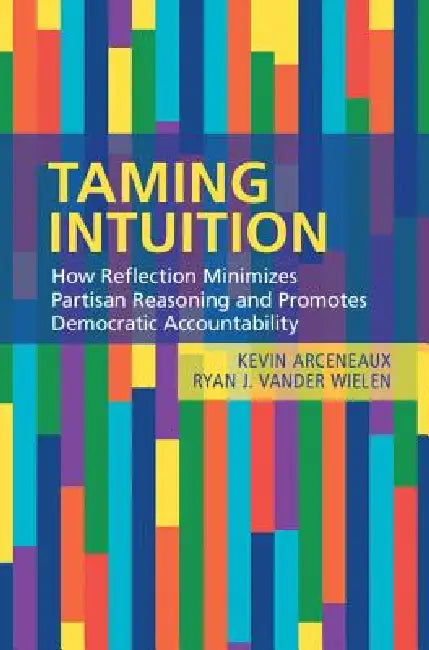
Taming Intuition | by Kevin Arceneaux | Ryan J. Vander Wielen | Cambridge University Press | by Kevin Arceneaux | Ryan J. Vander Wielen | Cambridge University Press | by Kevin Arceneaux | Ryan J. Vander Wielen | Cambridge University Press | by Kevin Arceneaux | Ryan J. Vander Wielen | Cambridge University Press | by Kevin Arceneaux | Ryan J. Vander Wielen | Cambridge University Press | by Kevin Arceneaux | Ryan J. Vander Wielen | Cambridge University Press | by Kevin Arceneaux | Ryan J. Vander W
Cambridge University Press