
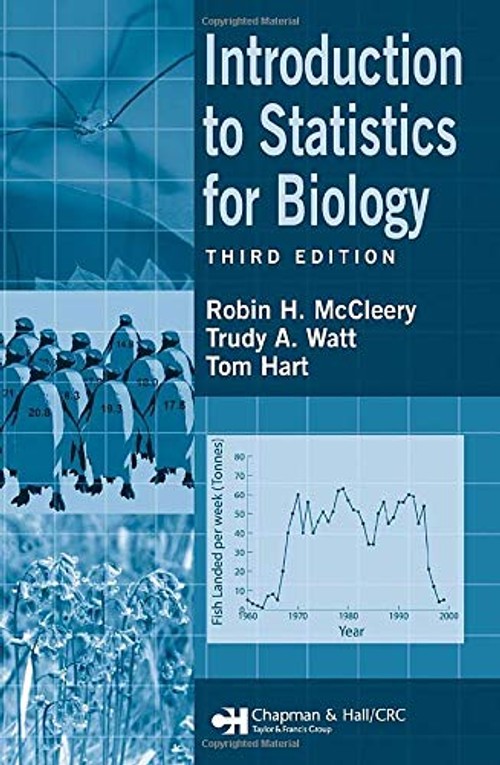
Introduction to Statistics for Biology: A Comprehensive Guide to Experimental Design and Data Analysis by Trudy A. Watt
Inclusive of all applicable taxes. FREE shipping on all orders.
Available Offers
- 🚚Free Delivery — Free shipping on all orders
- 💵Cash on Delivery — Pay when your order arrives
- ↩️15-Day Easy Returns — Hassle-free return policy
- 🔒Cash on Delivery — Pay safely when your order arrives
Check Delivery
Product Description
Introduction
For students of biology, the mere mention of statistics can often bring a sense of dread. Yet, in the modern biological sciences, a solid grasp of experimental design and data analysis is not just useful—it is essential. Introduction to Statistics for Biology, Third Edition by Trudy A. Watt is the perfect companion for Indian undergraduate and postgraduate students who want to build confidence in handling numerical data. This book demystifies statistical concepts with a clear, step-by-step approach, making it an indispensable resource for anyone pursuing a career in the life sciences.
Book Overview
Published by the renowned Chapman and Hall/CRC, this hardbound edition is a comprehensive guide that bridges the gap between biological research and statistical reasoning. Unlike many intimidating textbooks, this one is written with the biology student in mind—focusing on real-world applications rather than abstract theory. The third edition has been carefully updated to include more detailed explanations of probability, a stronger emphasis on experimental design, and a practical template for carrying out statistical tests from hypothesis to interpretation. Whether you are studying ecology, genetics, microbiology, or any other branch of biology, this book will help you think critically about your data.
Key Highlights
- Painless Introduction to Statistics: The book begins with the basics of elementary probability, making the rationale behind hypothesis testing easy to understand.
- Emphasis on Experimental Design: Learn how to plan your experiments and simulate data before you even step into the lab, saving time and improving accuracy.
- Practical Minitab Examples: Each statistical test is illustrated with worked examples using Minitab, one of the most widely used statistical software packages in academic and research settings.
- Updated Content: The third edition features fresh analyses, new graphics, and downloadable resources that include a free trial version of Minitab.
Inside the Book
This book is structured to guide you logically from basic concepts to more complex analyses. Early chapters introduce the fundamental ideas of probability and sampling, which are crucial for understanding why we perform statistical tests. The middle sections cover descriptive statistics, confidence intervals, and hypothesis testing, including t-tests, chi-square tests, and analysis of variance (ANOVA). Later chapters delve into regression, correlation, and non-parametric methods. Every chapter includes a general template for carrying out statistical tests, ensuring that you can apply what you have learned to your own research data.
Key Topics
- Elementary probability and its role in biology
- Experimental design and data simulation
- Descriptive statistics: mean, median, standard deviation
- Hypothesis testing: null and alternative hypotheses
- Parametric tests: t-tests, ANOVA, regression
- Non-parametric tests: Mann-Whitney, Kruskal-Wallis
- Correlation and regression analysis
- Interpreting statistical outputs in Minitab
Reader Benefits
- Build Numerical Confidence: Overcome the fear of numbers with a friendly, accessible writing style.
- Apply Directly to Research: The practical template helps you perform tests correctly every time, from hypothesis to interpretation.
- Save Time in the Lab: Learning to simulate data before experiments reduces wasted effort and improves experimental outcomes.
- Master Minitab: Gain hands-on experience with a leading statistical software package, a valuable skill for academic and industry jobs.
- Enhanced Understanding: The updated probability section makes the logic behind p-values and significance testing crystal clear.
Learning Outcomes
By the end of this book, readers will be able to: design robust biological experiments with proper controls and replication; choose the appropriate statistical test for a given dataset; perform analyses using Minitab with confidence; interpret statistical results in the context of biological hypotheses; and communicate findings clearly in reports, theses, and research papers. These skills are foundational for success in higher studies and careers in biotechnology, environmental science, medicine, and academia.
Who Should Read
This book is ideal for undergraduate and postgraduate students in the biological sciences, including those studying botany, zoology, microbiology, biochemistry, biotechnology, ecology, and environmental science. It is also a valuable refresher for researchers, lab technicians, and teachers who want to strengthen their statistical foundation. No prior background in statistics is assumed—only a willingness to learn.
About the Author
Trudy A. Watt is a respected educator and researcher with decades of experience teaching statistics to biology students. Her approachable style and deep understanding of the challenges faced by non-mathematicians have made her a trusted name in the field. She has worked extensively with Minitab and has designed this book to meet the specific needs of life science students, ensuring that complex ideas are broken down into digestible steps.
About the Publisher
Chapman and Hall/CRC is a world-leading publisher of scientific and technical books, known for its high-quality academic and professional resources. With a strong focus on mathematics, statistics, and the sciences, the publisher ensures that every title is rigorously reviewed and up to date. This edition continues that tradition, offering reliable, authoritative content that students and researchers can trust.
Conclusion
Introduction to Statistics for Biology, Third Edition is more than just a textbook—it is a practical toolkit that empowers biology students to become confident, data-literate scientists. Whether you are preparing for your first research project or aiming to publish your findings, this book will be your trusted guide through the world of biological statistics. Order your hardcover copy today from Bookshops.in and take the first step toward mastering the numbers behind the life sciences.
Quick Summary
Introduction to Statistics for Biology by Trudy A. Watt is a thoughtfully crafted textbook designed to ease biology students into the world of statistics. Recognizing that many students in the life sciences feel anxious about numerical work, the author uses a gentle, step-by-step approach that builds understanding from the ground up. The book begins with elementary probability to clarify the rationale behind hypothesis testing, then moves into simple statistical tests, experimental design, and data simulation. Each chapter includes worked examples drawn from real biological contexts, helping readers see the relevance of statistics to their own studies. The third edition places special emphasis on planning experiments and simulating data before conducting them, a practical skill that saves time and improves research quality. A general template for carrying out statistical tests—from hypothesis to interpretation—provides a reusable framework. This book is ideal for Indian undergraduates, postgraduates, and early-career researchers who want to overcome math anxiety and gain confidence in data analysis. By choosing Bookshops.in, you get a genuine hardcover edition with reliable delivery and excellent customer service, making it the smart choice for serious students.
Book Highlights
Book Specifications
| ISBN-13 | 9781584886525 |
| ISBN-10 | 1584886528 |
| Publisher | Chapman & Hall |
| Language | English |
| Dimensions | 15.24 x 1.91 x 22.86 cm |
| Category | Biology & Life Sciences › Biology |
| Genre | Non-fiction |
| Original Language | English |
Frequently Asked Questions
What is the main focus of this book?
Do I need a strong math background to use this book?
Is this book suitable for Indian university syllabi?
Does the book include examples from real biological studies?
How does the book help with experimental design?
What statistical tests are covered?
Is there a chapter on probability?
Can I use this book for self-study?
Who is the publisher?
Is the book available in English?
What is the price?
Does the book include exercises?
Why should I buy from Bookshops.in?
Readers Also Search For
Customers Also Bought
Mathematics
Stereotype Spaces and Algebras: 73 (De Gruyter Expositions in Mathematics, 73)
Mathematics
Semigroups in Algebra, Geometry and Analysis: 20 (De Gruyter Expositions in Mathematics, 20)

Mathematics
Geometry from the Pacific Rim: Proceedings of the Pacific Rim Geometry Conference held at National University of Singapore, Republic of Singapore, ... 1994 (De Gruyter Proceedings in Mathematics)
Mathematics
First International Tainan-Moscow Algebra Workshop: Proceedings of the International Conference held at National Cheng Kung University Tainan, Taiwan, ... 1994 (De Gruyter Proceedings in Mathematics)
Mathematics
Differential Geometry - Proceedings of the VIII International Colloquium (English, Jesus A. Alvarez Lopez | Eduardo Garcia-Rio)
Mathematics
Mathematical Theory of Optimal Processes (Classics of Soviet Mathematics)
Related Products
View All
Biology
Evolution: What the Fossils Say and Why It Matters by Donald R. Prothero
Biology
From Taxonomy to Phylogenetics – Life and Work of Willi Hennig

Biology
The Marine Biology of the South China Sea
Biology
Genetics Meets Metabolomics: from Experiment to Systems Biology
Biology
The Elements of Natural or Experimental Philosophy: 2
Biology