
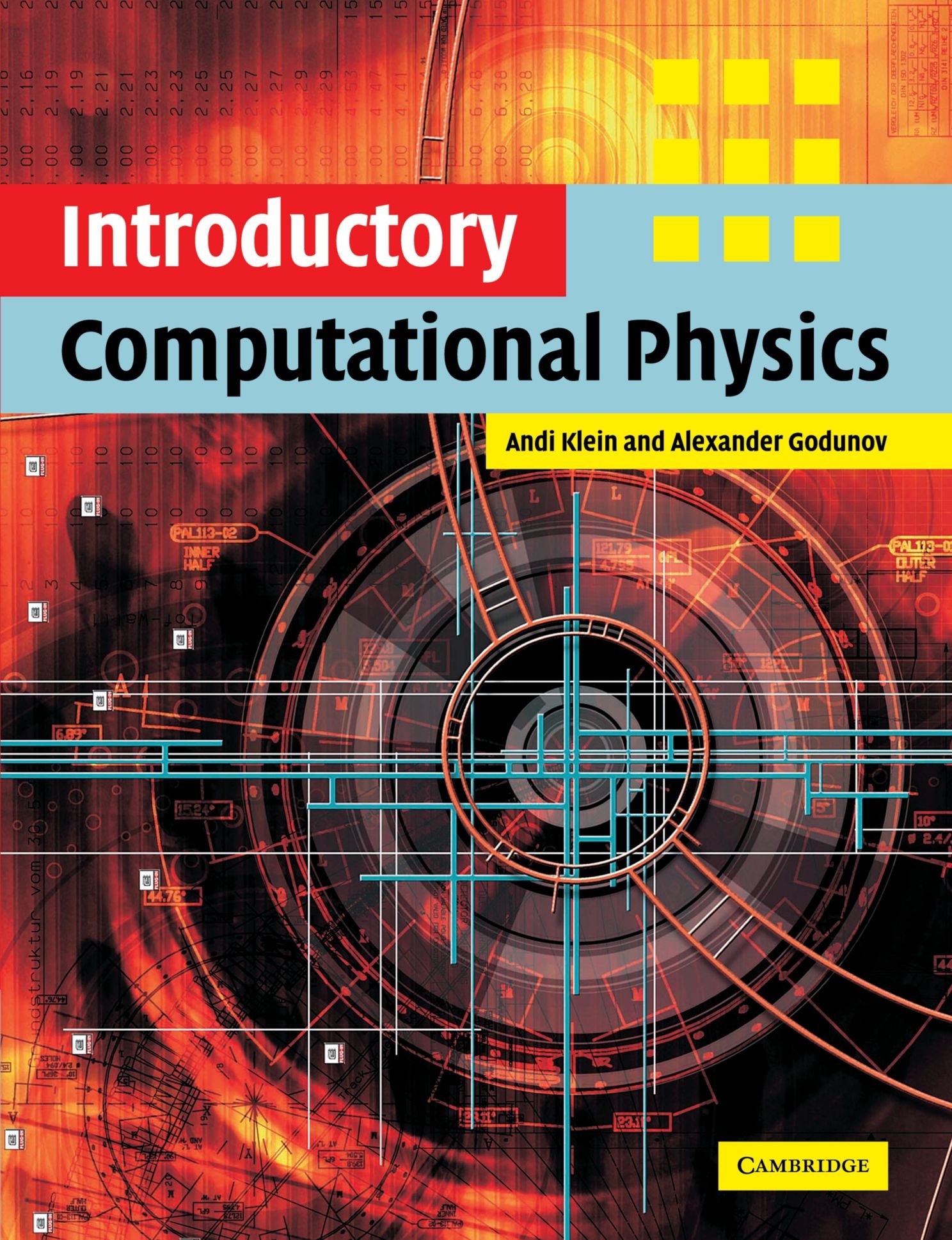
Introductory Computational Physics: A Hands-On Textbook for Undergraduate Students by Andi Klein – Learn Numerical Metho
Inclusive of all applicable taxes. FREE shipping on all orders.
Available Offers
- 🚚Free Delivery — Free shipping on all orders
- 💵Cash on Delivery — Pay when your order arrives
- ↩️15-Day Easy Returns — Hassle-free return policy
- 🔒Cash on Delivery — Pay safely when your order arrives
Check Delivery
Product Description
Introduction
In the rapidly evolving landscape of modern science, computational methods have become indispensable for physicists. Introductory Computational Physics by Andi Klein, published by Cambridge University Press, is a meticulously crafted textbook that bridges the gap between theoretical physics and practical computation. Designed specifically for undergraduate students in India and around the world, this hardbound edition offers a hands-on approach to solving complex physical problems using free, open-source software. Whether you are a student of physics, engineering, or applied mathematics, this book empowers you to harness the power of computers for simulations, data analysis, and numerical problem-solving.
Book Overview
This comprehensive textbook, first published in 2006, provides a solid foundation in computational physics without assuming prior programming expertise. It guides readers through the entire process of using computers to solve mathematical problems in physics, from writing code to visualizing results. The book exclusively relies on free software—Linux as the operating system and the ROOT package from CERN for graphical interfaces—making it accessible to students from all economic backgrounds. It includes numerous examples, exercises, and references to online resources, ensuring a complete learning experience for Indian undergraduates and self-learners alike.
Key Highlights
- Free Software Focus: Uses Linux and C++ compilers that come with the operating system, along with ROOT (a free data analysis framework from CERN), eliminating the need for expensive proprietary tools.
- Practical Orientation: Every chapter includes real-world physics problems, complete with sample programs and step-by-step explanations.
- Exercise-Rich Content: Hundreds of exercises help reinforce concepts and encourage independent problem-solving.
- Online Support: Supplementary materials, including solutions, updates, and additional references, are available at the Cambridge University Press website.
- Broad Scope: Covers topics ranging from basic numerical methods to advanced simulation techniques, suitable for a full semester course.
Inside the Book
The book is structured to take readers from foundational concepts to advanced applications. Early chapters introduce the Linux environment, C++ programming basics, and numerical techniques such as root finding, integration, and differential equations. Later chapters delve into Monte Carlo methods, molecular dynamics simulations, and data visualization using ROOT. Each topic is illustrated with physics examples, such as projectile motion, harmonic oscillators, and planetary orbits. The appendices provide quick references for C++ syntax, ROOT commands, and mathematical formulas.
Key Topics
- Introduction to Linux and command-line tools for scientific computing
- Fundamentals of C++ programming for physics applications
- Numerical integration and differentiation techniques
- Solving ordinary and partial differential equations
- Monte Carlo simulations and random number generation
- Molecular dynamics and many-body systems
- Data analysis and visualization with ROOT
- Error analysis and optimization of algorithms
Reader Benefits
- Cost-Effective Learning: All software used is free, so students only need a computer and this book to start learning.
- Skill Development: Gain practical programming skills that are highly valued in research labs, tech industries, and academia.
- Conceptual Clarity: Each numerical method is explained in the context of a physical problem, making abstract concepts tangible.
- Self-Paced Study: The logical progression and ample exercises allow for independent learning outside the classroom.
- Global Standards: The use of ROOT, a tool widely used in particle physics, prepares students for international research collaborations.
Learning Outcomes
By the end of this book, readers will be able to: write efficient C++ programs to solve physics problems; choose appropriate numerical methods for different types of equations; simulate physical systems using Monte Carlo and molecular dynamics techniques; visualize and analyze data using professional-grade tools; and critically evaluate the accuracy and limitations of computational results. These outcomes align with the curriculum of undergraduate physics programs across Indian universities.
Who Should Read
This book is ideal for B.Sc. and M.Sc. physics students, engineering students with an interest in computational methods, and self-taught enthusiasts who want to apply computing to physics. It is also a valuable resource for faculty members designing lab courses in computational physics. No prior programming experience is required, though a basic understanding of calculus and classical mechanics will be helpful.
About the Author
Andi Klein is a physicist and educator with extensive experience in computational science. Having worked at the intersection of physics and computing for decades, Klein brings a practical, student-friendly approach to teaching. The author's deep understanding of both the theoretical and experimental sides of physics ensures that the book remains grounded in real-world applications.
About the Publisher
Cambridge University Press is a globally respected academic publisher known for producing high-quality textbooks and research monographs. With a history spanning over four centuries, Cambridge University Press is synonymous with scholarly excellence. This hardcover edition is printed on durable paper, making it a long-lasting addition to any student's library.
Conclusion
Introductory Computational Physics is more than just a textbook—it is a gateway to mastering the computational tools that drive modern physics. With its clear explanations, free software philosophy, and wealth of practical examples, it is an essential resource for any Indian student serious about understanding the universe through computation. Order your copy from Bookshops.in today and take the first step towards becoming proficient in computational physics.
Quick Summary
Introductory Computational Physics by Andi Klein is a practical textbook designed for undergraduate physics students who want to harness the power of computers to solve complex problems. The book teaches numerical methods such as integration, Monte Carlo simulations, and solving differential equations, all using free and open-source tools: Linux, C++, and the ROOT data analysis framework from CERN. Readers will learn to write efficient code, visualize data, and simulate physical systems, from classical mechanics to modern physics. The author emphasizes hands-on learning with real-world examples, making it ideal for Indian students and self-learners. No prior programming experience is required, as the book starts from basics. By the end, readers will have a solid foundation in computational physics, preparing them for advanced research or careers in data science and engineering. Bookshops.in offers this premium hardcover edition at ₹2320 with reliable delivery across India, making it a valuable investment for any physics student.
Book Highlights
Book Specifications
| ISBN-13 | 9780521828628 |
| ISBN-10 | 0521828627 |
| Publisher | Cambridge University Press |
| Language | English |
| Dimensions | 18.42 x 0.64 x 24.13 cm |
| Weight | 502 g |
| Category | Science & Mathematics › Mathematics |
| Genre | Science & Mathematics |
| Original Language | English |
Frequently Asked Questions
Is this book suitable for beginners in programming?
What software do I need to use this book?
Does this book cover Monte Carlo methods?
Can I use Windows instead of Linux?
Is this book used in Indian universities?
What is the ROOT package?
Does the book include exercises?
Is this book relevant for modern physics?
Can I use this book for self-study?
Does it teach Python?
Is there a solutions manual?
What is the price in INR?
Is shipping free within India?
Readers Also Search For
Customers Also Bought
Mathematics
Stereotype Spaces and Algebras: 73 (De Gruyter Expositions in Mathematics, 73)
Mathematics
Semigroups in Algebra, Geometry and Analysis: 20 (De Gruyter Expositions in Mathematics, 20)
Mathematics
Geometry from the Pacific Rim: Proceedings of the Pacific Rim Geometry Conference held at National University of Singapore, Republic of Singapore, ... 1994 (De Gruyter Proceedings in Mathematics)
Mathematics
First International Tainan-Moscow Algebra Workshop: Proceedings of the International Conference held at National Cheng Kung University Tainan, Taiwan, ... 1994 (De Gruyter Proceedings in Mathematics)

Mathematics
Group Theory, Algebra, and Number Theory: Colloquium in Memory of Hans Zassenhaus held in Saarbrücken, Germany, June 4-5, 1993
Mathematics
Mathematical Theory of Optimal Processes (Classics of Soviet Mathematics)
Related Products
View AllMathematics
Stereotype Spaces and Algebras: 73 (De Gruyter Expositions in Mathematics, 73)
Mathematics
Semigroups in Algebra, Geometry and Analysis: 20 (De Gruyter Expositions in Mathematics, 20)
Mathematics
Geometry from the Pacific Rim: Proceedings of the Pacific Rim Geometry Conference held at National University of Singapore, Republic of Singapore, ... 1994 (De Gruyter Proceedings in Mathematics)
Mathematics
First International Tainan-Moscow Algebra Workshop: Proceedings of the International Conference held at National Cheng Kung University Tainan, Taiwan, ... 1994 (De Gruyter Proceedings in Mathematics)
Mathematics
Group Theory, Algebra, and Number Theory: Colloquium in Memory of Hans Zassenhaus held in Saarbrücken, Germany, June 4-5, 1993
Mathematics