
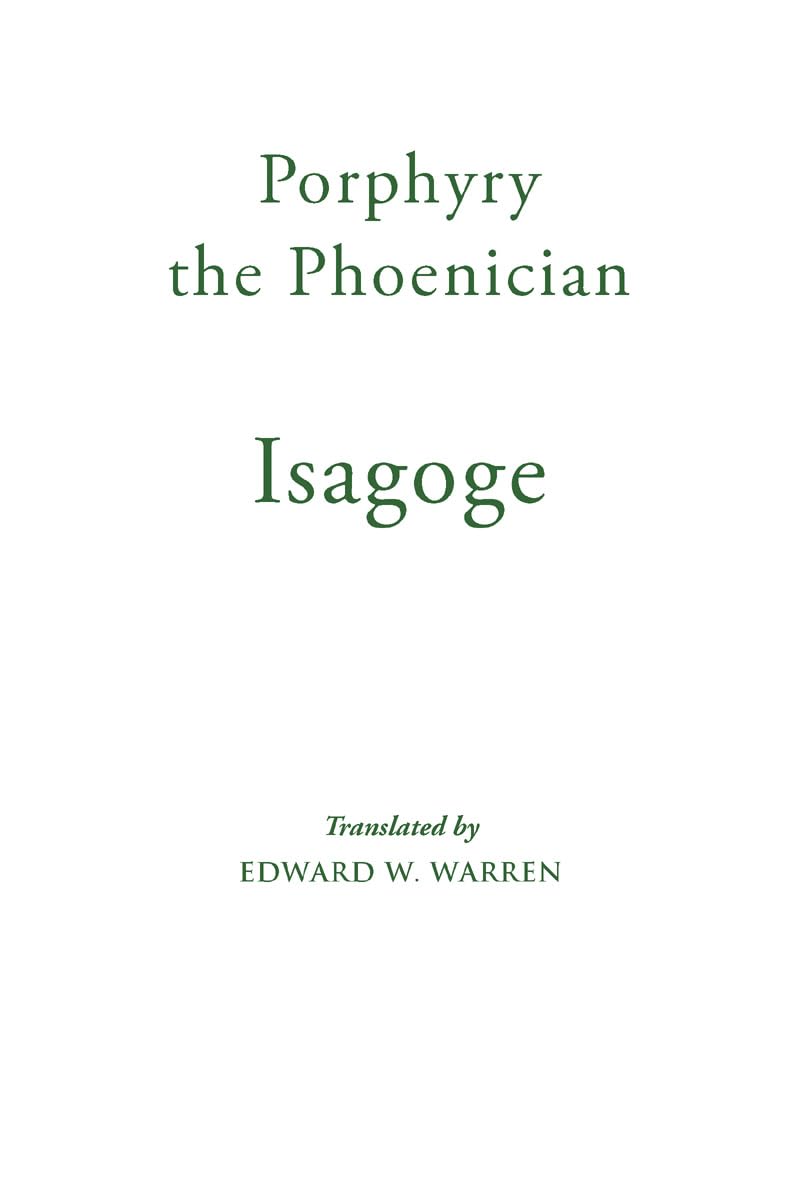
Porphyry the Phoenician Isagoge: A Classic Work on Logic and Neoplatonic Philosophy by Porphyry the Phoenician
Inclusive of all applicable taxes. FREE shipping on all orders.
Available Offers
- 🚚Free Delivery — Free shipping on all orders
- 💵Cash on Delivery — Pay when your order arrives
- ↩️15-Day Easy Returns — Hassle-free return policy
- 🔒Cash on Delivery — Pay safely when your order arrives
Check Delivery
Product Description
Introduction
Porphyry the Phoenician Isagoge is a foundational work in the history of Western philosophy and logic, now presented in a definitive hardcover edition by Brill. This volume offers scholars, students, and serious readers a meticulously curated text of the Isagoge—an introduction to Aristotle’s Categories that has shaped philosophical discourse for over a millennium. Published as part of Brill’s esteemed series, this edition combines rigorous scholarship with accessible presentation, making it an essential addition to any academic library or personal collection in India.
Book Overview
Originally composed by the Phoenician philosopher Porphyry in the third century CE, the Isagoge serves as a gateway to Aristotelian logic and Neoplatonic thought. This Brill edition provides the original Greek text alongside a fresh English translation, supported by extensive notes and commentary. The book explores the five predicables—genus, species, difference, property, and accident—which form the backbone of classical logic. For Indian readers studying comparative philosophy, logic, or the history of ideas, this volume offers a bridge between Eastern and Western intellectual traditions.
Key Highlights
- Authoritative Edition: Published by Brill, a world-renowned academic publisher known for its scholarly rigor.
- Bilingual Presentation: Includes both the original Greek and a modern English translation for comparative study.
- Critical Apparatus: Features textual notes, variant readings, and explanatory annotations to aid understanding.
- Historical Significance: The Isagoge influenced medieval scholasticism, Islamic philosophy, and Renaissance logic.
- Hardcover Durability: A premium binding suitable for frequent reference in libraries, classrooms, and personal study.
Inside the Book
This edition opens with a comprehensive introduction that situates Porphyry’s work within the context of late antiquity and its transmission through Syriac, Arabic, and Latin traditions. The main text is divided into clear sections, each focusing on one of the five predicables. Detailed footnotes clarify difficult passages, while a glossary of key terms aids readers unfamiliar with technical vocabulary. The volume concludes with a bibliography and indices that facilitate further research. Every page reflects Brill’s commitment to typographical clarity and scholarly precision.
Key Topics
- The five predicables: genus, species, difference, property, and accident
- Introduction to Aristotelian logic and categories
- Porphyry’s Neoplatonic interpretation of reality and language
- The problem of universals and its historical debates
- Relation between logic, ontology, and epistemology
- Transmission of Greek philosophy through ancient and medieval cultures
Reader Benefits
- Deepen Understanding: Gain a solid grasp of classical logic that underpins Western philosophy.
- Enhance Critical Thinking: Learn to analyze and classify concepts with precision.
- Cultural Insight: Explore how a Phoenician thinker shaped global intellectual history.
- Academic Preparation: Ideal for students of philosophy, classics, and Indian logic (Nyaya) seeking comparative perspectives.
- Reference Value: A durable hardcover that will last for years of study and citation.
Learning Outcomes
By engaging with this edition of the Isagoge, readers will be able to define and differentiate the five predicables, trace the influence of Porphyry on later philosophers like Boethius and Avicenna, analyze the problem of universals in its original context, and apply logical tools to philosophical and everyday reasoning. The book also equips readers with the skills to critically evaluate translations and commentaries, fostering independent scholarship.
Who Should Read
This book is ideal for undergraduate and postgraduate students of philosophy, especially those studying logic, metaphysics, or ancient philosophy. It is equally valuable for researchers in classical studies, comparative religion, and Indian philosophy who wish to explore parallels between Greek and Indian logical systems. Teachers and professors will find it a reliable text for course adoption, while autodidacts with an interest in the history of ideas will appreciate its depth and clarity.
About the Author
Porphyry the Phoenician (c. 234–305 CE) was a Neoplatonic philosopher, logician, and scholar born in Tyre (modern-day Lebanon). A student of Plotinus, he edited his master’s works into the Enneads and wrote extensively on philosophy, religion, and science. His Isagoge became the standard introduction to logic in both the Byzantine and Islamic worlds, later influencing medieval European thinkers such as Abelard and Aquinas. Porphyry’s work remains a cornerstone of logical studies.
About the Publisher
Brill is a prestigious academic publisher based in Leiden, Netherlands, with a history spanning over 300 years. Renowned for its high-quality editions in the humanities and social sciences, Brill produces critical texts, reference works, and monographs that set the standard for scholarship. This edition of the Isagoge reflects Brill’s dedication to preserving and disseminating classical knowledge with accuracy and elegance.
Conclusion
Porphyry the Phoenician Isagoge is more than a historical document—it is a living tool for understanding logic, language, and reality. This Brill hardcover edition offers Indian readers a rare opportunity to own a piece of philosophical heritage, presented with the care and authority that only a premier academic publisher can provide. Whether for academic pursuit or personal enrichment, this book is a wise investment in intellectual growth.
Quick Summary
Porphyry the Phoenician's Isagoge is a cornerstone of Western logic and Neoplatonic philosophy. Written in the 3rd century CE, this concise work introduces Aristotle's Categories by defining the five predicables: genus, species, difference, property, and accident. It became the standard textbook on logic for over a thousand years, influencing medieval scholars like Boethius and Aquinas. This Brill hardcover edition presents the text in English with scholarly notes, making it accessible to modern readers. Ideal for philosophy students, classicists, and anyone interested in the history of logic, the Isagoge also offers rich material for comparative philosophy with Indian traditions. By purchasing from Bookshops.in, you get a genuine, high-quality hardcover at a competitive price, delivered across India. Whether you are preparing for university exams or deepening your personal study, this book is an essential addition to your library.
Book Highlights
Book Specifications
| ISBN-13 | 9780888442659 |
| ISBN-10 | 0888442653 |
| Publisher | Pontifical Inst of Medieval studies |
| Language | English |
| Dimensions | 13.94 x 0.38 x 20.9 cm |
| Weight | 91 g |
| Category | Region & Countries › Europe |
| Genre | Philosophy |
| Reading Age | 18+ |
| Original Language | Greek |
Frequently Asked Questions
What is the Isagoge about?
Who is Porphyry the Phoenician?
Is this book suitable for beginners?
Does the book include commentary?
Why is the Isagoge important?
What language is this edition in?
Can this be used for Indian philosophy courses?
What is the price?
Does the book cover Porphyry's tree?
Who publishes this edition?
Is there a digital version available?
How is this book related to Aristotle?
Readers Also Search For
Related Products
View All
History
The Information Revolution: Transforming the World Through Technology (World History)
History
Human Nature and the French Revolution: From the Enlightenment to the Napoleonic Code: 3 (Polygons: Cultural Diversities and Intersections, 3)
History
The Unmaking of Home in Contemporary Art (Cultural Spaces)

History
Handbook to Life in Medieval and Early Modern Japan | by William E. Deal | Oxford University Press | by William E. Deal | Oxford University Press | by William E. Deal | Oxford University Press | by William E. Deal | Oxford University Press | by William E. Deal | Oxford University Press | by William E. Deal | Oxford University Press | by William E. Deal | Oxford University Press | by William E. Deal | Oxford University Press | by William E. Deal | Oxford University Press | by William E. Deal | Ox

History
The Narrators of Barbarian History (A.D. 550-800) | by Walter Goffart | University of Notre Dame Press | by Walter Goffart | University of Notre Dame Press | by Walter Goffart | University of Notre Dame Press | by Walter Goffart | University of Notre Dame Press | by Walter Goffart | University of Notre Dame Press | by Walter Goffart | University of Notre Dame Press | by Walter Goffart | University of Notre Dame Press | by Walter Goffart | University of Notre Dame Press | by Walter Goffart | Univ
History