
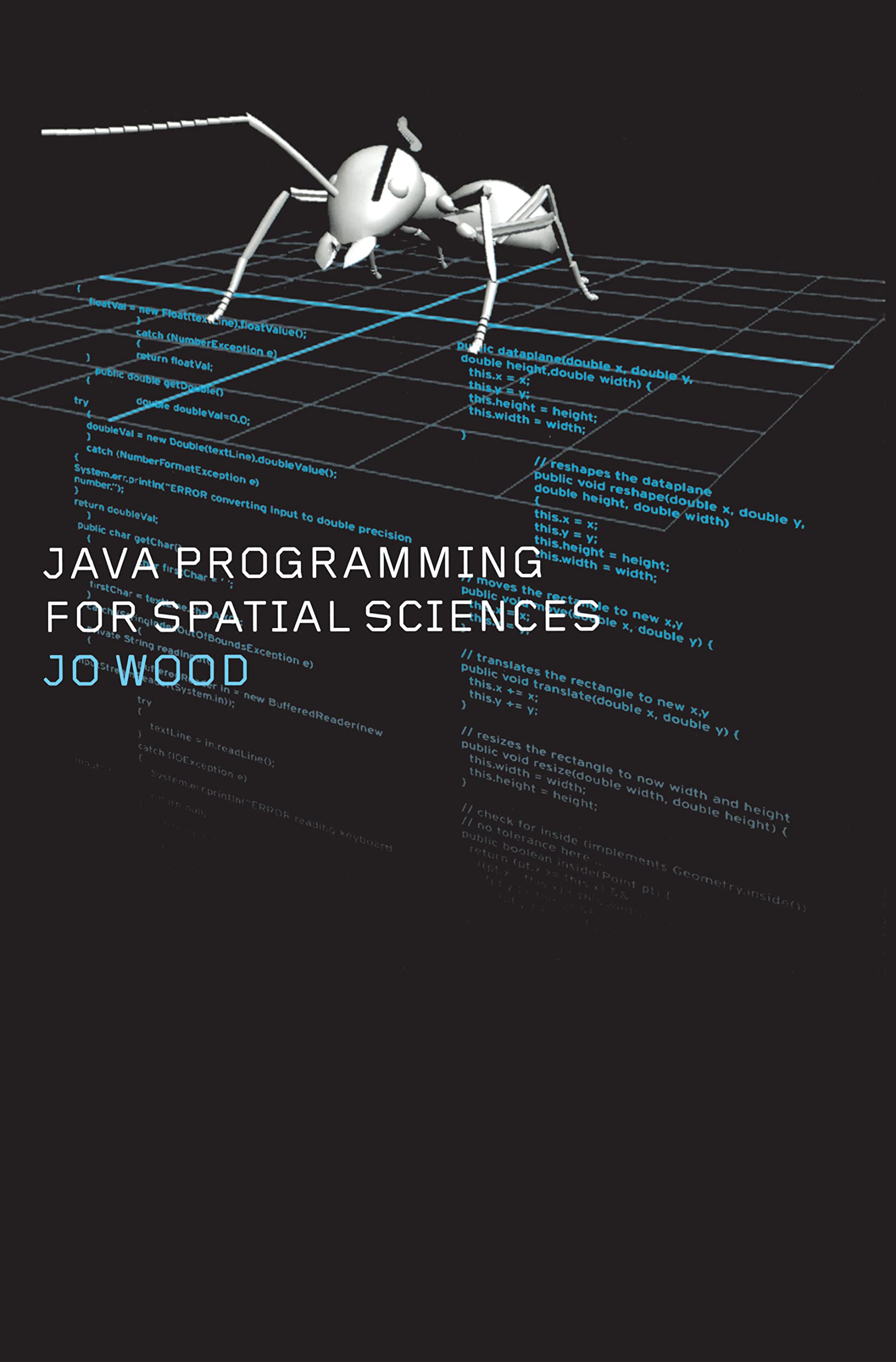
Java Programming for Spatial Sciences: A Practical Guide to Object-Oriented Modeling and Geographic Information by Jo Wo
Inclusive of all applicable taxes. FREE shipping on all orders.
Available Offers
- 🚚Free Delivery — Free shipping on all orders
- 💵Cash on Delivery — Pay when your order arrives
- ↩️15-Day Easy Returns — Hassle-free return policy
- 🔒Cash on Delivery — Pay safely when your order arrives
Check Delivery
Product Description
Introduction
In a world where data is increasingly linked to location, the ability to programmatically handle spatial information has become a vital skill. Java Programming for Spatial Sciences by Jo Wood is a comprehensive guide that bridges the gap between core Java programming and the specialized needs of geographic information systems (GIS) and spatial analysis. Published by CRC Press, this hardcover edition is an essential resource for Indian students and professionals looking to integrate programming with geography, remote sensing, and environmental science.
Book Overview
This book offers a structured journey from basic object-oriented programming concepts to advanced spatial modeling. It is designed to help readers build a strong foundation in Java while simultaneously learning how to apply these skills to handle, process, and visualize geographic data. The text covers everything from class design and inheritance to raster and vector data models, making it a perfect companion for courses in computer science, geography, and earth sciences. With a focus on practical implementation, the book ensures that theoretical knowledge is immediately applicable to real-world spatial problems.
Key Highlights
- Object-Oriented Modeling: Clear explanations of abstraction, inheritance, and encapsulation tailored for spatial data.
- Raster and Vector Models: Step-by-step guidance on building feature-rich models of space using Java.
- Modern Web Technologies: Coverage of applets, remote communication, and XML for delivering geographic information online.
- Hands-On Approach: Numerous code examples and exercises to reinforce learning and build practical skills.
Inside the Book
The book begins with an introduction to Java programming fundamentals, assuming no prior coding experience. It then moves into object-oriented design principles, showing how to create classes that represent geographic features like points, lines, and polygons. Later chapters delve into advanced topics such as spatial indexing, coordinate transformations, and the development of web-based mapping applications. Each chapter includes detailed code snippets, diagrams, and case studies that illustrate how Java can be used to solve spatial problems in fields like archaeology, biology, and urban planning.
Key Topics
- Introduction to Java syntax and development environment
- Object-oriented concepts: classes, objects, inheritance, and polymorphism
- Building raster models for continuous spatial data
- Creating vector models for discrete geographic features
- Spatial data input, output, and file handling
- Web-based applets and remote data communication
- XML for spatial data exchange and metadata
- Visualization techniques for maps and spatial graphics
Reader Benefits
By working through this book, readers will gain the confidence to write Java programs that can read, analyze, and display geographic information. They will learn how to design reusable code components for spatial applications, understand the differences between raster and vector data models, and explore how internet technologies can be leveraged to share spatial data. The practical exercises help in building a portfolio of projects that demonstrate competence in both programming and spatial science.
Learning Outcomes
- Write Java programs to model and manipulate geographic data
- Apply object-oriented principles to design spatial software
- Implement raster and vector data structures for real-world mapping
- Develop web-based applets for interactive map visualization
- Use XML to store and transmit spatial information
- Understand the role of programming in modern GIS and remote sensing
Who Should Read
This book is ideal for undergraduate and postgraduate students in geography, GIS, remote sensing, archaeology, biology, and environmental science who want to add programming to their toolkit. It is also valuable for self-taught programmers and professionals in the Indian geospatial industry who wish to formalize their understanding of Java in the context of spatial data. No prior programming experience is necessary, making it accessible to beginners while offering depth for more advanced learners.
About the Author
Jo Wood is a respected academic and researcher in the field of geographic information science. With years of experience teaching programming to geography students, he brings a unique perspective that combines technical rigor with real-world applicability. His expertise in spatial data modeling and visualization is evident throughout the book, making complex concepts easy to grasp for readers from diverse backgrounds.
About the Publisher
CRC Press is a globally recognized publisher of scientific, technical, and medical content. Known for its high-quality textbooks and reference works, CRC Press ensures that this book meets the highest standards of accuracy and pedagogical effectiveness. Indian readers can trust the reliability and depth of content that comes with the CRC Press imprint.
Conclusion
Java Programming for Spatial Sciences is more than just a programming book—it is a gateway to understanding how software can unlock the power of location-based data. Whether you are a student in a geography lab, a researcher analyzing satellite imagery, or a developer building mapping tools, this book provides the foundational knowledge and practical skills you need. With its clear explanations, hands-on examples, and focus on both classic and modern web technologies, it is an indispensable addition to any Indian library focused on programming and spatial sciences.
Quick Summary
Java Programming for Spatial Sciences by Jo Wood is a foundational textbook that bridges the gap between Java programming and geographic information systems. Designed for students and professionals alike, it introduces object-oriented concepts such as abstraction, inheritance, and encapsulation, and shows how to apply them to spatial data. Readers will learn to build both raster and vector models of geographic space, and explore modern internet technologies including web-based applets, remote communication, and XML for delivering geographic information. The book is ideal for Indian undergraduates and postgraduates in geography, GIS, computer science, and environmental science. With clear explanations and practical examples, it empowers readers to create robust spatial applications. Published by CRC Press, this hardcover edition is a durable resource for academic and professional libraries. By purchasing from Bookshops.in, Indian customers get authentic stock, competitive pricing, and reliable delivery across the country.
Book Highlights
Book Specifications
| ISBN-13 | 9780415260985 |
| ISBN-10 | 0415260981 |
| Publisher | CRC Pr I Llc |
| Language | English |
| Dimensions | 15.6 x 1.93 x 23.39 cm |
| Weight | 590 g |
| Country | India |
| Category | Languages › Java |
| Genre | Non-fiction |
| Original Language | English |
Frequently Asked Questions
What is Java Programming for Spatial Sciences about?
Who is the author of this book?
What is the ISBN of this book?
Is this book suitable for beginners in Java?
Does this book cover web-based GIS?
What topics are covered in spatial modeling?
Can I use this book for university coursework?
What is the price of this book on Bookshops.in?
Is the book available in hardcover?
Does the book include practical exercises?
What is the language of the book?
Who is the publisher?
How many reviews does the book have?
Why should I buy from Bookshops.in?
Readers Also Search For
Customers Also Bought

Programming
Algorithmische Sprache Und Programmentwicklung | by H. Partsch | F. L. Bauer | P. Pepper | Springer | by H. Partsch | F. L. Bauer | P. Pepper | Springer | by H. Partsch | F. L. Bauer | P. Pepper | Springer | by H. Partsch | F. L. Bauer | P. Pepper | Springer | by H. Partsch | F. L. Bauer | P. Pepper | Springer | by H. Partsch | F. L. Bauer | P. Pepper | Springer | by H. Partsch | F. L. Bauer | P. Pepper | Springer | by H. Partsch | F. L. Bauer | P. Pepper | Springer | by H. Partsch | F. L. Bauer
Programming
Distributed Algorithms | by Jean-Claude Bermond | Michel Raynal | Springer | by Jean-Claude Bermond | Michel Raynal | Springer | by Jean-Claude Bermond | Michel Raynal | Springer | by Jean-Claude Bermond | Michel Raynal | Springer | by Jean-Claude Bermond | Michel Raynal | Springer | by Jean-Claude Bermond | Michel Raynal | Springer | by Jean-Claude Bermond | Michel Raynal | Springer | by Jean-Claude Bermond | Michel Raynal | Springer | by Jean-Claude Bermond | Michel Raynal | Springer | by Jean
Programming
Meta-Level Control for Deductive Database Systems | by Helmut Schmidt | Springer | by Helmut Schmidt | Springer | by Helmut Schmidt | Springer | by Helmut Schmidt | Springer | by Helmut Schmidt | Springer | by Helmut Schmidt | Springer | by Helmut Schmidt | Springer | by Helmut Schmidt | Springer | by Helmut Schmidt | Springer | by Helmut Schmidt | Springer | by Helmut Schmidt | Springer | by Helmut Schmidt | Springer | by Helmut Schmidt | Springer | by Helmut Schmidt | Springer | by Helmut Schm
Programming
Java Web Services | by David A. Chappell | Tyler Jewell | O'Reilly Media | by David A. Chappell | Tyler Jewell | O'Reilly Media | by David A. Chappell | Tyler Jewell | O'Reilly Media | by David A. Chappell | Tyler Jewell | O'Reilly Media | by David A. Chappell | Tyler Jewell | O'Reilly Media | by David A. Chappell | Tyler Jewell | O'Reilly Media | by David A. Chappell | Tyler Jewell | O'Reilly Media | by David A. Chappell | Tyler Jewell | O'Reilly Media | by David A. Chappell | Tyler Jewell | O'
Programming
Database in Depth | by Chris J. Date | O'Reilly Media | by Chris J. Date | O'Reilly Media | by Chris J. Date | O'Reilly Media | by Chris J. Date | O'Reilly Media | by Chris J. Date | O'Reilly Media | by Chris J. Date | O'Reilly Media | by Chris J. Date | O'Reilly Media | by Chris J. Date | O'Reilly Media | by Chris J. Date | O'Reilly Media | by Chris J. Date | O'Reilly Media | by Chris J. Date | O'Reilly Media | by Chris J. Date | O'Reilly Media | by Chris J. Date | O'Reilly Media | by Chris J.
Programming
Integration of AI and OR Techniques in Constraint Programming for Combinatorial Optimization Problem | by Nicolas Beldiceanu | Narendra Jussien | Eric Pinson | Springer | by Nicolas Beldiceanu | Narendra Jussien | Eric Pinson | Springer | by Nicolas Beldiceanu | Narendra Jussien | Eric Pinson | Springer | by Nicolas Beldiceanu | Narendra Jussien | Eric Pinson | Springer | by Nicolas Beldiceanu | Narendra Jussien | Eric Pinson | Springer | by Nicolas Beldiceanu | Narendra Jussien | Eric Pinson |
Related Products
View All
Computers & Internet
Modern Full-Stack React Projects by Daniel Bugl
Computers & Internet
Mootools 1.2 Beginner's Guide (English, Jacob Gube)
Computers & Internet
Contemporary Methods for Speech Parameterization (Springerbriefs in Electrical and Computer Engineering / Springerbriefs in Speech Technology)

Computers & Internet
Information Technology and Lawyers | by Arno R. Lodder | Anja Oskamp | Springer | by Arno R. Lodder | Anja Oskamp | Springer | by Arno R. Lodder | Anja Oskamp | Springer | by Arno R. Lodder | Anja Oskamp | Springer | by Arno R. Lodder | Anja Oskamp | Springer | by Arno R. Lodder | Anja Oskamp | Springer | by Arno R. Lodder | Anja Oskamp | Springer | by Arno R. Lodder | Anja Oskamp | Springer | by Arno R. Lodder | Anja Oskamp | Springer | by Arno R. Lodder | Anja Oskamp | Springer | by Arno R. Lo

Computers & Internet
Digital Analysis of Remotely Sensed Imagery | by Jay Gao | McGraw-Hill Companies | by Jay Gao | McGraw-Hill Companies | by Jay Gao | McGraw-Hill Companies | by Jay Gao | McGraw-Hill Companies | by Jay Gao | McGraw-Hill Companies | by Jay Gao | McGraw-Hill Companies | by Jay Gao | McGraw-Hill Companies | by Jay Gao | McGraw-Hill Companies | by Jay Gao | McGraw-Hill Companies | by Jay Gao | McGraw-Hill Companies | by Jay Gao | McGraw-Hill Companies | by Jay Gao | McGraw-Hill Companies | by Jay Gao
Computers & Internet