
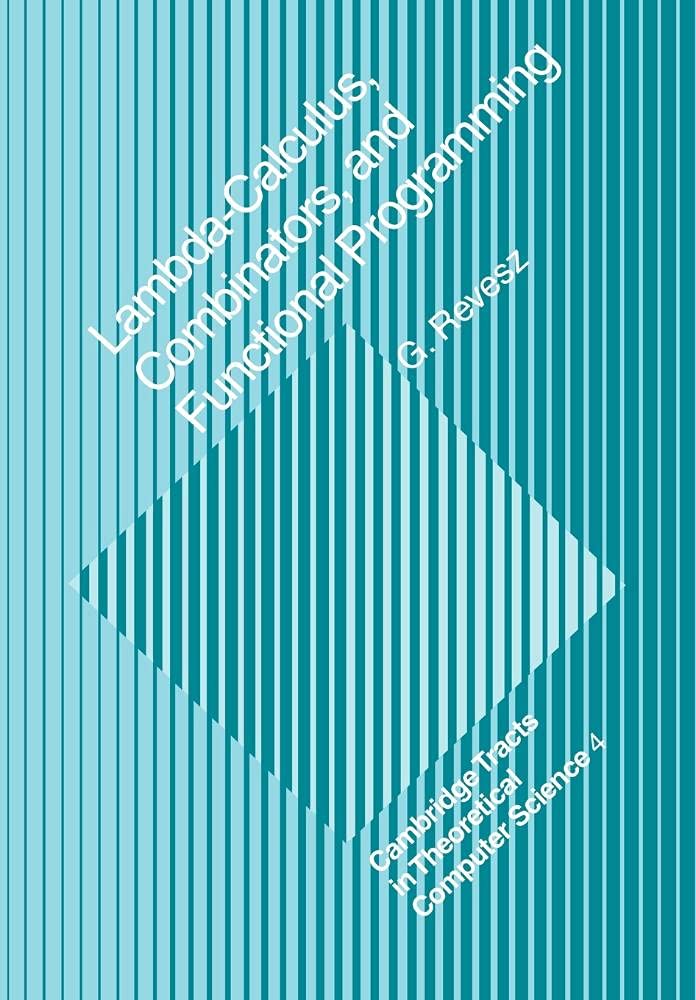
Lambda-calculus, Combinators and Functional Programming by G. E. Revesz – A Foundational Computer Science Textbook
Inclusive of all applicable taxes. FREE shipping on all orders.
Available Offers
- 🚚Free Delivery — Free shipping on all orders
- 💵Cash on Delivery — Pay when your order arrives
- ↩️15-Day Easy Returns — Hassle-free return policy
- 🔒Cash on Delivery — Pay safely when your order arrives
Check Delivery
Product Description
Introduction
For students and professionals navigating the theoretical foundations of computer science, few texts offer the clarity and depth of Lambda-calculus, Combinators and Functional Programming by G. E. Revesz. Published by Cambridge University Press, this hardcover edition is a definitive resource that bridges abstract mathematical concepts with practical programming paradigms. Whether you are a computer science student in an Indian university delving into functional languages or a researcher exploring the semantics of computation, this book provides a self-contained, rigorous yet accessible journey into the heart of lambda-calculus and combinatory logic.
Book Overview
Originally released in 1988, this work remains a timeless classic in the field. Revesz treats lambda-calculus not merely as a formal system but as a genuine functional language, demonstrating its direct relevance to modern programming. The book carefully avoids getting lost in peripheral mathematical details, focusing instead on the core ideas that underpin functional programming. It serves both as a primary textbook for a dedicated course on functional programming and as a supplementary guide for courses on programming language structure, implementation, theory of computation, or programming language semantics. The presentation is fully self-contained, assuming no prior specialized knowledge, making it ideal for Indian students transitioning from imperative to functional thinking.
Key Highlights
- Self-contained exposition — no prerequisite beyond basic mathematical maturity; all concepts are built from first principles.
- Lambda-calculus as a functional language — the book treats the subject as a practical tool, not just an abstract theory.
- Strong emphasis on combinators — a thorough exploration of combinatory logic and its relationship to lambda-calculus.
- Clear demonstration of applicability — shows how these theories directly influence functional programming languages like Haskell, ML, and Scheme.
- Rigorous yet accessible — balances formal definitions with intuitive explanations and examples.
- Enduring relevance — despite being decades old, the foundational concepts remain essential for understanding modern computing.
Inside the Book
The book systematically unfolds the universe of lambda-calculus. It begins with the basic syntax and reduction rules, gradually introducing the Church-Rosser theorem, normal forms, and the concept of computability. The middle sections delve into combinatory logic, presenting the famous SKI combinators and their equivalence to lambda-calculus. Later chapters explore fixed-point combinators, recursion, and the translation of functional programs into combinatory form. Each chapter includes carefully crafted exercises that reinforce learning, and the text is peppered with examples that illuminate abstract ideas. The final sections tie everything back to functional programming languages, showing how these theoretical constructs are implemented in real-world systems.
Key Topics
- Lambda-calculus syntax and reduction strategies (alpha, beta, eta conversion)
- Church numerals and representing data in lambda-calculus
- The Church-Rosser property and confluence
- Combinatory logic: S, K, I combinators and beyond
- Translation between lambda-calculus and combinators
- Fixed-point combinators and recursion
- Functional programming language semantics
- Implementation techniques for functional languages
Reader Benefits
By studying this book, readers gain a rock-solid foundation in the theoretical underpinnings of functional programming. This understanding translates directly into writing cleaner, more modular, and less error-prone code. The concepts of higher-order functions, immutable data, and referential transparency become second nature. For Indian students preparing for competitive exams or advanced studies, this book provides the theoretical depth required for topics like programming language theory, compiler design, and formal verification. Researchers will find the rigorous treatment invaluable for exploring new paradigms in computation. Moreover, the ability to think in terms of functions and composition enhances problem-solving skills across all areas of computer science.
Learning Outcomes
After completing this book, readers will be able to: define and manipulate lambda terms with confidence; understand and apply reduction strategies; prove basic properties of lambda-calculus using the Church-Rosser theorem; construct combinatory expressions and translate between lambda-calculus and combinators; implement recursion using fixed-point combinators; analyze the semantics of functional programming languages; and appreciate the deep connections between logic, computation, and programming. These outcomes prepare students for advanced coursework in type theory, proof assistants, and programming language design.
Who Should Read
This book is ideal for undergraduate and postgraduate computer science students in Indian universities who are taking courses on functional programming, programming languages, or theory of computation. It is also highly recommended for self-taught programmers who wish to deepen their understanding of functional paradigms beyond surface-level syntax. Researchers in theoretical computer science, logic, and semantics will find it a reliable reference. Additionally, instructors looking for a concise yet comprehensive textbook for a semester-long course on lambda-calculus and combinators will appreciate its structure and clarity.
About the Author
G. E. Revesz is a respected computer scientist known for his contributions to the theory of programming languages and formal systems. With a career spanning academia and research, Revesz has focused on making complex theoretical ideas accessible to students and practitioners. His writing style is precise yet engaging, reflecting a deep commitment to education. This book, in particular, showcases his ability to distill intricate concepts into a coherent and teachable form, earning it a place on the shelves of generations of computer scientists.
About the Publisher
Cambridge University Press is one of the world's oldest and most prestigious academic publishers, with a history dating back to 1534. Renowned for its rigorous editorial standards and commitment to scholarly excellence, Cambridge University Press publishes works that shape academic discourse globally. This hardcover edition of Revesz's book upholds that tradition, offering a durable, high-quality volume that will withstand years of study and reference. For Indian readers, a Cambridge University Press publication represents a guarantee of authenticity, accuracy, and intellectual depth.
Conclusion
Lambda-calculus, Combinators and Functional Programming is more than a textbook — it is a gateway to understanding the very essence of computation. For Indian students and professionals seeking to master functional programming and its theoretical foundations, this book is an indispensable companion. Its self-contained nature, clear exposition, and enduring relevance make it a worthy addition to any computer science library. Order your hardcover copy from Bookshops.in today and take a decisive step toward computational mastery.
Quick Summary
Lambda-calculus, Combinators and Functional Programming by G. E. Revesz is a classic textbook that offers a clear and self-contained introduction to the foundational theories of lambda-calculus and combinators. Unlike purely mathematical treatments, this book treats lambda-calculus as a functional language, making it directly relevant to computer science. It covers essential topics such as the Church-Rosser theorem, fixed-point combinator, reduction strategies, and substitution algorithms, all while demonstrating their application to functional programming. The book is ideal for computer science students and researchers who want a firm grounding in these theories, whether for a course on functional programming or as supplementary reading for programming languages, theory of computing, or semantics. Written by G. E. Revesz and published by Cambridge University Press, this hardcover edition is a durable resource for academic and professional libraries. By purchasing from Bookshops.in, Indian readers get fast delivery, genuine copies, and the assurance of a trusted national bookstore.
Book Highlights
Book Specifications
| ISBN-13 | 9780521114295 |
| ISBN-10 | 0521114292 |
| Publisher | Cambridge University Press |
| Language | English |
| Dimensions | 16.99 x 1.12 x 24.38 cm |
| Weight | 320 g |
| Country | India |
| Category | Software Design, Testing & Engineering › Software Architecture |
| Genre | Nonfiction |
| Original Language | English |
Frequently Asked Questions
What is this book about?
Who is the author?
Who should read this book?
Is this book suitable for beginners?
What topics are covered?
How is this book different from other lambda-calculus texts?
Does the book include exercises?
Is this book used in Indian universities?
What is the ISBN?
Is the book available in hardcover?
Can I use this book for self-study?
Does it cover combinatory logic?
What is the price in India?
How can I buy this book?
Readers Also Search For
Customers Also Bought

Programming
Algorithmische Sprache Und Programmentwicklung | by H. Partsch | F. L. Bauer | P. Pepper | Springer | by H. Partsch | F. L. Bauer | P. Pepper | Springer | by H. Partsch | F. L. Bauer | P. Pepper | Springer | by H. Partsch | F. L. Bauer | P. Pepper | Springer | by H. Partsch | F. L. Bauer | P. Pepper | Springer | by H. Partsch | F. L. Bauer | P. Pepper | Springer | by H. Partsch | F. L. Bauer | P. Pepper | Springer | by H. Partsch | F. L. Bauer | P. Pepper | Springer | by H. Partsch | F. L. Bauer
Programming
Distributed Algorithms | by Jean-Claude Bermond | Michel Raynal | Springer | by Jean-Claude Bermond | Michel Raynal | Springer | by Jean-Claude Bermond | Michel Raynal | Springer | by Jean-Claude Bermond | Michel Raynal | Springer | by Jean-Claude Bermond | Michel Raynal | Springer | by Jean-Claude Bermond | Michel Raynal | Springer | by Jean-Claude Bermond | Michel Raynal | Springer | by Jean-Claude Bermond | Michel Raynal | Springer | by Jean-Claude Bermond | Michel Raynal | Springer | by Jean
Programming
Meta-Level Control for Deductive Database Systems | by Helmut Schmidt | Springer | by Helmut Schmidt | Springer | by Helmut Schmidt | Springer | by Helmut Schmidt | Springer | by Helmut Schmidt | Springer | by Helmut Schmidt | Springer | by Helmut Schmidt | Springer | by Helmut Schmidt | Springer | by Helmut Schmidt | Springer | by Helmut Schmidt | Springer | by Helmut Schmidt | Springer | by Helmut Schmidt | Springer | by Helmut Schmidt | Springer | by Helmut Schmidt | Springer | by Helmut Schm
Programming
Java Web Services | by David A. Chappell | Tyler Jewell | O'Reilly Media | by David A. Chappell | Tyler Jewell | O'Reilly Media | by David A. Chappell | Tyler Jewell | O'Reilly Media | by David A. Chappell | Tyler Jewell | O'Reilly Media | by David A. Chappell | Tyler Jewell | O'Reilly Media | by David A. Chappell | Tyler Jewell | O'Reilly Media | by David A. Chappell | Tyler Jewell | O'Reilly Media | by David A. Chappell | Tyler Jewell | O'Reilly Media | by David A. Chappell | Tyler Jewell | O'
Programming
Database in Depth | by Chris J. Date | O'Reilly Media | by Chris J. Date | O'Reilly Media | by Chris J. Date | O'Reilly Media | by Chris J. Date | O'Reilly Media | by Chris J. Date | O'Reilly Media | by Chris J. Date | O'Reilly Media | by Chris J. Date | O'Reilly Media | by Chris J. Date | O'Reilly Media | by Chris J. Date | O'Reilly Media | by Chris J. Date | O'Reilly Media | by Chris J. Date | O'Reilly Media | by Chris J. Date | O'Reilly Media | by Chris J. Date | O'Reilly Media | by Chris J.
Programming
Integration of AI and OR Techniques in Constraint Programming for Combinatorial Optimization Problem | by Nicolas Beldiceanu | Narendra Jussien | Eric Pinson | Springer | by Nicolas Beldiceanu | Narendra Jussien | Eric Pinson | Springer | by Nicolas Beldiceanu | Narendra Jussien | Eric Pinson | Springer | by Nicolas Beldiceanu | Narendra Jussien | Eric Pinson | Springer | by Nicolas Beldiceanu | Narendra Jussien | Eric Pinson | Springer | by Nicolas Beldiceanu | Narendra Jussien | Eric Pinson |
Related Products
View All
Computers & Internet
Modern Full-Stack React Projects by Daniel Bugl
Computers & Internet
Mootools 1.2 Beginner's Guide (English, Jacob Gube)
Computers & Internet
Contemporary Methods for Speech Parameterization (Springerbriefs in Electrical and Computer Engineering / Springerbriefs in Speech Technology)

Computers & Internet
Information Technology and Lawyers | by Arno R. Lodder | Anja Oskamp | Springer | by Arno R. Lodder | Anja Oskamp | Springer | by Arno R. Lodder | Anja Oskamp | Springer | by Arno R. Lodder | Anja Oskamp | Springer | by Arno R. Lodder | Anja Oskamp | Springer | by Arno R. Lodder | Anja Oskamp | Springer | by Arno R. Lodder | Anja Oskamp | Springer | by Arno R. Lodder | Anja Oskamp | Springer | by Arno R. Lodder | Anja Oskamp | Springer | by Arno R. Lodder | Anja Oskamp | Springer | by Arno R. Lo

Computers & Internet
Digital Analysis of Remotely Sensed Imagery | by Jay Gao | McGraw-Hill Companies | by Jay Gao | McGraw-Hill Companies | by Jay Gao | McGraw-Hill Companies | by Jay Gao | McGraw-Hill Companies | by Jay Gao | McGraw-Hill Companies | by Jay Gao | McGraw-Hill Companies | by Jay Gao | McGraw-Hill Companies | by Jay Gao | McGraw-Hill Companies | by Jay Gao | McGraw-Hill Companies | by Jay Gao | McGraw-Hill Companies | by Jay Gao | McGraw-Hill Companies | by Jay Gao | McGraw-Hill Companies | by Jay Gao
Computers & Internet