
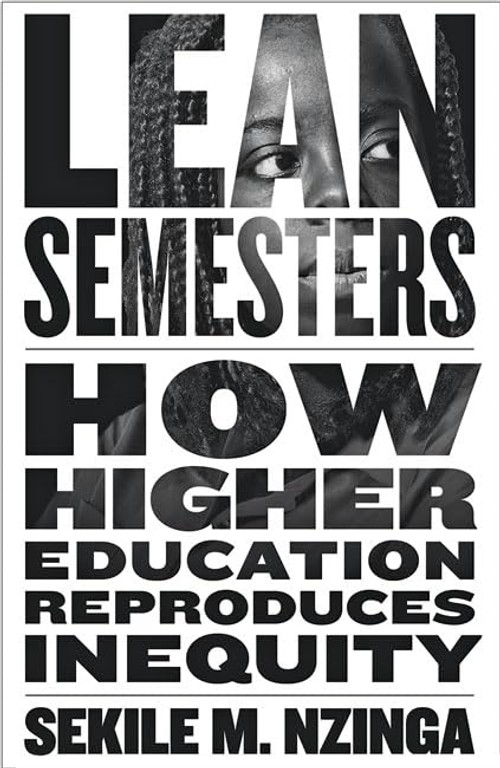
Lean Semesters: How Higher Education Reproduces Inequity by Sekile M. Nzinga – A Critical Examination of Race, Gender, a
Inclusive of all applicable taxes. FREE shipping on all orders.
Available Offers
- 🚚Free Delivery — Free shipping on all orders
- 💵Cash on Delivery — Pay when your order arrives
- ↩️15-Day Easy Returns — Hassle-free return policy
- 🔒Cash on Delivery — Pay safely when your order arrives
Check Delivery
Product Description
Introduction
In an era where higher education is often hailed as the great equalizer, Lean Semesters – How Higher Education Reproduces Inequity by Sekile M. Nzinga offers a powerful and necessary counter-narrative. This hard-hitting book, published by Johns Hopkins University Press, shines a stark light on the systemic inequalities that persist within the modern university system. For Indian students, scholars, and educators who are witnessing the rapid corporatisation of our own academic institutions, this book provides a critical framework to understand how privilege and disadvantage are perpetuated, not dismantled, within the hallowed halls of learning.
Book Overview
Lean Semesters is a deeply researched and passionately argued work that examines the lived experiences of women of colour, particularly Black women, within the neoliberal university. Sekile M. Nzinga draws on extensive interviews and data to reveal how the promise of academic advancement often conceals a reality of exploitation, debt, and disposability. The book argues that the university, rather than being a meritocratic space, actively reproduces social and economic inequity by underfunding graduate students of colour, hiring them disproportionately into precarious contingent faculty roles, and channelling them into undervalued disciplines. This is not just an American story—it resonates powerfully with the growing casualisation of academic labour and the rising debt burden faced by students in India and across the globe.
Key Highlights
- Rigorous Research: Based on interviews with dozens of Black women academics and extensive data analysis, the book offers evidence-based insights into systemic academic inequity.
- Timely Critique: Addresses the rise of the corporatised university and its impact on the most vulnerable scholars, a phenomenon increasingly visible in Indian higher education.
- Intersectional Lens: Examines how race, gender, and class intersect to create compounded exploitation for women of colour in academia.
- Actionable Framework: Provides a vocabulary and analytical tools to understand and challenge the structures that reproduce inequality.
- Authoritative Voice: Sekile M. Nzinga is a respected scholar and activist, bringing both academic rigour and personal insight to the subject.
Inside the Book
This hardcover volume takes readers on a compelling journey through the hidden curriculum of academic inequality. Nzinga unpacks how graduate funding disparities, the overreliance on adjunct labour, and the devaluation of certain disciplines create a system where Black women are systematically indebted and discarded. The book explores the emotional and material toll of navigating a system that promises opportunity while delivering precarity. Chapters delve into the politics of mentorship, the burden of service work, and the ways in which academic capitalism exploits the labour of women of colour. Each page challenges the myth of the level playing field, offering instead a nuanced understanding of how power operates within the university.
Key Topics
- Neoliberalism and the corporatisation of higher education
- Racial and gender inequality in academic funding and hiring
- The contingent faculty crisis and labour precarity
- Educational debt and its disproportionate impact on women of colour
- The devaluation of disciplines dominated by marginalised groups
- Mentorship, sponsorship, and institutional gatekeeping
- Resistance and strategies for survival within the academy
Reader Benefits
By reading Lean Semesters, you will gain a deeper understanding of the hidden mechanisms that shape academic careers and outcomes. The book equips you with critical insights to navigate your own academic journey more consciously, whether you are a student, a faculty member, or an administrator. It will help you recognise the structural barriers that exist beneath the surface of meritocratic rhetoric, and it provides a language to articulate these injustices. For those committed to building a more equitable educational landscape, this book is an indispensable resource that offers both diagnosis and direction.
Learning Outcomes
- Understand the concept of the neoliberal university and its impact on equity
- Identify the systemic factors that contribute to the exploitation of women of colour in academia
- Analyse the relationship between graduate funding, debt, and career trajectories
- Critique the myth of meritocracy in higher education
- Recognise the patterns of labour precarity and contingent employment in universities
- Develop a framework for advocating for structural change within academic institutions
Who Should Read
This book is essential reading for graduate students, early-career researchers, and faculty members who are questioning the disparities they witness or experience. It is equally valuable for university administrators, policymakers, and anyone involved in higher education reform. For Indian readers, particularly those in the social sciences, humanities, and education studies, the book offers a comparative lens to examine our own academic systems. Students of sociology, gender studies, critical race theory, and labour studies will find it a vital addition to their reading lists. Ultimately, anyone who believes in the transformative power of education and wants to understand why it so often falls short will find this book illuminating.
About the Author
Sekile M. Nzinga is a scholar, writer, and activist whose work focuses on the intersections of race, gender, and labour in higher education. She holds a PhD from the University of Illinois at Chicago and has extensive experience as a faculty member and administrator. Nzinga’s research has been published in leading academic journals, and she is a sought-after speaker on issues of equity and justice in academia. Her writing blends academic rigour with a passionate commitment to social change, making her a powerful voice in contemporary educational discourse.
About the Publisher
Johns Hopkins University Press is one of the oldest and most prestigious academic publishers in the United States. Founded in 1878, it has a long tradition of publishing groundbreaking scholarship across a wide range of disciplines. The press is known for its commitment to intellectual excellence and for bringing critical, often challenging, works to a global audience. With Lean Semesters, Johns Hopkins University Press continues its legacy of amplifying voices that interrogate power and inequality within the academy.
Conclusion
Lean Semesters – How Higher Education Reproduces Inequity is not just a book; it is a call to action. In an age where the promise of education is increasingly compromised by market forces, Sekile M. Nzinga’s work is a beacon of clarity and courage. For Indian readers who are navigating the complexities of a rapidly changing academic landscape, this book offers both a mirror and a map. It reflects uncomfortable truths about the systems we inhabit, and it maps out pathways toward a more just and equitable future. Add this essential hardcover to your library today and join the conversation about what higher education can—and should—become.
Quick Summary
Lean Semesters by Sekile M. Nzinga is a groundbreaking critical analysis of how the modern corporate university system systematically reproduces inequity for Black women. The book delves into the harsh realities faced by Black women in graduate school and academic careers, from funding disparities and contingent labour exploitation to crushing educational debt. Nzinga argues that the neoliberal university, far from being a meritocratic space, operates as a site of compounded exploitation along lines of race, gender, and class. Drawing on critical race theory, feminist scholarship, and personal narratives, the book exposes the structural barriers that persist even as more Black women earn advanced degrees. This work is essential for students, educators, researchers, and activists seeking to understand and challenge systemic injustice in higher education. By purchasing from Bookshops.in, Indian readers gain access to a premium hardcover edition that combines rigorous scholarship with urgent social critique, making it a vital addition to any academic or personal library.
Book Highlights
Book Specifications
| ISBN-13 | 9781421438764 |
| ISBN-10 | 1421438763 |
| Publisher | Johns Hopkins University Press |
| Language | English |
| Dimensions | 12.7 x 2.01 x 20.32 cm |
| Weight | 327 g |
| Category | Social Sciences › Gender Studies |
| Genre | Nonfiction |
| Reading Age | Adult |
| Original Language | English |
Frequently Asked Questions
What is Lean Semesters about?
Who is the author of Lean Semesters?
Is this book suitable for Indian readers?
What type of binding is this book?
What is the ISBN-13?
Is this a digital or print book?
Can I buy this book from Bookshops.in?
What makes this book different from other books on higher education?
Does the book include real stories?
What theoretical frameworks does the book use?
Who would benefit most from reading this book?
Is the book easy to read for non-academics?
What is the price in INR?
Readers Also Search For
Customers Also Bought

Sociology
Imagination Beyond Nation: Latin American Popular Culture: 349 (Pitt Latin American Series)

Sociology
Boomer Volunteer Engagement: Facilitator's Tool Kit

Sociology
Making a Success of Marriage: Planning for Happily Ever After

Sociology
Causal Mediation Analysis (Analytical Methods for Social Research)

Sociology
Marriage and the Moral Imagination (New Departures in Anthropology)

Sociology
Social Change, Resistance and Social Practices: 19 (Studies in Critical Social Sciences, 19)
Related Products
View All
Gender Studies
Century of Women: How Women Have Transformed the World since 1900
Gender Studies
Women As Sites of Culture: Women's Roles in Cultural Formation from the Renaissance to the 20th Century
Gender Studies
Tillie Olsen and the Dialectical Philosophy of Proletarian Literature
Gender Studies
Denied: Women, Sports, and the Contradictions of Identity
Gender Studies
Interrogating Harmful Cultural Practices (English, Chia Longman | Tamsin Bradley)
Gender Studies