
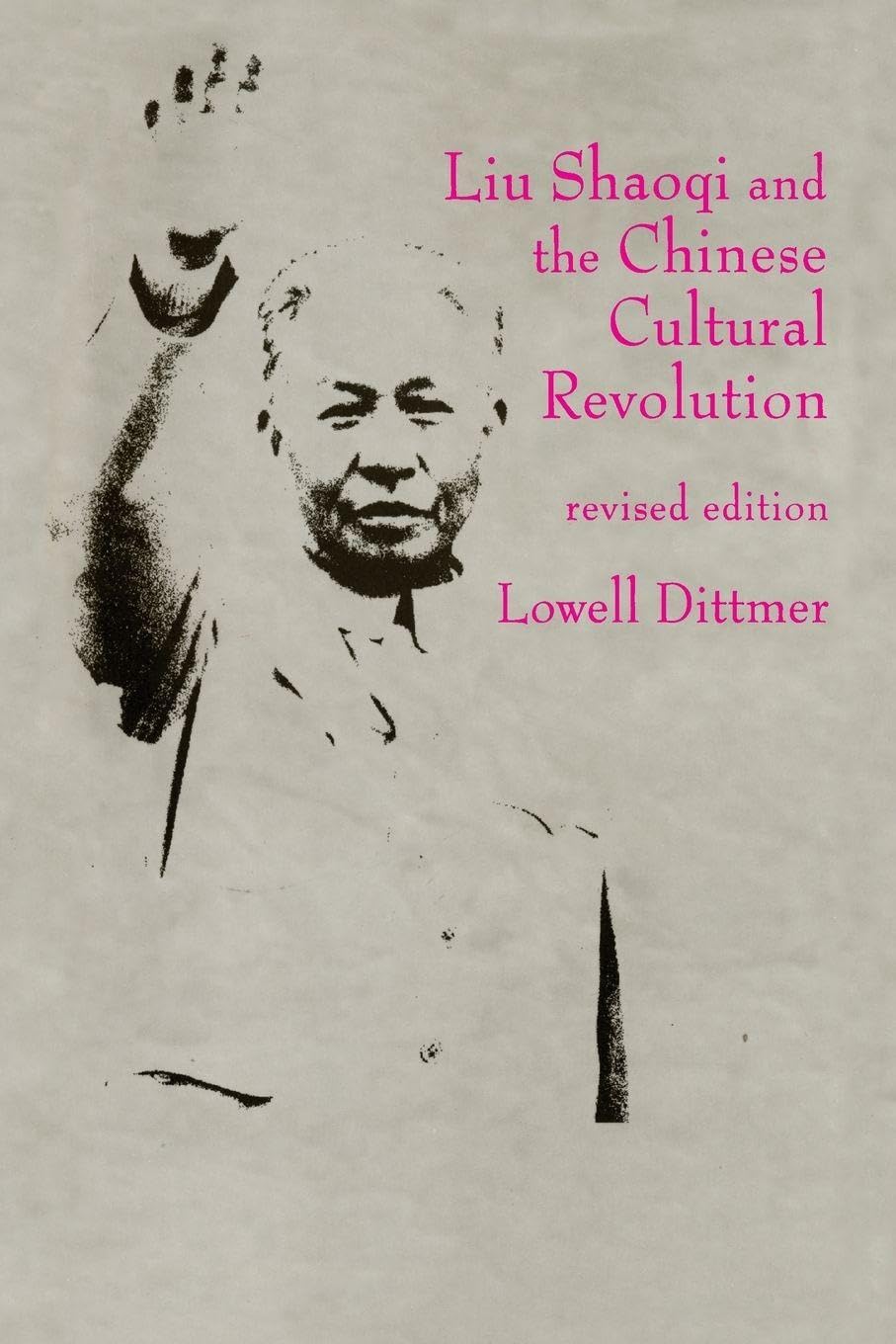
Liu Shaoqi and the Chinese Cultural Revolution: A Political Biography by Lowell Dittmer – Understanding China's Revoluti
Inclusive of all applicable taxes. FREE shipping on all orders.
Available Offers
- 🚚Free Delivery — Free shipping on all orders
- 💵Cash on Delivery — Pay when your order arrives
- ↩️15-Day Easy Returns — Hassle-free return policy
- 🔒Cash on Delivery — Pay safely when your order arrives
Check Delivery
Product Description
Introduction
In the turbulent landscape of modern Chinese history, few figures are as enigmatic and consequential as Liu Shaoqi. Lowell Dittmer’s definitive study, Liu Shaoqi and the Chinese Cultural Revolution, offers an incisive exploration of the political dynamics that shaped China’s revolutionary trajectory. This hardcover edition, published by Routledge, is an essential resource for students, scholars, and anyone seeking a deeper understanding of one of the most pivotal periods in twentieth-century Asia. Written for an English-speaking audience, the book bridges complex historical analysis with accessible narrative, making it a valuable addition to any academic or personal library in India.
Book Overview
This meticulously researched volume delves into the life and political fate of Liu Shaoqi, once a key leader of the Chinese Communist Party and a presumed successor to Mao Zedong. Dittmer examines how Liu’s pragmatic approach to economic modernization and state-building collided with the ideological fervour of the Cultural Revolution. The book does not merely recount events; it dissects the policy-making processes of a revolutionary state grappling with the challenges of development. By addressing the elite conflicts that erupted in the late 1960s, the work illuminates the broader struggle between revolutionary purity and the exigencies of governance. It is a story of ambition, ideology, and the human cost of political upheaval.
Key Highlights
- Original and rigorous analysis of Liu Shaoqi’s role in the Chinese Communist Party, based on extensive archival research and primary sources.
- Contextual depth that connects Liu’s personal trajectory to the larger themes of economic modernization and political development in post-1949 China.
- Critical examination of the Cultural Revolution’s impact on China’s monolithic elite, revealing the fractures within the leadership.
- Clear narrative structure that balances biographical detail with theoretical insights into revolutionary statecraft.
- Relevance to contemporary debates about governance, ideology, and reform in authoritarian systems.
Inside the Book
The book is organized into thematic chapters that trace Liu Shaoqi’s rise, his policy contributions, and his eventual downfall. Dittmer begins by situating Liu within the early revolutionary movement, then moves through his role in economic reconstruction during the Great Leap Forward’s aftermath. The heart of the work focuses on the Cultural Revolution’s eruption, where Liu became a central target of Maoist campaigns. The author uses a multidisciplinary approach, blending political science, history, and sociology to decode the motivations of key actors. Readers will find detailed discussions of factional struggles, the role of mass mobilization, and the institutional logic that led to Liu’s purge. The epilogue reflects on the legacy of Liu’s ideas in China’s later reforms.
Key Topics
- The rise and fall of Liu Shaoqi within the Chinese Communist Party hierarchy.
- The ideological and policy differences between Mao Zedong and Liu Shaoqi.
- The Cultural Revolution as a crisis of political legitimacy and elite cohesion.
- Economic modernization versus revolutionary idealism in state policy.
- The mechanics of political purges and mass campaigns in authoritarian regimes.
- Comparative perspectives on leadership succession and institutionalization.
Reader Benefits
This book offers Indian readers a rare window into the inner workings of China’s political system, a subject of immense geopolitical relevance. It helps decode the complexities of Chinese history without oversimplification. For students of political science, the case study of Liu Shaoqi provides timeless lessons on the tension between personal ambition and institutional loyalty. Historians will appreciate the meticulous sourcing, while general readers will be captivated by the dramatic narrative of a leader undone by the very forces he helped unleash. The book also encourages critical thinking about how revolutions evolve into bureaucracies—a theme resonant for any developing democracy.
Learning Outcomes
- Understand the key events and actors of the Chinese Cultural Revolution from a scholarly perspective.
- Analyze the relationship between ideology, policy, and power in a one-party state.
- Evaluate the challenges of economic modernization within a revolutionary framework.
- Grasp the nuances of elite politics and factionalism in authoritarian systems.
- Develop a comparative framework to study political leadership and succession crises.
Who Should Read
This book is ideal for postgraduate and undergraduate students of Chinese history, political science, and international relations. It is also highly recommended for faculty members teaching courses on modern Asia, comparative politics, or revolutionary movements. Journalists and policy analysts focusing on China will find the historical context invaluable. Additionally, any curious reader with an interest in biographies of political figures or the dark underbelly of ideological revolutions will be deeply engaged. The book assumes no prior expertise but rewards careful reading with profound insights.
About the Author
Lowell Dittmer is a distinguished professor of political science at the University of California, Berkeley, and a leading authority on Chinese politics. He has authored numerous works on East Asian affairs, including studies on political culture, leadership, and reform. Dittmer’s scholarship is known for its analytical rigour and balanced perspective, drawing on decades of research and fieldwork. His ability to synthesize complex historical data with theoretical frameworks makes him a trusted voice in the field. This book stands as a testament to his deep engagement with China’s political evolution.
About the Publisher
Routledge is a globally respected academic publisher, renowned for its extensive catalogue in the humanities and social sciences. With a legacy spanning over a century, Routledge is committed to disseminating high-quality scholarship that advances knowledge and understanding. Their titles are rigorously peer-reviewed and widely adopted in universities worldwide. For Indian readers, a Routledge publication guarantees credibility, accuracy, and intellectual depth. This hardcover edition is produced to the highest standards of durability and readability, suitable for both library collections and personal study.
Conclusion
Liu Shaoqi and the Chinese Cultural Revolution is more than a biography; it is a masterful inquiry into the nature of power, ideology, and modernization. Lowell Dittmer’s work remains a cornerstone for anyone seeking to comprehend China’s tumultuous journey through the twentieth century. For Indian students and scholars, this book offers not only historical knowledge but also a framework for understanding political change in complex societies. Add this essential volume to your collection from Bookshops.in and explore the depths of a revolution that reshaped the world.
Quick Summary
Liu Shaoqi and the Chinese Cultural Revolution by Lowell Dittmer is a seminal academic work that delves into the political turmoil of 1960s China, focusing on the rise and fall of Liu Shaoqi, once Mao Zedong's designated successor. The book illuminates how China's revolutionary state grappled with the conflicting demands of economic modernization and political ideology, ultimately leading to the decimation of its elite. Written for students and scholars of political science, history, and Asian studies, this volume offers a rigorous analysis of factionalism, policy-making, and the human cost of ideological purity. Readers will gain a nuanced understanding of the Cultural Revolution's origins, dynamics, and legacy. By purchasing from Bookshops.in, Indian readers receive a high-quality hardcover edition with trusted delivery and customer service, supporting a local bookstore that values academic excellence.
Book Highlights
Book Specifications
| ISBN-13 | 9781563249525 |
| ISBN-10 | 1563249529 |
| Publisher | M E Sharpe Inc |
| Language | English |
| Dimensions | 15.19 x 2.34 x 22.91 cm |
| Weight | 544 g |
| Category | Region & Countries › Asia |
| Genre | Non-fiction |
| Reading Age | Adult |
| Original Language | English |
Frequently Asked Questions
What is the main focus of this book?
Who is the author?
Is this book suitable for beginners?
What time period does the book cover?
Does the book discuss Mao Zedong?
Is this a biography or a historical analysis?
What makes this book unique?
Can Indian students benefit from this book?
Is the book available in hardcover?
What is the price?
Does the book include references?
Is this book used in university courses?
How does this book relate to India?
Readers Also Search For
Related Products
View All
History
The Information Revolution: Transforming the World Through Technology (World History)

History
Human Nature and the French Revolution: From the Enlightenment to the Napoleonic Code: 3 (Polygons: Cultural Diversities and Intersections, 3)
History
The Unmaking of Home in Contemporary Art (Cultural Spaces)

History
Handbook to Life in Medieval and Early Modern Japan | by William E. Deal | Oxford University Press | by William E. Deal | Oxford University Press | by William E. Deal | Oxford University Press | by William E. Deal | Oxford University Press | by William E. Deal | Oxford University Press | by William E. Deal | Oxford University Press | by William E. Deal | Oxford University Press | by William E. Deal | Oxford University Press | by William E. Deal | Oxford University Press | by William E. Deal | Ox

History
The Narrators of Barbarian History (A.D. 550-800) | by Walter Goffart | University of Notre Dame Press | by Walter Goffart | University of Notre Dame Press | by Walter Goffart | University of Notre Dame Press | by Walter Goffart | University of Notre Dame Press | by Walter Goffart | University of Notre Dame Press | by Walter Goffart | University of Notre Dame Press | by Walter Goffart | University of Notre Dame Press | by Walter Goffart | University of Notre Dame Press | by Walter Goffart | Univ

History