
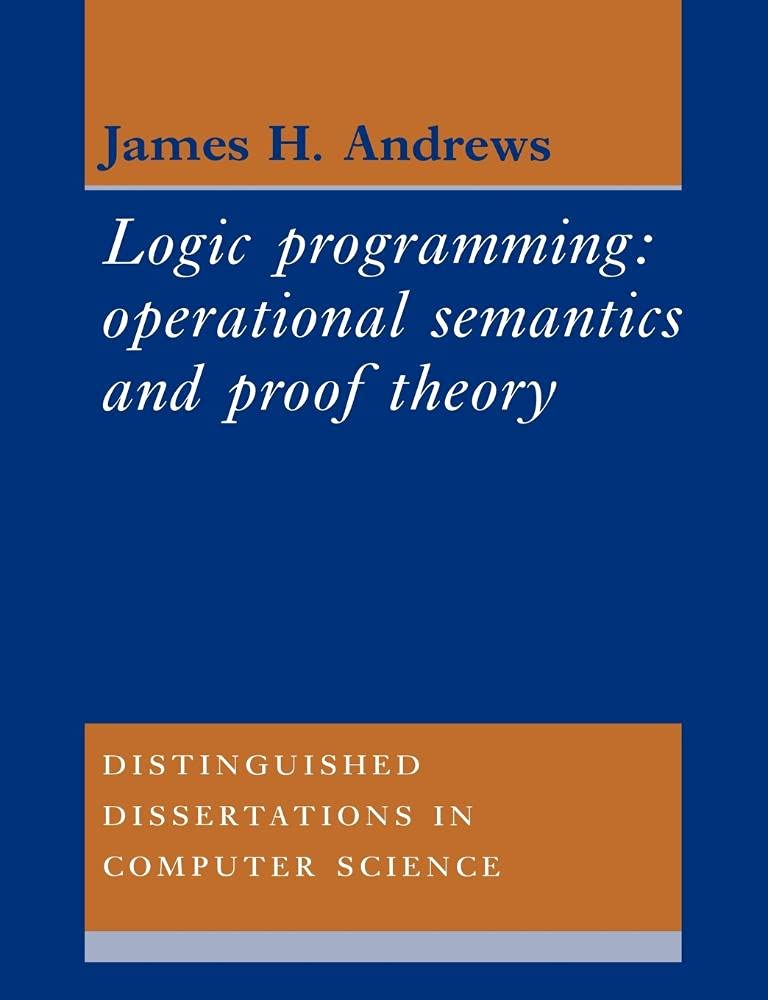
Logic Programming: Operational Semantics and Proof Theory by J. Andrews – A Comprehensive Guide to Depth-First and Bread
Inclusive of all applicable taxes. FREE shipping on all orders.
Available Offers
- 🚚Free Delivery — Free shipping on all orders
- 💵Cash on Delivery — Pay when your order arrives
- ↩️15-Day Easy Returns — Hassle-free return policy
- 🔒Cash on Delivery — Pay safely when your order arrives
Check Delivery
Product Description
Introduction
Logic programming has long stood at the intersection of theoretical computer science and practical software development, offering a unique paradigm where computation is driven by logical deduction rather than sequential instructions. In the Indian academic landscape, where computer science curricula increasingly emphasize formal methods and declarative programming, understanding the operational semantics and proof theory of logic programming languages becomes essential. J. Andrews' book, Logic Programming: Operational Semantics and Proof Theory, published by Cambridge University Press, provides a rigorous yet accessible treatment of this subject, bridging the gap between abstract theory and real-world implementation. This hardcover volume is an indispensable resource for researchers, postgraduate students, and professionals seeking to deepen their grasp of how logic programming languages actually work under the hood.
Book Overview
This book offers a homogeneous and systematic exploration of both the operational and logical semantics of logic programming languages, covering theoretical foundations as well as practical languages like Prolog. Dr Andrews addresses a critical issue that has long divided the logic programming community: the incompleteness introduced by depth-first search strategies used in most practical implementations. By precisely characterizing this incompleteness, the author shows how breadth-first search strategies can more faithfully reflect the underlying theory. The text is carefully structured to guide readers from basic concepts to advanced topics, making it suitable for both newcomers to the field and experienced researchers. The book's unique contribution lies in its unified framework that connects proof theory, model theory, and computational behaviour, offering insights that are not available in any other single volume.
Key Highlights
- Bridging Theory and Practice: Provides a clear characterization of how depth-first search in practical languages leads to incompleteness, and how breadth-first search aligns more closely with logical semantics.
- Comprehensive Semantics: Covers both operational semantics (how programs execute) and logical semantics (what programs mean) in a cohesive manner.
- Rigorous Mathematical Foundation: Develops proof-theoretic concepts such as SLD-resolution, fixpoint semantics, and Herbrand models with precision.
- Practical Relevance: Includes discussions on search strategies, backtracking, and control mechanisms that directly impact real-world logic programming.
- Unique Insights: Presents original ideas on the relationship between search order and logical completeness, making it a valuable reference for AI researchers.
Inside the Book
The book is organized into well-structured chapters that build upon each other. It begins with an introduction to logic programming and its theoretical underpinnings, then moves into operational semantics, covering SLD-resolution and the role of unification. Subsequent chapters delve into proof theory, exploring the connection between logical deduction and computation. The author dedicates significant attention to the analysis of search strategies, comparing depth-first and breadth-first approaches, and their impact on completeness. Later chapters address advanced topics such as negation, constraint logic programming, and the integration of meta-programming. Each chapter includes carefully chosen examples and exercises that reinforce learning, making it suitable for both self-study and classroom use.
Key Topics
- Foundations of logic programming and Horn clause logic
- SLD-resolution and its variants
- Operational semantics for logic programming languages
- Proof theory and logical consequence
- Depth-first versus breadth-first search strategies
- Completeness and incompleteness results
- Herbrand interpretations and models
- Fixpoint semantics and least model semantics
- Negation as failure and stratified programs
- Constraint logic programming and its semantics
- Meta-programming and reflective architectures
- Applications in artificial intelligence and knowledge representation
Reader Benefits
By studying this book, readers will gain a deep understanding of how logic programming languages actually compute, moving beyond surface-level syntax to the underlying semantics. They will learn to critically evaluate the trade-offs between different search strategies, enabling them to write more efficient and logically sound programs. The book equips readers with the theoretical tools needed to design new logic programming languages or extend existing ones. For Indian students preparing for competitive exams or research careers, the rigorous treatment of proof theory and model theory provides a strong foundation in formal methods. Practitioners working on AI systems, expert systems, or natural language processing will find the analysis of search strategies directly applicable to improving their systems' performance and correctness.
Learning Outcomes
- Understand the operational semantics of logic programming languages, including SLD-resolution and unification.
- Analyze the completeness properties of different search strategies and their implications for program correctness.
- Apply proof-theoretic concepts to reason about logic programs and their behaviour.
- Compare and contrast depth-first and breadth-first search in terms of efficiency and logical soundness.
- Construct formal models of logic programs using Herbrand interpretations and fixpoint theory.
- Evaluate the impact of negation and constraints on program semantics.
- Develop a theoretical perspective that bridges the gap between logic programming theory and practice.
- Design logic programs with a clear understanding of how control flow affects logical completeness.
Who Should Read
This book is primarily intended for researchers and postgraduate students in computer science, particularly those specializing in logic programming, formal semantics, artificial intelligence, or theoretical computer science. It is also highly suitable for advanced undergraduate students who have completed introductory courses in logic or programming languages. Indian faculty members teaching courses on logic programming, declarative languages, or knowledge representation will find it an excellent reference and textbook. Practitioners working on AI search algorithms, theorem provers, or knowledge-based systems will benefit from the deep insights into search strategy and completeness. Additionally, anyone interested in the philosophical foundations of computation, where logic meets programming, will find this book a rewarding read.
About the Author
J. Andrews is a distinguished researcher in the field of logic programming and theoretical computer science. With a career spanning several decades, Dr Andrews has made significant contributions to the understanding of operational semantics and proof theory for logic programming languages. His work is known for its clarity, rigour, and ability to connect abstract theoretical concepts with practical implementation concerns. This book represents the culmination of his extensive research and teaching experience, offering a perspective that is both authoritative and accessible. Dr Andrews' insights into the incompleteness of depth-first search have influenced subsequent work in AI search strategies and logic programming language design.
About the Publisher
Cambridge University Press is one of the world's oldest and most prestigious academic publishers, with a history dating back to 1534. Known for its rigorous editorial standards and commitment to scholarly excellence, Cambridge University Press publishes works that shape academic discourse across disciplines. This book is part of their distinguished series on computer science and artificial intelligence, reflecting the press's dedication to advancing knowledge in cutting-edge fields. For Indian readers, a Cambridge University Press publication carries a mark of quality and reliability, ensuring that the content has been peer-reviewed and edited to the highest standards.
Conclusion
Logic Programming: Operational Semantics and Proof Theory by J. Andrews is a seminal work that every serious student or researcher of logic programming should own. It not only clarifies the theoretical foundations but also provides practical insights that can improve the way logic programs are designed and executed. In an era where AI and formal methods are gaining prominence in Indian academia and industry, this book offers a timeless foundation. Whether you are a student grappling with the nuances of SLD-resolution or a researcher exploring new search strategies, this hardcover volume will serve as a trusted companion. Add it to your library today and deepen your understanding of one of computer science's most elegant paradigms.
Quick Summary
Logic Programming: Operational Semantics and Proof Theory by J. Andrews is a seminal academic work that provides a unified and rigorous treatment of the semantics—both operational and logical—of logic programming languages. The book addresses a critical gap between theoretical logic programming and its practical implementations, specifically focusing on the search strategies used to find solutions. Andrews precisely characterizes how depth-first search, the common strategy in languages like Prolog, is incomplete, and contrasts it with breadth-first search, which more faithfully reflects the logical foundations. This makes the book invaluable for researchers in logic programming, formal semantics, and artificial intelligence search strategies. Readers will gain deep insights into resolution, unification, model theory, and proof theory, all presented in a clear, formal style. Published by Cambridge University Press, this hardcover edition is a durable reference for graduate students and professionals. By purchasing from Bookshops.in, Indian customers receive a genuine copy with prompt service, supporting local bookstores while accessing world-class academic content.
Book Highlights
Book Specifications
| ISBN-13 | 9780521607544 |
| ISBN-10 | 052160754X |
| Publisher | Cambridge University Press |
| Language | English |
| Dimensions | 18.9 x 0.71 x 24.61 cm |
| Weight | 230 g |
| Country | India |
| Category | Software Design, Testing & Engineering › Object-Oriented Design |
| Genre | Non-fiction |
| Reading Age | Adult |
| Original Language | English |
Frequently Asked Questions
What is the main focus of this book?
Who is the author of Logic Programming: Operational Semantics and Proof Theory?
Is this book suitable for beginners in logic programming?
What makes this book different from other logic programming texts?
Does the book cover practical languages like Prolog?
What is the ISBN-13 of this book?
Is this book available in paperback?
Can this book help with AI search strategies?
What is the price of this book in India?
Is the book written in English?
Who is the publisher of this book?
Does the book include exercises or problems?
Why should I buy this book from Bookshops.in?
Readers Also Search For
Customers Also Bought

Programming
Algorithmische Sprache Und Programmentwicklung | by H. Partsch | F. L. Bauer | P. Pepper | Springer | by H. Partsch | F. L. Bauer | P. Pepper | Springer | by H. Partsch | F. L. Bauer | P. Pepper | Springer | by H. Partsch | F. L. Bauer | P. Pepper | Springer | by H. Partsch | F. L. Bauer | P. Pepper | Springer | by H. Partsch | F. L. Bauer | P. Pepper | Springer | by H. Partsch | F. L. Bauer | P. Pepper | Springer | by H. Partsch | F. L. Bauer | P. Pepper | Springer | by H. Partsch | F. L. Bauer
Programming
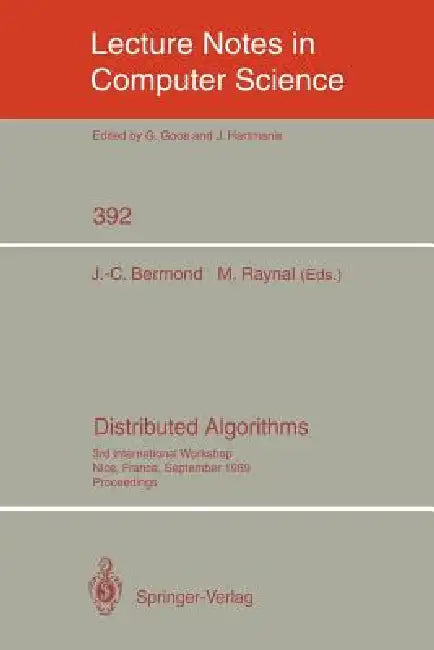
Distributed Algorithms | by Jean-Claude Bermond | Michel Raynal | Springer | by Jean-Claude Bermond | Michel Raynal | Springer | by Jean-Claude Bermond | Michel Raynal | Springer | by Jean-Claude Bermond | Michel Raynal | Springer | by Jean-Claude Bermond | Michel Raynal | Springer | by Jean-Claude Bermond | Michel Raynal | Springer | by Jean-Claude Bermond | Michel Raynal | Springer | by Jean-Claude Bermond | Michel Raynal | Springer | by Jean-Claude Bermond | Michel Raynal | Springer | by Jean
Programming
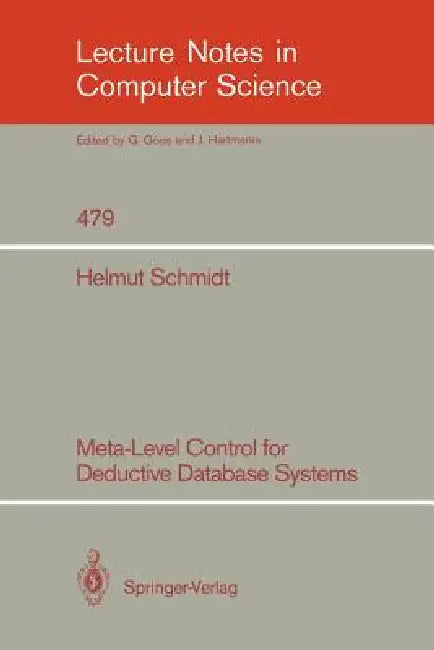
Meta-Level Control for Deductive Database Systems | by Helmut Schmidt | Springer | by Helmut Schmidt | Springer | by Helmut Schmidt | Springer | by Helmut Schmidt | Springer | by Helmut Schmidt | Springer | by Helmut Schmidt | Springer | by Helmut Schmidt | Springer | by Helmut Schmidt | Springer | by Helmut Schmidt | Springer | by Helmut Schmidt | Springer | by Helmut Schmidt | Springer | by Helmut Schmidt | Springer | by Helmut Schmidt | Springer | by Helmut Schmidt | Springer | by Helmut Schm
Programming
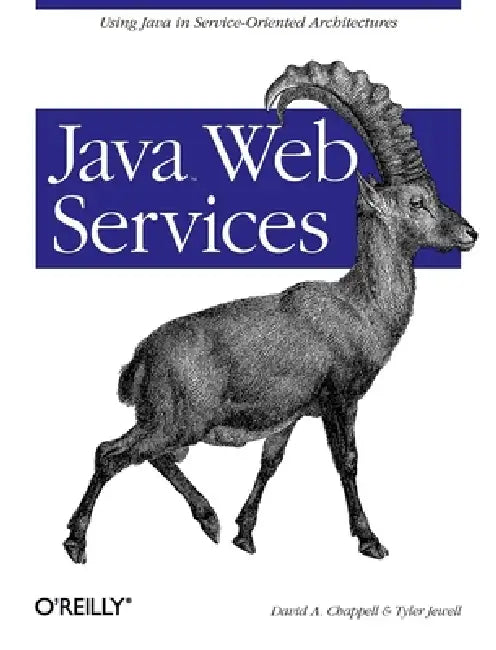
Java Web Services | by David A. Chappell | Tyler Jewell | O'Reilly Media | by David A. Chappell | Tyler Jewell | O'Reilly Media | by David A. Chappell | Tyler Jewell | O'Reilly Media | by David A. Chappell | Tyler Jewell | O'Reilly Media | by David A. Chappell | Tyler Jewell | O'Reilly Media | by David A. Chappell | Tyler Jewell | O'Reilly Media | by David A. Chappell | Tyler Jewell | O'Reilly Media | by David A. Chappell | Tyler Jewell | O'Reilly Media | by David A. Chappell | Tyler Jewell | O'
Programming
Database in Depth | by Chris J. Date | O'Reilly Media | by Chris J. Date | O'Reilly Media | by Chris J. Date | O'Reilly Media | by Chris J. Date | O'Reilly Media | by Chris J. Date | O'Reilly Media | by Chris J. Date | O'Reilly Media | by Chris J. Date | O'Reilly Media | by Chris J. Date | O'Reilly Media | by Chris J. Date | O'Reilly Media | by Chris J. Date | O'Reilly Media | by Chris J. Date | O'Reilly Media | by Chris J. Date | O'Reilly Media | by Chris J. Date | O'Reilly Media | by Chris J.
Programming
Integration of AI and OR Techniques in Constraint Programming for Combinatorial Optimization Problem | by Nicolas Beldiceanu | Narendra Jussien | Eric Pinson | Springer | by Nicolas Beldiceanu | Narendra Jussien | Eric Pinson | Springer | by Nicolas Beldiceanu | Narendra Jussien | Eric Pinson | Springer | by Nicolas Beldiceanu | Narendra Jussien | Eric Pinson | Springer | by Nicolas Beldiceanu | Narendra Jussien | Eric Pinson | Springer | by Nicolas Beldiceanu | Narendra Jussien | Eric Pinson |
Related Products
View All
Computers & Internet
Modern Full-Stack React Projects by Daniel Bugl
Computers & Internet
Mootools 1.2 Beginner's Guide (English, Jacob Gube)
Computers & Internet
Contemporary Methods for Speech Parameterization (Springerbriefs in Electrical and Computer Engineering / Springerbriefs in Speech Technology)

Computers & Internet
Information Technology and Lawyers | by Arno R. Lodder | Anja Oskamp | Springer | by Arno R. Lodder | Anja Oskamp | Springer | by Arno R. Lodder | Anja Oskamp | Springer | by Arno R. Lodder | Anja Oskamp | Springer | by Arno R. Lodder | Anja Oskamp | Springer | by Arno R. Lodder | Anja Oskamp | Springer | by Arno R. Lodder | Anja Oskamp | Springer | by Arno R. Lodder | Anja Oskamp | Springer | by Arno R. Lodder | Anja Oskamp | Springer | by Arno R. Lodder | Anja Oskamp | Springer | by Arno R. Lo

Computers & Internet
Digital Analysis of Remotely Sensed Imagery | by Jay Gao | McGraw-Hill Companies | by Jay Gao | McGraw-Hill Companies | by Jay Gao | McGraw-Hill Companies | by Jay Gao | McGraw-Hill Companies | by Jay Gao | McGraw-Hill Companies | by Jay Gao | McGraw-Hill Companies | by Jay Gao | McGraw-Hill Companies | by Jay Gao | McGraw-Hill Companies | by Jay Gao | McGraw-Hill Companies | by Jay Gao | McGraw-Hill Companies | by Jay Gao | McGraw-Hill Companies | by Jay Gao | McGraw-Hill Companies | by Jay Gao
Computers & Internet