
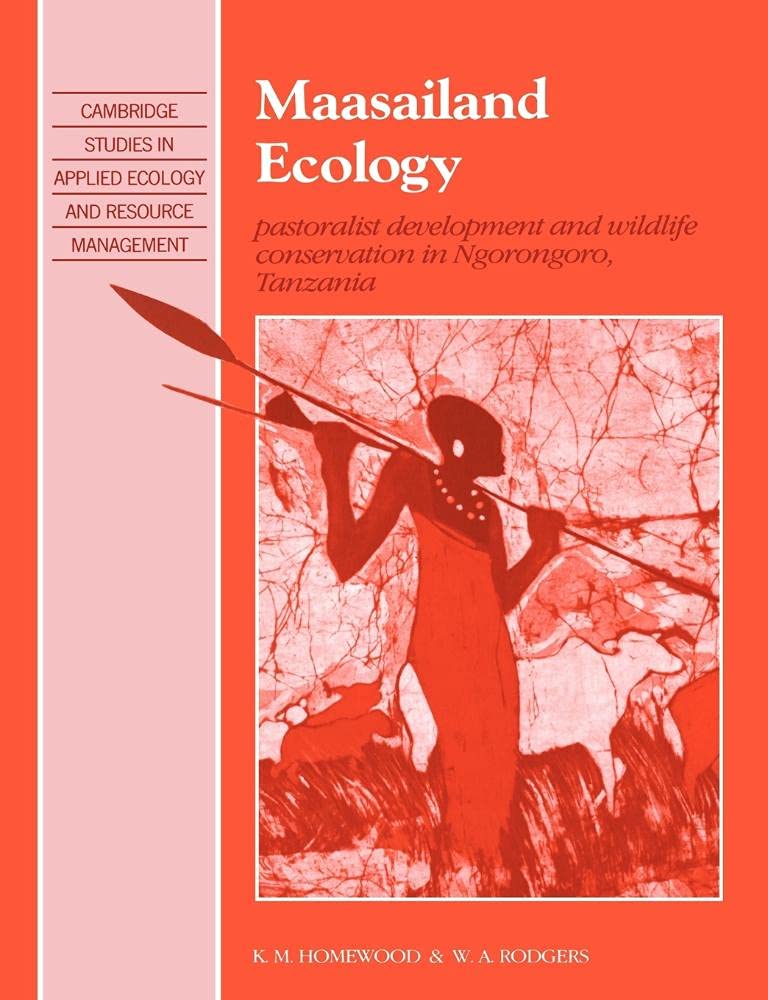
Maasailand Ecology: Pastoralist Development and Wildlife Conservation in Ngorongoro, Tanzania by K. M. Homewood – A Camb
Inclusive of all applicable taxes. FREE shipping on all orders.
Available Offers
- 🚚Free Delivery — Free shipping on all orders
- 💵Cash on Delivery — Pay when your order arrives
- ↩️15-Day Easy Returns — Hassle-free return policy
- 🔒Cash on Delivery — Pay safely when your order arrives
Check Delivery
Product Description
Introduction
In the heart of East Africa, the Ngorongoro Conservation Area stands as a living laboratory where millennia-old pastoral traditions meet the urgent demands of modern wildlife preservation. Maasailand Ecology: Pastoralist Development and Wildlife Conservation in Ngorongoro, Tanzania by K. M. Homewood is a seminal work that unravels the complex interplay between Maasai herders, their livestock, and the iconic savanna fauna that shares this fragile landscape. Published by Cambridge University Press, this hardcover volume offers a rigorous, field-based analysis that is as relevant for Indian ecologists and conservation students as it is for global environmental practitioners.
Book Overview
This book is not merely a field study—it is a comprehensive synthesis of African rangeland ecology, pastoralist livelihoods, and wildlife management. Centered on the Ngorongoro Maasai and their herds, the text integrates decades of ecological data to challenge popular narratives about land degradation and human-wildlife conflict. Homewood presents a nuanced argument that sustainable development in Maasailand requires balancing the needs of pastoralist communities with the imperatives of biodiversity conservation. The hardcover edition is meticulously organized, blending quantitative research with ethnographic insight to provide a holistic understanding of one of the world's most iconic conservation areas.
Key Highlights
- Interdisciplinary Approach: Combines ecology, anthropology, and development studies to offer a multi-dimensional view of conservation challenges.
- Field-Based Evidence: Draws on years of primary research with Maasai pastoralists, including detailed livestock and wildlife census data.
- Global Relevance: The management dilemmas of Ngorongoro mirror conflicts in Indian protected areas like the Western Ghats and the Sundarbans.
- Critical Analysis: Debunks myths about overgrazing and desertification, presenting ecological facts that challenge conventional wisdom.
- Practical Solutions: Proposes actionable management strategies that respect both indigenous knowledge and scientific conservation.
Inside the Book
Readers will find a thorough examination of the Ngorongoro ecosystem, from soil chemistry and vegetation dynamics to the migratory patterns of wildebeest and zebra. The book delves into the historical and political context of land use, examining how colonial policies and post-independence legislation have shaped current tensions. Detailed chapters cover livestock husbandry, wildlife population trends, and the socio-economic realities of Maasai households. The narrative is enriched with maps, graphs, and tables that make complex ecological data accessible. Homewood does not shy away from controversy, tackling issues such as eviction of pastoralists from conservation areas and the ethics of fortress conservation.
Key Topics
- Pastoralist ecology and traditional land management in East Africa
- Wildlife conservation strategies in human-dominated landscapes
- Rangeland dynamics: grazing pressure, fire regimes, and biodiversity
- Human-wildlife conflict mitigation and community-based conservation
- Policy analysis of the Ngorongoro Conservation Area management
- Climate change impacts on savanna ecosystems and pastoral livelihoods
Reader Benefits
This book empowers readers with a deep, evidence-based understanding of one of the most contentious debates in conservation science. For Indian students of ecology and environmental studies, it offers comparative insights into similar challenges faced by tribal communities in protected areas. Professionals working in wildlife management will gain practical frameworks for designing participatory conservation programs. The text also serves as a valuable resource for development practitioners seeking to understand the intersection of indigenous rights and ecological sustainability. By the end, readers will be equipped to critically evaluate conservation policies and advocate for inclusive, science-driven solutions.
Learning Outcomes
- Analyze the ecological and social factors that influence pastoralist land-use systems.
- Evaluate the effectiveness of different conservation models in African savannas.
- Understand the methodological approaches used in interdisciplinary field ecology.
- Critically assess the role of traditional knowledge in modern wildlife management.
- Develop informed perspectives on the trade-offs between development and conservation.
Who Should Read
This book is indispensable for postgraduate students and researchers in ecology, conservation biology, and environmental science. It is equally valuable for wildlife managers, park authorities, and NGO professionals working in human-wildlife conflict zones. Indian readers with an interest in pastoralist societies—such as the Gujjars, Bakarwals, or Rabaris—will find striking parallels. Additionally, policy makers and rural development planners seeking evidence-based approaches to sustainable land use will benefit from its rigorous analysis.
About the Author
K. M. Homewood is a distinguished ecologist and anthropologist with decades of field experience in East Africa. Her research has focused on the ecology of pastoralist systems and the conservation of African savannas. She has published extensively in peer-reviewed journals and has been a leading voice in advocating for community-based conservation. Homewood’s work combines scientific rigor with deep respect for indigenous knowledge, making her a trusted authority in the field of rangeland ecology.
About the Publisher
Cambridge University Press is one of the world’s oldest and most prestigious academic publishers. Known for its commitment to scholarly excellence, Cambridge publishes works that shape the frontiers of science, humanities, and social sciences. This hardcover edition reflects the Press’s dedication to producing authoritative, high-quality resources for researchers, educators, and students worldwide.
Conclusion
Maasailand Ecology is a landmark contribution to the literature on conservation and development. It moves beyond simplistic binaries of people versus wildlife to present a nuanced, data-driven narrative that respects the complexity of real-world ecosystems. For anyone serious about understanding how to balance human livelihoods with biodiversity preservation, this book is an essential addition to their library. Order your copy from Bookshops.in today and gain a deeper appreciation for the ecological heritage of Maasailand.
Quick Summary
Maasailand Ecology by K. M. Homewood is a comprehensive study of pastoralist development and wildlife conservation in the Ngorongoro Conservation Area, one of the world's most important heritage sites. The book synthesizes field research on Maasai herds and local ecology with broader debates in African savanna management. It addresses perceived problems such as overgrazing and wildlife decline, offering evidence-based insights and practical solutions. Ideal for ecology students, conservation professionals, and researchers, this Cambridge University Press title provides a balanced, interdisciplinary perspective. Readers will learn about rangeland dynamics, human-wildlife coexistence, and sustainable land use. By purchasing from Bookshops.in, Indian readers receive a high-quality print edition with reliable delivery and customer support.
Book Highlights
Book Specifications
| ISBN-13 | 9780521607490 |
| ISBN-10 | 0521607493 |
| Publisher | Cambridge University Press |
| Language | English |
| Dimensions | 18.9 x 1.85 x 24.61 cm |
| Weight | 596 g |
| Country | India |
| Category | Biology & Life Sciences › Biology |
| Genre | Non-fiction |
| Reading Age | Adult |
| Original Language | English |
Frequently Asked Questions
What is Maasailand Ecology about?
Who is the author of Maasailand Ecology?
Is this book suitable for students?
Does the book include field research data?
What is the main theme of the book?
Which publisher released this book?
Is the book focused only on Tanzania?
Does it cover human-wildlife conflict?
What is the Ngorongoro Conservation Area?
Is this book technical or accessible?
Can I use this book for my research?
What language is the book in?
Does it include maps or illustrations?
Is the book still relevant today?
Where can I buy Maasailand Ecology in India?
Readers Also Search For
Customers Also Bought

Mathematics
Stereotype Spaces and Algebras: 73 (De Gruyter Expositions in Mathematics, 73)

Mathematics
Semigroups in Algebra, Geometry and Analysis: 20 (De Gruyter Expositions in Mathematics, 20)

Mathematics
Geometry from the Pacific Rim: Proceedings of the Pacific Rim Geometry Conference held at National University of Singapore, Republic of Singapore, ... 1994 (De Gruyter Proceedings in Mathematics)

Mathematics
First International Tainan-Moscow Algebra Workshop: Proceedings of the International Conference held at National Cheng Kung University Tainan, Taiwan, ... 1994 (De Gruyter Proceedings in Mathematics)

Mathematics
Differential Geometry - Proceedings of the VIII International Colloquium (English, Jesus A. Alvarez Lopez | Eduardo Garcia-Rio)

Mathematics
Mathematical Theory of Optimal Processes (Classics of Soviet Mathematics)
Related Products
View All
Biology
Evolution: What the Fossils Say and Why It Matters by Donald R. Prothero
Biology
From Taxonomy to Phylogenetics – Life and Work of Willi Hennig

Biology
The Marine Biology of the South China Sea
Biology
Genetics Meets Metabolomics: from Experiment to Systems Biology
Biology
The Elements of Natural or Experimental Philosophy: 2
Biology