
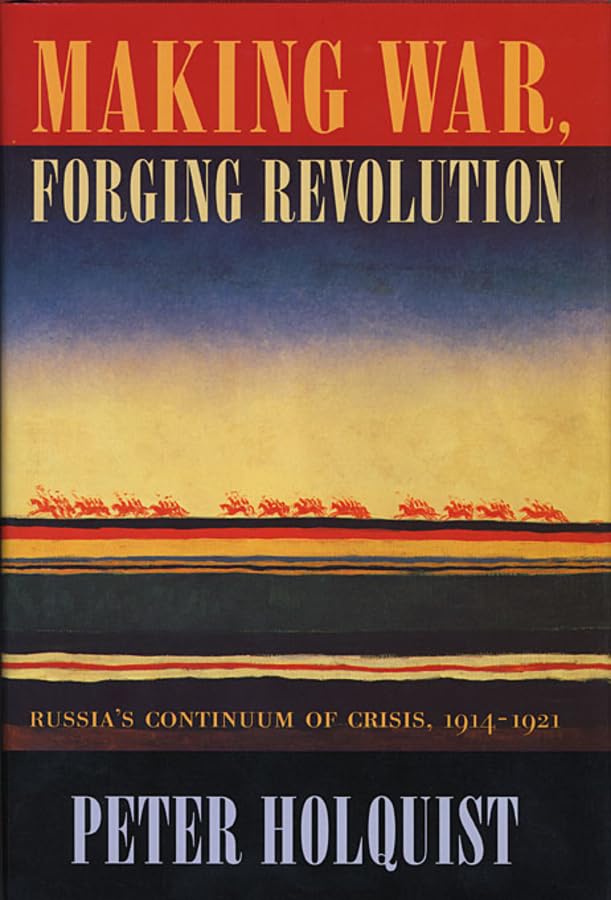
Making War, Forging Revolution: Russia's Continuum of Crisis, 1914-1921 by Peter Holquist – A Scholarly Analysis of Sovi
Inclusive of all applicable taxes. FREE shipping on all orders.
Available Offers
- 🚚Free Delivery — Free shipping on all orders
- 💵Cash on Delivery — Pay when your order arrives
- ↩️15-Day Easy Returns — Hassle-free return policy
- 🔒Cash on Delivery — Pay safely when your order arrives
Check Delivery
Product Description
Introduction
In the vast landscape of historical scholarship on the Russian Revolution, few works manage to bridge the gap between the cataclysmic events of World War I and the brutal consolidation of Soviet power as seamlessly as Peter Holquist’s Making War, Forging Revolution: Russia's Continuum of Crisis, 1914-1921. Published by Harvard University Press, this hardbound volume offers a fresh, deeply researched perspective that challenges conventional narratives. For Indian readers and students of modern history, this book is an essential guide to understanding how war, revolution, and state-building are inextricably linked—a theme that resonates well beyond Russia’s borders.
Book Overview
Holquist’s work repositions the Bolshevik Revolution not as a sudden rupture with the past, but as a critical phase within a broader, continent-wide crisis that began with the outbreak of the First World War. The author meticulously traces how both Tsarist and Soviet regimes adopted and intensified practices of total mobilization, surveillance, and violence that were common among European powers during wartime. By examining the period from 1914 to 1921 as a single continuum, the book reveals how emergency measures became permanent fixtures in political life, shaping the very DNA of the Soviet state. This is not merely a study of political upheaval; it is a profound analysis of how societies transform under the pressures of protracted conflict.
Key Highlights
- Continuum of Crisis: The book’s central thesis—that the Russian Revolution cannot be understood in isolation from World War I and the subsequent civil war—offers a unified framework for studying this turbulent era.
- Comparative Approach: Holquist situates Russian practices within the context of European wartime measures, showing that Bolshevik policies were often radicalized versions of common wartime statecraft.
- Genealogy of Bolshevik Practices: Instead of viewing Soviet policies as entirely novel, the author traces their origins to Tsarist and European precedents, providing a nuanced genealogy of political violence and mobilization.
- Supercharged Context: The book highlights how Russia’s unique social, economic, and political conditions—such as a weak civil society and deep class divisions—amplified the impact of wartime measures, leading to a more extreme outcome.
Inside the Book
Structured around the evolving relationship between state and society, Making War, Forging Revolution delves into specific policies such as food requisitioning, propaganda, and the use of terror as tools of governance. Holquist draws on a wealth of archival sources to illustrate how ordinary citizens experienced and resisted these measures. The narrative moves fluidly from the battlefields of the Eastern Front to the streets of Petrograd, and from the offices of Tsarist bureaucrats to the meeting rooms of the Bolshevik Central Committee. Each chapter builds a compelling case for seeing the entire period as a single, traumatic process of state-building through crisis management.
Key Topics
- Total mobilization and the militarization of daily life
- The role of violence in revolutionary state formation
- Continuities between Tsarist and Soviet administrative practices
- Food supply policies and their social consequences
- Propaganda, surveillance, and the control of information
- The civil war as a laboratory for future Soviet governance
- International dimensions of the Russian crisis, 1914-1921
Reader Benefits
This book equips readers with a sophisticated understanding of how modern states emerge from crises. It challenges simplistic narratives of revolution as a clean break, offering instead a nuanced view of historical change. For Indian readers, the parallels with post-colonial state-building and the challenges of managing diverse societies during times of upheaval become strikingly evident. The rigorous scholarship also sharpens critical thinking skills, as Holquist constantly asks readers to question received wisdom about the origins of Soviet authoritarianism.
Learning Outcomes
By engaging with this text, readers will gain the ability to:
- Analyze the interconnectedness of war and revolution in early 20th-century Russia
- Identify the specific policies and practices that bridged the Tsarist and Soviet eras
- Critically evaluate the role of violence as a tool of state consolidation
- Understand the European context of Russian political developments
- Apply the concept of a “continuum of crisis” to other historical and contemporary situations
- Differentiate between revolutionary rhetoric and actual administrative continuity
Who Should Read
Making War, Forging Revolution is indispensable for undergraduate and postgraduate students of modern Russian history, comparative politics, and war studies. It is equally valuable for researchers focusing on state formation, political violence, and the sociology of revolution. History enthusiasts with a serious interest in the First World War or the Russian Civil War will find this work both challenging and rewarding. Additionally, scholars of Indian modern history may draw insightful comparisons with the subcontinent’s own experiences of war, partition, and nation-building.
About the Author
Peter Holquist is a distinguished historian of modern Russia and Europe. He has held academic positions at Cornell University and the University of Pennsylvania, where his research has focused on the interplay between war, revolution, and state power. Holquist’s work is known for its meticulous archival research and its ability to place Russian history within a broader European framework. He is also the author of numerous articles that have reshaped scholarly debates on the origins of Soviet political culture.
About the Publisher
Harvard University Press is one of the oldest and most prestigious academic publishers in the world. Based in Cambridge, Massachusetts, it has a long tradition of publishing groundbreaking works in history, political science, and the humanities. Its rigorous editorial standards ensure that every title, including this one, meets the highest levels of scholarly excellence. For readers in India, a Harvard University Press book is a mark of quality and depth.
Conclusion
In Making War, Forging Revolution, Peter Holquist delivers a masterful reinterpretation that will change how you think about one of the most consequential events of the 20th century. By refusing to treat the Bolshevik Revolution as a standalone episode, he reveals the painful, violent, and complex process through which modern Russia was forged. For any Indian reader seeking to understand the deep roots of state power, crisis, and transformation, this book is an invaluable addition to your library. Order your hardcover copy today from Bookshops.in and delve into a history that still echoes in our world.
Quick Summary
Making War, Forging Revolution: Russia's Continuum of Crisis, 1914-1921 by Peter Holquist offers a groundbreaking reinterpretation of the Bolshevik Revolution and the emergence of the Soviet state. Holquist argues that the revolution was not a sudden rupture but part of a longer continuum of crisis, mobilization, and violence that began with World War I and extended through the Russian civil war. By comparing Tsarist and Bolshevik policies, he demonstrates how both regimes adopted total mobilization measures common to other warring European powers, but in a supercharged and concentrated form. The book provides a new genealogy for Bolshevik political practices, situating them clearly within Russian and European wartime measures. Readers will gain a deeper understanding of how war shaped the Soviet system and the role of violence in state formation. This scholarly work is ideal for history students, researchers, and anyone interested in the origins of modern Russia. Buy your copy from Bookshops.in, India's trusted online bookstore for premium academic titles.
Book Highlights
Book Specifications
| ISBN-13 | 9780674009073 |
| ISBN-10 | 067400907X |
| Publisher | Harvard Univ Pr |
| Language | English |
| Dimensions | 17.78 x 2.97 x 22.96 cm |
| Weight | 703 g |
| Category | World › Revolutionary |
| Genre | History |
| Original Language | English |
Frequently Asked Questions
What is the main argument of Making War, Forging Revolution?
Who is the author Peter Holquist?
What time period does the book cover?
Is this book suitable for undergraduate students?
Does the book compare Tsarist and Bolshevik policies?
What makes this book different from other histories of the Russian Revolution?
Is the book based on archival research?
How does the book define 'total mobilization'?
What is the significance of the year 1921 in the book?
Does the book cover the role of violence?
What is the binding type of this edition?
Can I use this book for a research paper?
Where can I buy this book in India?
Readers Also Search For
Related Products
View All
History
The Information Revolution: Transforming the World Through Technology (World History)
History
Human Nature and the French Revolution: From the Enlightenment to the Napoleonic Code: 3 (Polygons: Cultural Diversities and Intersections, 3)
History
The Unmaking of Home in Contemporary Art (Cultural Spaces)

History
Handbook to Life in Medieval and Early Modern Japan | by William E. Deal | Oxford University Press | by William E. Deal | Oxford University Press | by William E. Deal | Oxford University Press | by William E. Deal | Oxford University Press | by William E. Deal | Oxford University Press | by William E. Deal | Oxford University Press | by William E. Deal | Oxford University Press | by William E. Deal | Oxford University Press | by William E. Deal | Oxford University Press | by William E. Deal | Ox

History
The Narrators of Barbarian History (A.D. 550-800) | by Walter Goffart | University of Notre Dame Press | by Walter Goffart | University of Notre Dame Press | by Walter Goffart | University of Notre Dame Press | by Walter Goffart | University of Notre Dame Press | by Walter Goffart | University of Notre Dame Press | by Walter Goffart | University of Notre Dame Press | by Walter Goffart | University of Notre Dame Press | by Walter Goffart | University of Notre Dame Press | by Walter Goffart | Univ
History