
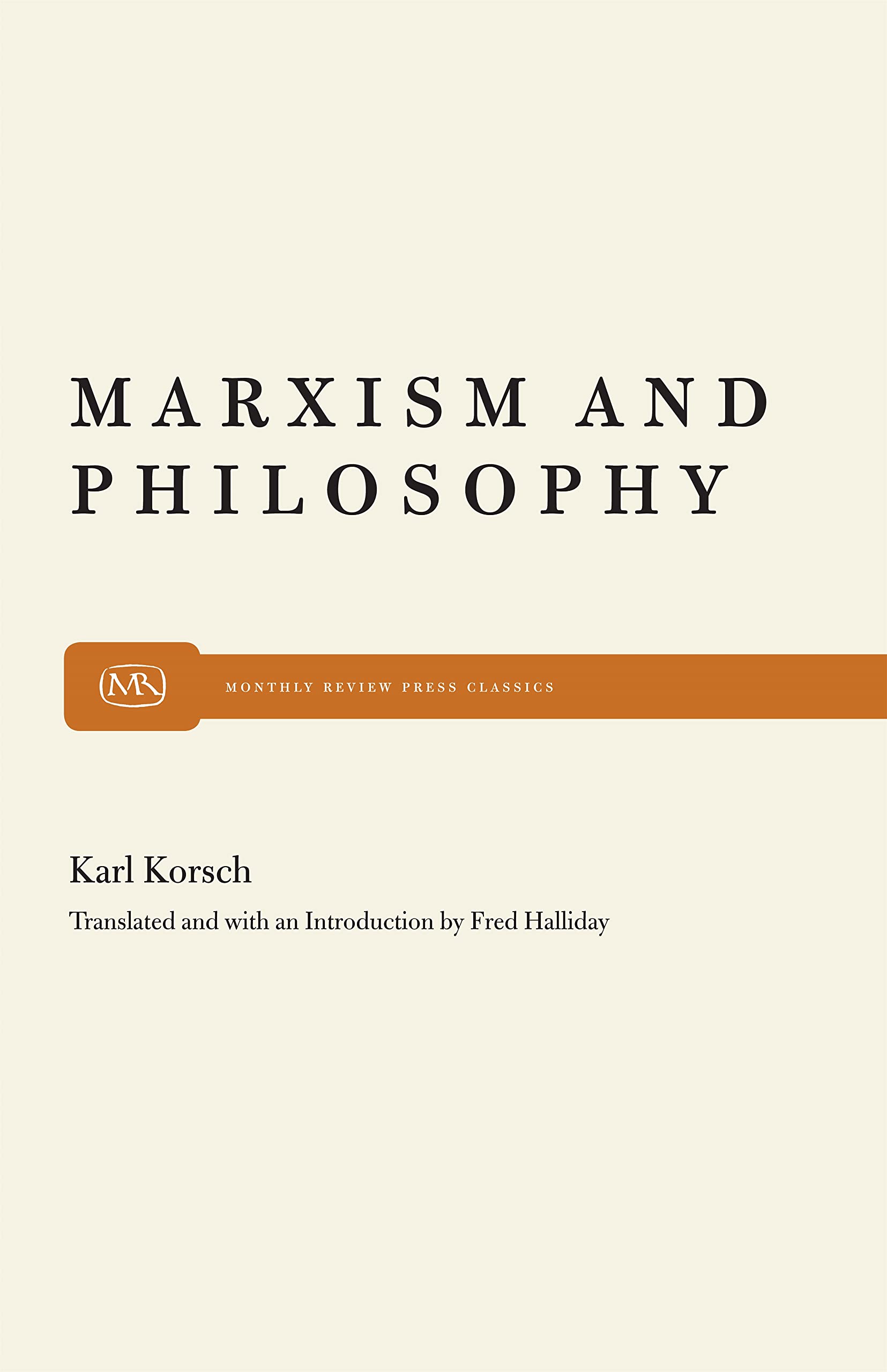
Marxism and Philosophy: A Foundational Work in Marxist Theory by Karl Korsch
Inclusive of all applicable taxes. FREE shipping on all orders.
Available Offers
- 🚚Free Delivery — Free shipping on all orders
- 💵Cash on Delivery — Pay when your order arrives
- ↩️15-Day Easy Returns — Hassle-free return policy
- 🔒Cash on Delivery — Pay safely when your order arrives
Check Delivery
Product Description
Introduction
In the landscape of Marxist theory, few works have sparked as much debate and enduring relevance as Karl Korsch’s Marxism and Philosophy. Originally published in 1923, this hardcover edition from Monthly Review Press brings back a pivotal text that challenges conventional interpretations of Marxism. For Indian students, scholars, and activists navigating questions of ideology, revolution, and social change, Korsch’s work offers a rigorous yet accessible entry into the philosophical foundations of Marxist thought. This book is not just a historical artifact—it is a living document that continues to provoke critical thinking about the relationship between theory and practice.
Book Overview
Marxism and Philosophy is Karl Korsch’s masterwork, a bold reexamination of how Marxist theory interacts with bourgeois philosophy. Korsch argues that Marxism cannot be reduced to a mere economic doctrine or a set of political slogans—it must be understood as a revolutionary worldview rooted in the Hegelian dialectic. He insists on the centrality of praxis, or the unity of theory and action, and critiques both dogmatic Marxists and liberal philosophers for failing to grasp this dynamic. Though widely attacked in its time, the book has attained a place among the most important works of twentieth-century Marxist theory. This edition is essential for anyone seeking to understand the evolution of critical theory and the ongoing relevance of dialectical thinking in contemporary struggles.
Key Highlights
- Foundational text that reshaped Marxist philosophy in the 20th century
- Rigorous analysis of the relationship between Marxism and Hegelian dialectics
- Emphasis on revolutionary praxis as the core of Marxist method
- Critical engagement with both bourgeois philosophy and orthodox Marxism
- Monthly Review Press edition—a trusted publisher of radical social theory
- Hardcover format for lasting reference and study
Inside the Book
This volume delves into the philosophical underpinnings of Marxism, starting with a critique of the separation between theory and practice in traditional philosophy. Korsch traces the development of Marxist thought from Hegel through Marx and Engels, arguing that the dialectical method is not just a tool for analysis but a guide for revolutionary action. He addresses the degeneration of Marxism into a positivist science and calls for a return to its critical, emancipatory core. The book includes a substantial introduction that contextualizes Korsch’s arguments within the debates of his time, making it accessible to readers unfamiliar with early 20th-century European philosophy.
Key Topics
- The Hegelian dialectic and its role in Marxist theory
- Critique of bourgeois philosophy and ideology
- The unity of theory and revolutionary praxis
- Historical materialism as a living, dynamic method
- The relationship between Marxism and social science
- Korsch’s debate with Leninism and orthodox Marxism
Reader Benefits
By engaging with Marxism and Philosophy, readers will gain a deeper understanding of the philosophical roots of revolutionary thought. This book equips students with the tools to analyze not just economic systems but the ideological frameworks that sustain them. For activists, it offers a powerful reminder that theory must inform action—and that action, in turn, must reshape theory. The hardcover edition ensures durability, making it a valuable addition to any personal library or academic collection. Indian readers will find particular resonance in Korsch’s critique of dogmatism, as it speaks to the need for context-sensitive, praxis-oriented approaches in diverse social movements.
Learning Outcomes
- Understand the dialectical method as developed by Hegel and applied by Marx
- Critically evaluate the relationship between philosophy and social revolution
- Analyze the limitations of both bourgeois idealism and mechanistic materialism
- Apply Korsch’s insights to contemporary debates in social theory and activism
- Develop a nuanced perspective on the history of Marxist thought
Who Should Read
This book is ideal for advanced undergraduate and postgraduate students of political science, philosophy, sociology, and history. It is equally valuable for researchers in critical theory, cultural studies, and postcolonial studies. Activists and organizers seeking a theoretical grounding for their work will find Korsch’s arguments both challenging and inspiring. Anyone interested in the intersection of philosophy and social change—from university libraries to grassroots study circles—will benefit from this enduring classic.
About the Author
Karl Korsch (1886–1961) was a German Marxist philosopher, lawyer, and political activist. A contemporary of Georg Lukács and Antonio Gramsci, Korsch was a leading figure in the Western Marxist tradition. He was a member of the German Communist Party and later a critic of both Stalinism and social democracy. His work on the relationship between Marxism and philosophy influenced the Frankfurt School and remains central to debates on critical theory. Korsch’s insistence on the primacy of praxis and his rejection of dogmatic orthodoxy make him a vital thinker for anyone engaged in the struggle for social justice.
About the Publisher
Monthly Review Press is an independent publishing house based in New York, dedicated to radical social theory and critique. Founded in 1949 by Paul Sweezy and Leo Huberman, the press has published seminal works by thinkers such as Harry Magdoff, Samir Amin, and Ellen Meiksins Wood. Known for its commitment to accessible yet rigorous scholarship, Monthly Review Press continues to produce books that challenge capitalism and inspire movements for social change. This edition of Marxism and Philosophy reflects that enduring mission.
Conclusion
Marxism and Philosophy is more than a historical document—it is a call to think critically and act decisively. Karl Korsch’s incisive analysis of the dialectic, his critique of bourgeois ideology, and his unwavering commitment to revolutionary praxis remain as urgent today as they were a century ago. For Indian readers seeking to understand the philosophical dimensions of social transformation, this hardcover edition from Monthly Review Press is an indispensable resource. Add it to your collection and join the ongoing conversation about theory, practice, and the possibility of a just world.
Quick Summary
Marxism and Philosophy by Karl Korsch is a landmark work in Marxist theory that challenges orthodox interpretations and calls for a renewed engagement with Hegelian dialectics. First published in 1923, this book argues that Marxism is not a static economic doctrine but a dynamic philosophy of praxis that must constantly critique bourgeois ideology. Korsch insists on the inseparability of theory and revolutionary practice, making this text essential for understanding the development of Western Marxism. Readers will gain deep insight into the philosophical foundations of Marxism, the role of dialectics, and the necessity of critical self-reflection in political thought. This hardcover edition from Monthly Review Press is ideal for Indian students, researchers, and activists who seek a rigorous theoretical grounding. By purchasing from Bookshops.in, you support an independent Indian bookstore and receive a high-quality physical copy perfect for study and reference.
Book Highlights
Book Specifications
| ISBN-13 | 9780853451532 |
| ISBN-10 | 0853451532 |
| Publisher | Monthly Review Press,U.S. |
| Language | English |
| Dimensions | 13.97 x 1.04 x 21.59 cm |
| Weight | 249 g |
| Category | Political Science › Political History |
| Genre | Non-fiction |
| Original Language | German |
Frequently Asked Questions
What is Marxism and Philosophy about?
Who is the author of Marxism and Philosophy?
What is the main argument of the book?
Why is the Hegelian dialectic important in this book?
Is this book suitable for beginners in Marxism?
What is revolutionary praxis?
How does this book relate to Western Marxism?
What is the ISBN for Marxism and Philosophy?
Is this book available in hardcover?
What language is the book written in?
Who should read Marxism and Philosophy?
What is the price of the book?
Why buy from Bookshops.in?
Readers Also Search For
Customers Also Bought

Sociology
Imagination Beyond Nation: Latin American Popular Culture: 349 (Pitt Latin American Series)

Sociology
Boomer Volunteer Engagement: Facilitator's Tool Kit

Sociology
Making a Success of Marriage: Planning for Happily Ever After

Sociology
Causal Mediation Analysis (Analytical Methods for Social Research)

Sociology
Marriage and the Moral Imagination (New Departures in Anthropology)

Sociology
Social Change, Resistance and Social Practices: 19 (Studies in Critical Social Sciences, 19)
Related Products
View All
Society & Social Sciences
Oxford Studies in Epistemology, Volume 3 | by Tamar Szabo Gendler | John Hawthorne | OUP UK | by Tamar Szabo Gendler | John Hawthorne | OUP UK | by Tamar Szabo Gendler | John Hawthorne | OUP UK | by Tamar Szabo Gendler | John Hawthorne | OUP UK | by Tamar Szabo Gendler | John Hawthorne | OUP UK | by Tamar Szabo Gendler | John Hawthorne | OUP UK | by Tamar Szabo Gendler | John Hawthorne | OUP UK | by Tamar Szabo Gendler | John Hawthorne | OUP UK | by Tamar Szabo Gendler | John Hawthorne | OUP UK
Society & Social Sciences
Sidgwick's Ethics and Victorian Moral Philosophy | by J. B. Schneewind | Jerome B. Schneewind | OUP Oxford | by J. B. Schneewind | Jerome B. Schneewind | OUP Oxford | by J. B. Schneewind | Jerome B. Schneewind | OUP Oxford | by J. B. Schneewind | Jerome B. Schneewind | OUP Oxford | by J. B. Schneewind | Jerome B. Schneewind | OUP Oxford | by J. B. Schneewind | Jerome B. Schneewind | OUP Oxford | by J. B. Schneewind | Jerome B. Schneewind | OUP Oxford | by J. B. Schneewind | Jerome B. Schneewind

Society & Social Sciences
Cognitive Phenomenology | by Tim Bayne | Michelle Montague | OUP UK | by Tim Bayne | Michelle Montague | OUP UK | by Tim Bayne | Michelle Montague | OUP UK | by Tim Bayne | Michelle Montague | OUP UK | by Tim Bayne | Michelle Montague | OUP UK | by Tim Bayne | Michelle Montague | OUP UK | by Tim Bayne | Michelle Montague | OUP UK | by Tim Bayne | Michelle Montague | OUP UK | by Tim Bayne | Michelle Montague | OUP UK | by Tim Bayne | Michelle Montague | OUP UK | by Tim Bayne | Michelle Montague |

Society & Social Sciences
Alasdair MacIntyre on Practical Philosophy | by Kelvin Knight | Peter Wicks | University of Notre Dame Press | by Kelvin Knight | Peter Wicks | University of Notre Dame Press | by Kelvin Knight | Peter Wicks | University of Notre Dame Press | by Kelvin Knight | Peter Wicks | University of Notre Dame Press | by Kelvin Knight | Peter Wicks | University of Notre Dame Press | by Kelvin Knight | Peter Wicks | University of Notre Dame Press | by Kelvin Knight | Peter Wicks | University of Notre Dame P

Society & Social Sciences
Philosophical Historicism and the Betrayal of First Philosophy | by Carl Page | Penn State University Press | by Carl Page | Penn State University Press | by Carl Page | Penn State University Press | by Carl Page | Penn State University Press | by Carl Page | Penn State University Press | by Carl Page | Penn State University Press | by Carl Page | Penn State University Press | by Carl Page | Penn State University Press | by Carl Page | Penn State University Press | by Carl Page | Penn State Univ
Society & Social Sciences