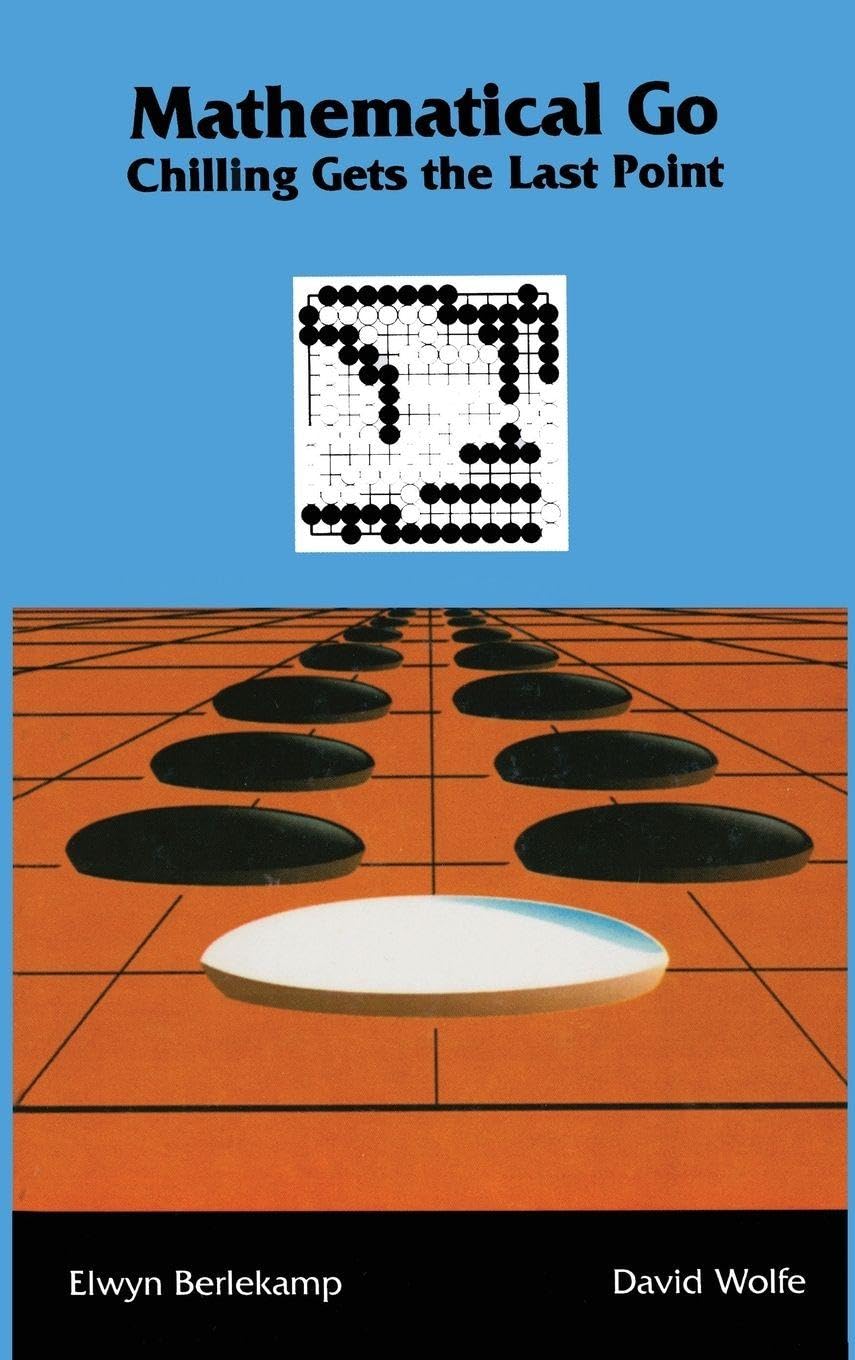
Mathematical Go: Chilling Gets the Last Point by Elwyn Berlekamp – A Pioneering Combinatorial Game Theory Book for Go Pl
Inclusive of all applicable taxes. FREE shipping on all orders.
Available Offers
- 🚚Free Delivery — Free shipping on all orders
- 💵Cash on Delivery — Pay when your order arrives
- ↩️15-Day Easy Returns — Hassle-free return policy
- 🔒Cash on Delivery — Pay safely when your order arrives
Check Delivery
Product Description
Introduction
Go, the ancient board game of strategy and subtlety, has captivated minds for millennia. While its rules are deceptively simple, the depth of play has long resisted formal mathematical analysis — until now. Mathematical Go: Chilling Gets the Last Point, authored by renowned mathematician Elwyn Berlekamp, bridges the gap between abstract combinatorial game theory and the concrete challenges faced by Go players. This hardcover edition, published by A K Peters, is a landmark work that reveals how mathematics can unlock the secrets of endgame play, offering fresh insights for both serious Go enthusiasts and students of game theory.
Book Overview
This book is not a conventional guide to winning at Go. Instead, it presents a rigorous yet accessible exploration of how combinatorial game theory — specifically the concept of 'chilling' — can be applied to Go endgames. Berlekamp demonstrates that many endgame positions, previously thought to be matters of intuition or experience, can be evaluated with mathematical precision. By treating Go positions as sums of independent subgames, the author shows how players can determine the optimal move sequence and, crucially, secure the last point. The work is built on the foundations of the theory developed by John Conway, but it extends it significantly to address the unique complexities of Go. This is a book for those who wish to understand the underlying structure of the game at a deeper, more analytical level.
Key Highlights
- Pioneering Connection: First comprehensive application of combinatorial game theory to real Go endgame problems, many of which had stumped professional players.
- Chilling Technique: Introduces the 'chilling' operator, a mathematical tool that transforms complex Go positions into simpler, analyzable numbers.
- Real-World Solutions: Provides concrete, provably optimal strategies for common endgame scenarios, backed by rigorous proofs.
- Accessible Mathematics: While mathematically deep, the book is written to be understood by Go players with a solid grasp of the game, even if they are not professional mathematicians.
- Historical Significance: Represents a major milestone in the study of combinatorial games, influencing both game theory and artificial intelligence research.
Inside the Book
The book is structured to guide readers from basic concepts to advanced applications. Early chapters introduce the fundamental ideas of combinatorial game theory — numbers, games, sums, and comparisons — in the context of Go endgames. Berlekamp then presents the chilling theorem, which allows the 'temperature' of a Go position to be lowered, simplifying its analysis. Later chapters delve into specific endgame types, including corridors, kos, and complex multi-stone captures, each accompanied by detailed diagrams and step-by-step calculations. The final sections include appendices that summarize key results and provide a glossary of terms, making the book a lasting reference.
Key Topics Covered
- Combinatorial game theory fundamentals: numbers, games, and the concept of 'hot' and 'cold' positions
- The chilling operator and its application to Go endgames
- Analysis of corridors, including one-step and two-step corridors
- Mathematical treatment of ko fights and seki positions
- Evaluation of multiple independent endgame moves
- Comparison of mathematical predictions with professional play
- Advanced topics: infinitesimals, switches, and atomic moves
Reader Benefits
By studying this book, readers will gain a new lens through which to view Go. Instead of relying solely on pattern recognition or heuristics, you will learn to evaluate endgame positions with logical certainty. This leads to more confident play, especially in close games where every point matters. Mathematicians will appreciate the elegant extension of theory to a practical domain, while Go players will discover that many 'intuitive' moves can be justified — or overturned — by calculation. The book also sharpens analytical thinking skills that are applicable beyond the board, such as breaking complex problems into manageable parts.
Learning Outcomes
- Understand the core principles of combinatorial game theory as applied to Go
- Learn to identify and isolate independent subgames in endgame positions
- Master the chilling technique to simplify positional evaluation
- Develop the ability to calculate optimal move sequences in standard endgame scenarios
- Gain insight into why certain professional moves are correct or suboptimal
- Acquire a foundation for further research in combinatorial game theory
Who Should Read This Book
This book is intended for a dual audience. First, it is for Go players who have reached an intermediate level (approximately 10 kyu or stronger) and wish to deepen their understanding of endgame strategy. Second, it is for mathematicians and computer scientists with an interest in game theory, particularly those curious about how abstract mathematics can illuminate real-world games. University students studying discrete mathematics or artificial intelligence will also find valuable case studies. The book assumes no formal mathematical background beyond basic algebra, but a willingness to engage with symbolic reasoning is essential.
About the Author
Elwyn Berlekamp (1940–2019) was a distinguished American mathematician and computer scientist, best known for his pioneering work in combinatorial game theory, coding theory, and error-correcting codes. A professor at the University of California, Berkeley, he co-authored the seminal work Winning Ways for Your Mathematical Plays with John Conway and Richard Guy. Berlekamp was also an accomplished Go player and actively worked to bridge the gap between mathematical theory and practical play. His research has had lasting impact on both recreational mathematics and telecommunications.
About the Publisher
A K Peters is a respected academic publisher specializing in mathematics, computer science, and visual arts. Known for producing high-quality, durable hardcover editions, A K Peters has a strong tradition of publishing works that make advanced mathematical ideas accessible to enthusiasts and professionals alike. This edition of Mathematical Go reflects their commitment to excellence, with clear typesetting, well-reproduced diagrams, and a sturdy binding suitable for years of study.
Conclusion
Mathematical Go: Chilling Gets the Last Point is a unique and invaluable resource for anyone who wishes to see Go through the lens of mathematical logic. It challenges the notion that the game is purely intuitive and offers a powerful toolkit for endgame analysis. Whether you are a Go player striving to improve your win rate, a mathematician exploring the frontiers of game theory, or a student looking for a compelling example of applied mathematics, this book will reward your attention. Add this hardcover volume to your library and discover how the last point can be won with certainty.
Quick Summary
Mathematical Go: Chilling Gets the Last Point by Elwyn Berlekamp is a groundbreaking work that applies combinatorial game theory to the ancient board game of Go. Published by A K Peters, this hardcover book introduces the concept of 'chilling' to simplify and solve endgame positions that have long puzzled even professional players. Written for both mathematicians and serious Go enthusiasts, the book bridges abstract mathematical concepts with practical gameplay. Readers will learn how to analyze endgame moves using game values, compare positions, and make optimal decisions. Berlekamp's clear explanations and numerous diagrams make complex ideas accessible. This book is essential for anyone interested in the mathematical foundations of strategy games. By purchasing from Bookshops.in, Indian customers receive a genuine, high-quality hardcover edition with reliable delivery. Whether you are a researcher in game theory or an advanced Go player seeking deeper insights, Mathematical Go offers a unique and rewarding intellectual journey.
Book Highlights
Book Specifications
| ISBN-13 | 9781568810324 |
| ISBN-10 | 1568810326 |
| Publisher | A K Peters Ltd |
| Language | English |
| Dimensions | 16.51 x 2.54 x 24.13 cm |
| Weight | 590 g |
| Country | India |
| Category | Mathematics › Statistics |
| Genre | Non-fiction |
| Original Language | English |
Frequently Asked Questions
What is Mathematical Go about?
Who is the author of Mathematical Go?
Do I need to be a mathematician to understand this book?
Is this book only about Go endgames?
What is the chilling technique?
Can this book improve my Go game?
Is this book suitable for beginners in Go?
What publisher released Mathematical Go?
Is this book available in India?
What is the ISBN of this book?
Does the book contain exercises?
How is this book different from other Go books?
Can I use this book for academic research?
Readers Also Search For
Customers Also Bought
Mathematics
Stereotype Spaces and Algebras: 73 (De Gruyter Expositions in Mathematics, 73)
Mathematics
Semigroups in Algebra, Geometry and Analysis: 20 (De Gruyter Expositions in Mathematics, 20)
Mathematics
Geometry from the Pacific Rim: Proceedings of the Pacific Rim Geometry Conference held at National University of Singapore, Republic of Singapore, ... 1994 (De Gruyter Proceedings in Mathematics)
Mathematics
First International Tainan-Moscow Algebra Workshop: Proceedings of the International Conference held at National Cheng Kung University Tainan, Taiwan, ... 1994 (De Gruyter Proceedings in Mathematics)
Mathematics
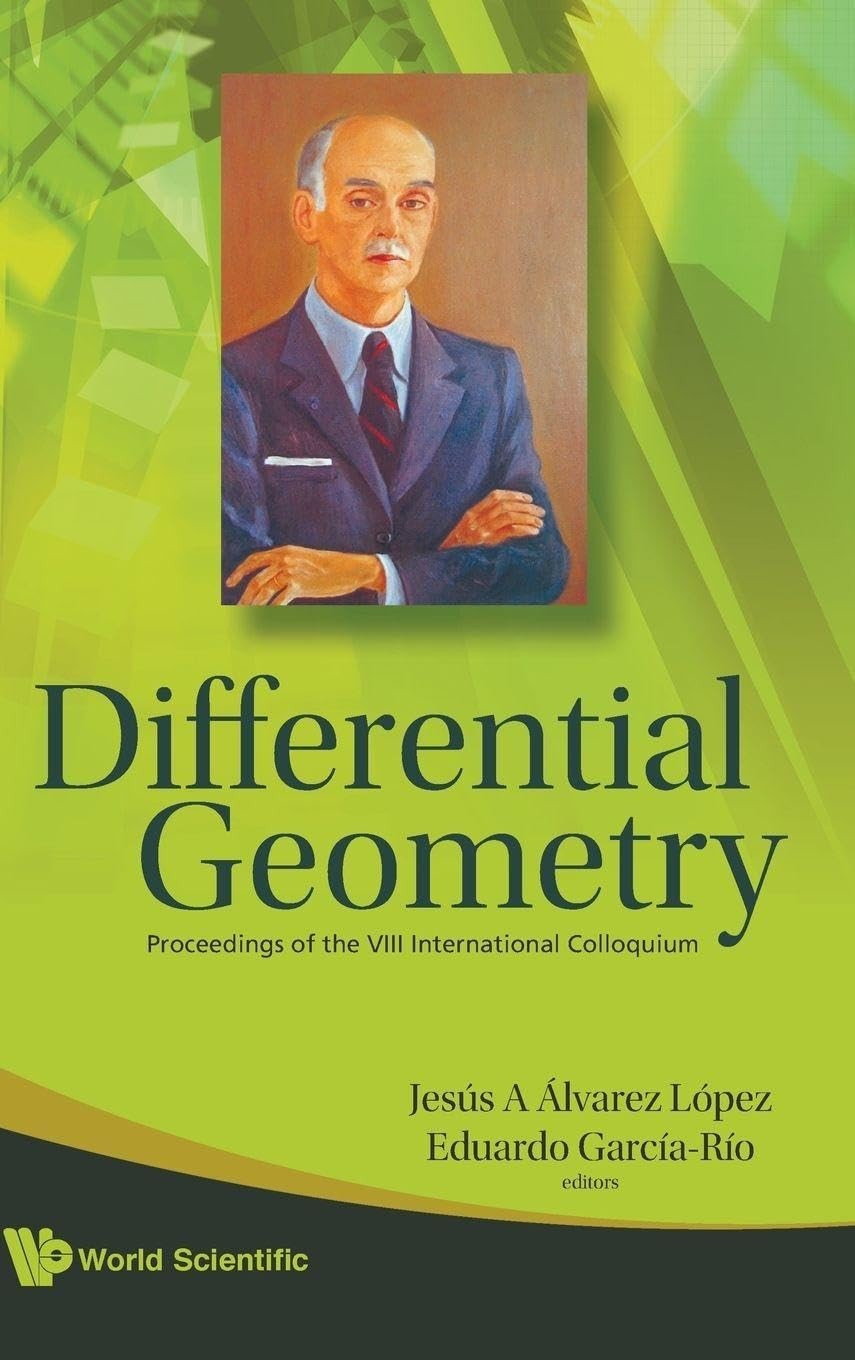
Differential Geometry - Proceedings of the VIII International Colloquium (English, Jesus A. Alvarez Lopez | Eduardo Garcia-Rio)
Mathematics
Mathematical Theory of Optimal Processes (Classics of Soviet Mathematics)
Related Products
View All
Statistics
Asymptotics in Statistics and Probability: Papers in Honor of George Gregory Roussas
Statistics
Inequalities in Analysis and Probability: 3rd Edition
Statistics
Random Graphs, Geometry and Asymptotic Structure
Statistics
Inference for Functional Data With Applications: 200 (Springer Series in Statistics, 692)
Statistics
High-Dimensional Probability: An Introduction with Applications in Data Science (Cambridge Series in Statistical and Probabilistic Mathematics)
Statistics