
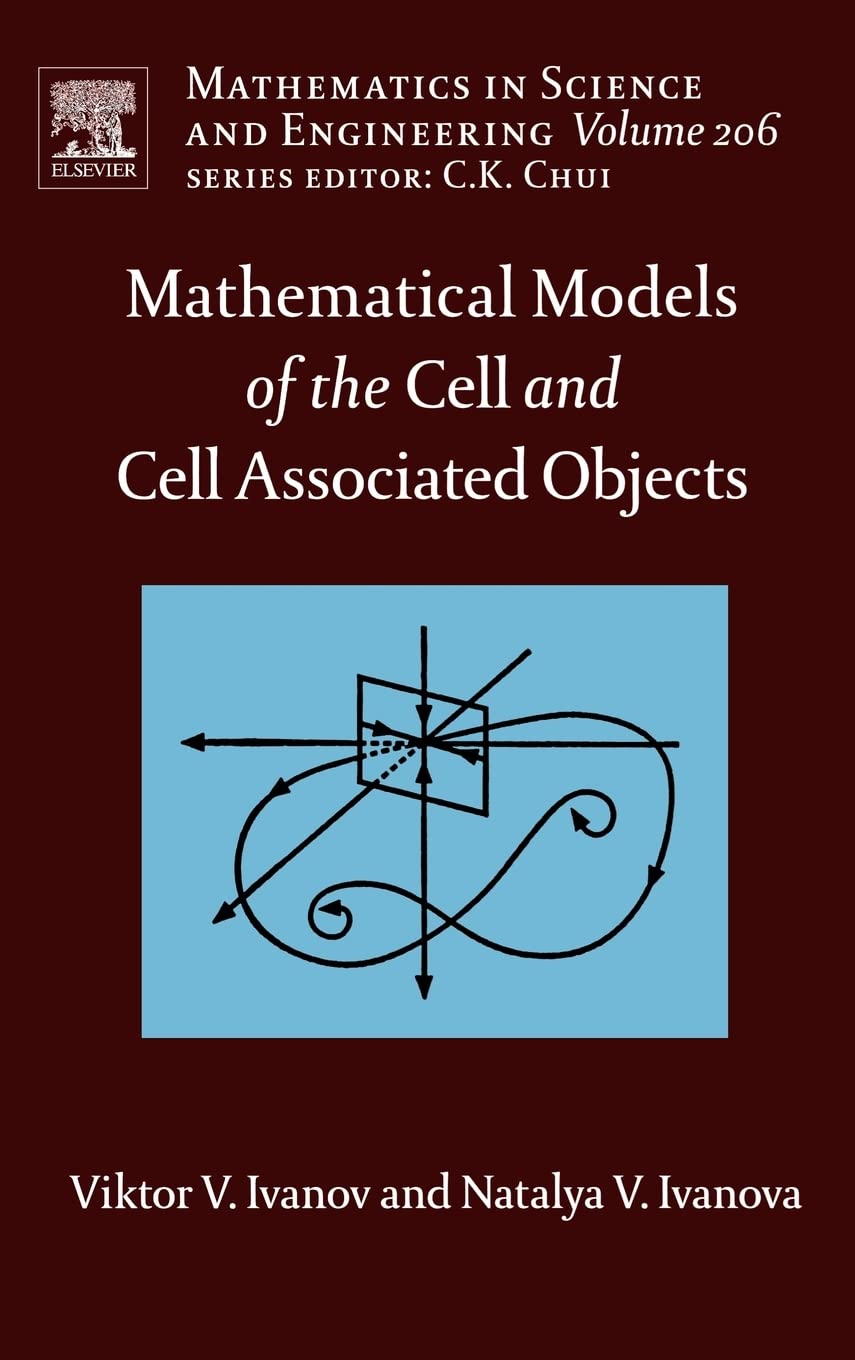
Mathematical Models of the Cell and Cell Associated Objects by Viktor V. Ivanov – A Detailed Reference for Cellular Mode
Inclusive of all applicable taxes. FREE shipping on all orders.
Available Offers
- 🚚Free Delivery — Free shipping on all orders
- 💵Cash on Delivery — Pay when your order arrives
- ↩️15-Day Easy Returns — Hassle-free return policy
- 🔒Cash on Delivery — Pay safely when your order arrives
Check Delivery
Product Description
Introduction
In the ever-evolving landscape of biological and medical research, the ability to model complex cellular systems has become indispensable. Mathematical Models of the Cell and Cell Associated Objects by Viktor V. Ivanov offers a comprehensive and rigorous exploration of how mathematical frameworks can decode the intricate behaviour of cells, viruses, and their interactions. Published by Elsevier Science, this hardbound volume is an essential resource for students, researchers, and professionals across India who seek to bridge the gap between theoretical mathematics and practical cell biology.
Book Overview
This authoritative work presents a detailed survey of hundreds of results in the modelling of cells and cell-associated objects. The author systematically builds from fundamental principles to advanced applications, covering everything from single-cell dynamics to the modelling of complex disease processes. The book is particularly notable for its application of mathematical models to pressing biomedical challenges, including AIDS, cancers, and the mechanisms underlying human longevity. It is not merely a collection of equations but a thoughtful integration of biology, mathematics, and computational science.
Key Highlights
- Comprehensive Coverage: Explores a wide range of models for cellular processes, from metabolic pathways to signal transduction.
- Disease-Focused Applications: Dedicated sections on modelling AIDS progression, tumour growth, and ageing-related cellular changes.
- Rigorous Mathematical Foundation: Employs differential equations, stochastic processes, and network theory to describe biological phenomena.
- Interdisciplinary Approach: Bridges pure mathematics with experimental biology, making it valuable for both theorists and practitioners.
- Research-Oriented Content: Includes recent advances and open problems, encouraging further investigation.
Inside the Book
The book is structured to guide the reader from basic concepts to sophisticated models. Early chapters introduce essential mathematical tools—such as ordinary and partial differential equations—and their relevance to cell biology. Subsequent sections delve into the modelling of cell membranes, organelles, and the cytoskeleton. Special attention is given to cell-associated objects like viruses, bacteria, and prions. The latter part of the book focuses on applied modelling in immunology, cancer biology, and the biology of ageing, with numerous case studies and computational examples drawn from real research.
Key Topics
- Cell Dynamics: Modelling cell growth, division, and death.
- Intracellular Processes: Enzyme kinetics, gene regulation, and signalling networks.
- Cell–Environment Interactions: Adhesion, migration, and tissue formation.
- Pathogen Modelling: Viral replication, immune evasion, and co-infection dynamics.
- Disease Modelling: HIV/AIDS progression, cancer metastasis, and longevity determinants.
- Computational Methods: Numerical simulation, parameter estimation, and sensitivity analysis.
Reader Benefits
By studying this book, readers will gain a powerful toolkit for analysing biological systems quantitatively. They will learn to formulate hypotheses in mathematical terms, test them against experimental data, and derive predictions that can guide laboratory research. The book also helps in developing critical thinking skills essential for interdisciplinary work. For Indian students preparing for competitive exams like CSIR-NET, GATE, or JRF in life sciences or mathematics, this text provides a solid grounding in a rapidly growing field. Researchers will find the extensive bibliography and model repositories invaluable for their own work.
Learning Outcomes
- Understand the fundamental principles of mathematical modelling in cell biology.
- Construct and analyse models of cellular processes using differential equations and stochastic methods.
- Apply modelling techniques to study diseases such as AIDS and cancer.
- Evaluate the role of cellular models in understanding ageing and longevity.
- Interpret simulation results and relate them to experimental observations.
- Identify open problems and future directions in the field.
Who Should Read
This book is ideally suited for postgraduate students and researchers in mathematics, biophysics, bioinformatics, systems biology, and computational biology. It is also highly relevant for medical researchers and clinicians interested in the quantitative aspects of disease progression. Undergraduate students with a strong background in calculus and basic biology will find it accessible with additional effort. Professionals in pharmaceuticals, biotechnology, and public health who wish to incorporate modelling into their work will benefit greatly from the practical examples.
About the Author
Viktor V. Ivanov is a distinguished mathematician and biologist with decades of experience in theoretical and computational biology. His research spans cellular biophysics, dynamical systems, and the mathematical epidemiology of infectious diseases. He has published extensively in international journals and has been a visiting professor at several leading universities. His unique ability to translate complex biological questions into elegant mathematical models makes him a leading voice in the field.
About the Publisher
Elsevier Science is a world-renowned academic publisher with a legacy of over 140 years. Known for its rigorous peer-review process and high-quality scientific content, Elsevier publishes thousands of books and journals that shape research across all disciplines. This book, part of their prestigious science and mathematics collection, upholds the publisher’s commitment to advancing knowledge through authoritative and accessible works.
Conclusion
Mathematical Models of the Cell and Cell Associated Objects is more than a textbook—it is a gateway to understanding life at its most fundamental level through the lens of mathematics. Whether you are a student embarking on a research career or a seasoned scientist seeking new perspectives, this book will equip you with the concepts and tools to make meaningful contributions. Order your hardcover copy from Bookshops.in today and add this indispensable reference to your library.
Quick Summary
Mathematical Models of the Cell and Cell Associated Objects by Viktor V. Ivanov is a seminal reference work that surveys hundreds of mathematical modeling results in cellular biology. The book systematically explores how mathematical frameworks can describe cell structure, function, and interactions, with particular emphasis on applications to AIDS, cancer, and longevity research. It is designed for graduate students, researchers, and professionals in biomathematics, systems biology, and related fields. Readers will gain a deep understanding of quantitative approaches to cellular processes, including cell cycle dynamics, signaling pathways, and population models. The book bridges theoretical mathematics with experimental biology, offering practical examples and case studies. By purchasing from Bookshops.in, Indian customers receive a genuine hardcover edition delivered reliably, supporting local business while accessing world-class academic content. This book is an indispensable resource for anyone serious about mathematical biology and its real-world applications in disease modeling.
Book Highlights
Book Specifications
| ISBN-13 | 9780444527141 |
| ISBN-10 | 0444527141 |
| Publisher | Elsevier Science Ltd |
| Language | English |
| Dimensions | 15.9 x 1.85 x 23.11 cm |
| Weight | 680 g |
| Category | Mathematics › Calculus |
| Genre | Science & Mathematics |
| Original Language | English |
Frequently Asked Questions
What is this book about?
Who is the author?
Is this book suitable for beginners?
Does the book cover AIDS modeling?
Does it include cancer models?
What is the language of the book?
What is the ISBN?
Is this a hardcover book?
Can I use this for my PhD research?
Does the book discuss longevity?
Is it available in Indian bookstores?
What category does this book fall under?
Are there any digital editions?
Readers Also Search For
Customers Also Bought
Mathematics
Stereotype Spaces and Algebras: 73 (De Gruyter Expositions in Mathematics, 73)
Mathematics
Semigroups in Algebra, Geometry and Analysis: 20 (De Gruyter Expositions in Mathematics, 20)
Mathematics
Geometry from the Pacific Rim: Proceedings of the Pacific Rim Geometry Conference held at National University of Singapore, Republic of Singapore, ... 1994 (De Gruyter Proceedings in Mathematics)
Mathematics
First International Tainan-Moscow Algebra Workshop: Proceedings of the International Conference held at National Cheng Kung University Tainan, Taiwan, ... 1994 (De Gruyter Proceedings in Mathematics)
Mathematics
Differential Geometry - Proceedings of the VIII International Colloquium (English, Jesus A. Alvarez Lopez | Eduardo Garcia-Rio)
Mathematics
Mathematical Theory of Optimal Processes (Classics of Soviet Mathematics)
Related Products
View AllMathematics
Stereotype Spaces and Algebras: 73 (De Gruyter Expositions in Mathematics, 73)
Mathematics
Semigroups in Algebra, Geometry and Analysis: 20 (De Gruyter Expositions in Mathematics, 20)
Mathematics
Geometry from the Pacific Rim: Proceedings of the Pacific Rim Geometry Conference held at National University of Singapore, Republic of Singapore, ... 1994 (De Gruyter Proceedings in Mathematics)
Mathematics
First International Tainan-Moscow Algebra Workshop: Proceedings of the International Conference held at National Cheng Kung University Tainan, Taiwan, ... 1994 (De Gruyter Proceedings in Mathematics)
Mathematics
Differential Geometry - Proceedings of the VIII International Colloquium (English, Jesus A. Alvarez Lopez | Eduardo Garcia-Rio)
Mathematics