
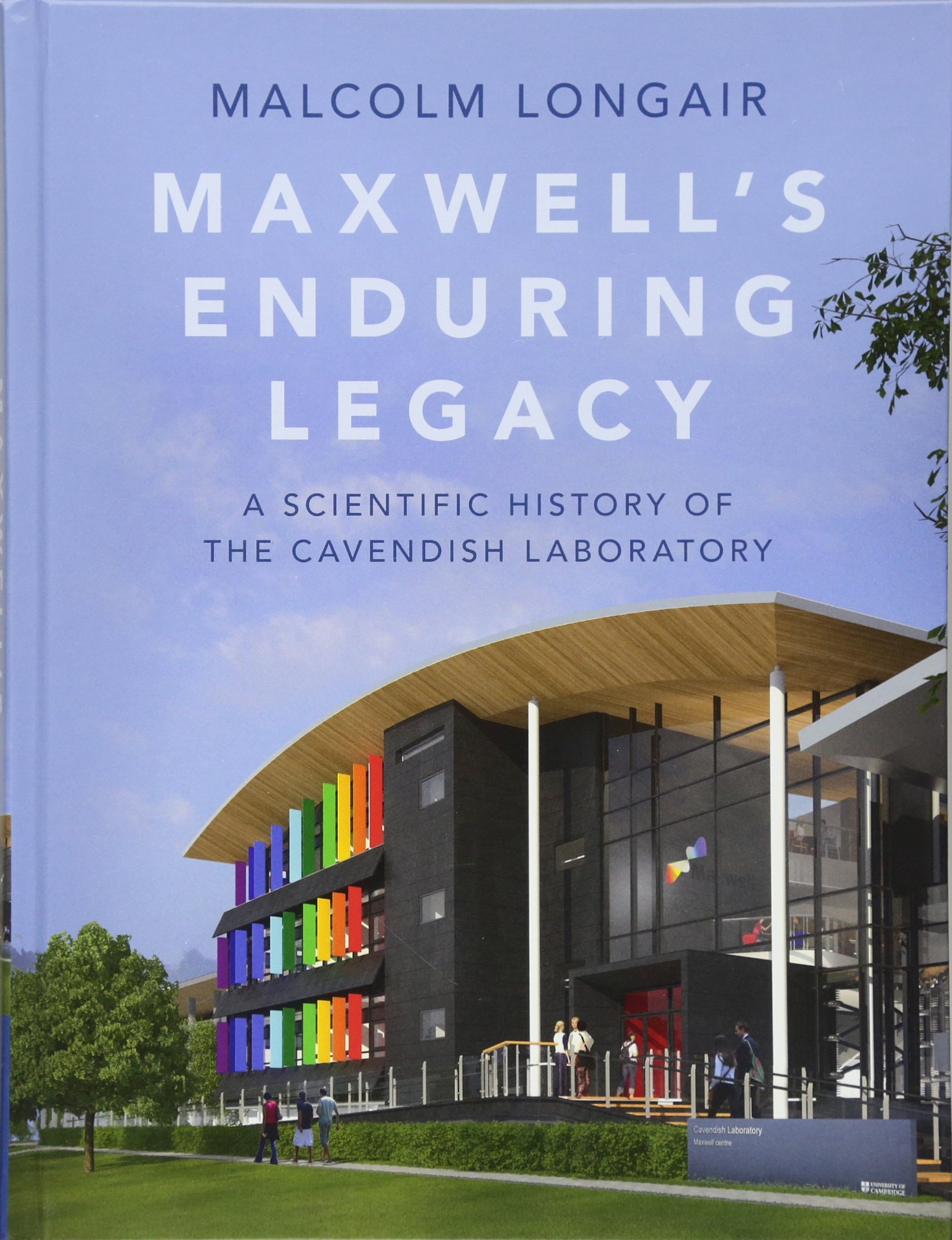
Maxwell's Enduring Legacy: A Scientific History of the Cavendish Laboratory by Malcolm Longair – The Definitive Account
Inclusive of all applicable taxes. FREE shipping on all orders.
Available Offers
- 🚚Free Delivery — Free shipping on all orders
- 💵Cash on Delivery — Pay when your order arrives
- ↩️15-Day Easy Returns — Hassle-free return policy
- 🔒Cash on Delivery — Pay safely when your order arrives
Check Delivery
Product Description
Introduction
The Cavendish Laboratory at the University of Cambridge is one of the most celebrated centres of scientific discovery in the world. From the electron to the neutron, from the structure of DNA to the first pulsar, its legacy is woven into the very fabric of modern physics. In Maxwell's Enduring Legacy: A Scientific History of the Cavendish Laboratory, Malcolm Longair offers a captivating, non-technical journey through the laboratory's remarkable story. This hardcover volume from Cambridge University Press is an essential addition to the library of every science enthusiast, student, and researcher in India.
Book Overview
This book is not merely a chronological account; it is a scientific biography of an institution. Longair traces the laboratory's evolution from its founding in 1874 under James Clerk Maxwell, through the leadership of Rayleigh, J. J. Thomson, Ernest Rutherford, and William Lawrence Bragg, and into the modern era under Mott, Pippard, and Edwards. The narrative is richly illustrated with original diagrams, photographs of apparatus, and excerpts from landmark papers, making the science accessible without sacrificing depth. The author places each discovery in its international context, showing how the Cavendish shaped—and was shaped by—the broader currents of physics.
Key Highlights
- Comprehensive Coverage: Spans over 140 years of groundbreaking research, from Maxwell's electromagnetic theory to contemporary condensed matter physics.
- Richly Illustrated: Contains numerous photographs of original equipment, archival images, and diagrams from seminal papers.
- Non-Technical Approach: Complex ideas are explained in clear, engaging language suitable for general readers.
- Authoritative Author: Written by Malcolm Longair, a distinguished physicist and former head of the Cavendish Laboratory's astrophysics group.
- Updated to the Present: Includes the laboratory's work under the leadership of Mott, Pippard, and Edwards, bringing the story into the 21st century.
Inside the Book
The book is structured around the tenures of the Cavendish professors, each of whom left an indelible mark. Readers will encounter Maxwell's theoretical foundations, Rayleigh's precision measurements, J. J. Thomson's discovery of the electron using cathode rays, Rutherford's pioneering work on radioactivity and the nuclear model, and Bragg's revolutionary use of X-ray crystallography to unveil the structure of DNA. Later chapters delve into the development of radio astronomy, the discovery of pulsars, and the laboratory's contributions to low-temperature physics and semiconductors. The narrative is woven with personal anecdotes and insights into the scientific process.
Key Topics
- James Clerk Maxwell and the founding of the laboratory
- Lord Rayleigh and the standardisation of electrical units
- J. J. Thomson and the discovery of the electron
- Ernest Rutherford and the nuclear atom
- Lawrence Bragg and the birth of molecular biology
- The discovery of the neutron by James Chadwick
- The unravelling of DNA structure by Watson and Crick
- Radio astronomy and the discovery of pulsars
- Superconductivity and low-temperature physics
- Semiconductor physics and the transistor
Reader Benefits
This book offers Indian readers a unique window into how a single laboratory can transform our understanding of the universe. It demystifies the process of scientific discovery, showing that breakthroughs are built on collaboration, persistence, and intellectual curiosity. Students will find inspiration in the stories of scientists who started with simple apparatus and changed the world. Teachers can use the book to bring history alive in the classroom. For professionals, it provides a valuable perspective on the evolution of experimental physics. The non-technical language ensures that anyone with an interest in science can enjoy and learn from this work.
Learning Outcomes
After reading this book, you will be able to:
- Trace the major discoveries made at the Cavendish Laboratory from 1874 to the present.
- Understand the scientific and social contexts that enabled these breakthroughs.
- Appreciate the interplay between theory, experiment, and technology in physics.
- Recognise the contributions of key figures like Maxwell, Thomson, Rutherford, and Bragg.
- Explain how the Cavendish Laboratory influenced the development of modern physics worldwide.
Who Should Read
This book is ideal for undergraduate and postgraduate students of physics, history of science, and engineering. It is equally suited for science teachers, researchers, and curious general readers who want to understand how the greatest discoveries in physics were made. If you have ever wondered how a single laboratory could produce so many Nobel Prize-winning ideas, this book is for you. It is also a wonderful gift for anyone passionate about the history of science.
About the Author
Malcolm Longair is a renowned astrophysicist and historian of science. He served as the Jacksonian Professor of Natural Philosophy at the University of Cambridge and was the head of the Cavendish Laboratory's astrophysics group. He is the author of several acclaimed books, including High Energy Astrophysics and The Cosmic Century. His deep connection to the Cavendish Laboratory lends this book an authenticity and insider perspective that few other authors could provide.
About the Publisher
Cambridge University Press is a world-leading academic publisher with a history dating back to 1534. Known for its rigorous editorial standards and commitment to scholarly excellence, Cambridge University Press publishes works that shape research and education across the globe. This hardcover edition is produced to the highest quality, ensuring that Maxwell's Enduring Legacy will be a lasting addition to your collection.
Conclusion
Maxwell's Enduring Legacy: A Scientific History of the Cavendish Laboratory is more than a history book—it is an inspiring testament to human curiosity and ingenuity. Malcolm Longair has crafted a narrative that is both intellectually rigorous and deeply accessible. For Indian students, teachers, and science lovers, this book offers a rare opportunity to walk in the footsteps of giants and understand how the Cavendish Laboratory forever changed our world. Order your copy from Bookshops.in today and bring home a piece of scientific heritage.
Quick Summary
Maxwell's Enduring Legacy: A Scientific History of the Cavendish Laboratory by Malcolm Longair is a masterful chronicle of one of the world's most influential scientific institutions. The book traces the laboratory's journey from its founding in 1874 under James Clerk Maxwell, through the revolutionary discoveries of J.J. Thomson (electron), Ernest Rutherford (nuclear structure), and the Braggs (X-ray crystallography), to modern achievements like the determination of DNA structure and the discovery of pulsars. Written by a physicist who spent much of his career at the Cavendish, the narrative is both authoritative and accessible, explaining complex physics in everyday language. Lavishly illustrated with historical photographs and diagrams from original papers, the book places each breakthrough in its international context. This is an essential read for Indian physics students, science history buffs, and anyone curious about how experimental physics shaped our modern world. By purchasing from Bookshops.in, readers get a premium hardcover edition with fast delivery across India.
Book Highlights
Book Specifications
| ISBN-13 | 9781107083691 |
| ISBN-10 | 1107083699 |
| Publisher | Cambridge University Press |
| Language | English |
| Dimensions | 19.69 x 3.18 x 25.4 cm |
| Weight | 1 kg 620 g |
| Category | Science & Mathematics › Physics |
| Genre | Nonfiction |
| Reading Age | Adult |
| Original Language | English |
Frequently Asked Questions
What is Maxwell's Enduring Legacy about?
Who is the author of this book?
Is this book suitable for non-scientists?
What key discoveries are covered in the book?
Does the book include illustrations?
Why is the Cavendish Laboratory famous?
Is this book available in hardcover?
Can Indian students benefit from reading this book?
Does the book cover the work of James Clerk Maxwell?
What is the reading level of this book?
How is this book different from other physics history books?
Is the book written in English?
Does the book include information about DNA discovery?
Where can I buy this book in India?
Readers Also Search For
Customers Also Bought
Mathematics
Stereotype Spaces and Algebras: 73 (De Gruyter Expositions in Mathematics, 73)

Mathematics
Semigroups in Algebra, Geometry and Analysis: 20 (De Gruyter Expositions in Mathematics, 20)
Mathematics
Geometry from the Pacific Rim: Proceedings of the Pacific Rim Geometry Conference held at National University of Singapore, Republic of Singapore, ... 1994 (De Gruyter Proceedings in Mathematics)

Mathematics
First International Tainan-Moscow Algebra Workshop: Proceedings of the International Conference held at National Cheng Kung University Tainan, Taiwan, ... 1994 (De Gruyter Proceedings in Mathematics)
Mathematics
Differential Geometry - Proceedings of the VIII International Colloquium (English, Jesus A. Alvarez Lopez | Eduardo Garcia-Rio)
Mathematics
Mathematical Theory of Optimal Processes (Classics of Soviet Mathematics)
Related Products
View All
Physics
The Quantum and Cosmic Codes of the Universe
Physics
Physics for You by Keith Johnson – GCSE Physics Textbook
Physics
Experimental Techniques in Nuclear Physics
Physics
Essential Physics I

Physics
Modern Foundations of Quantum Optics
Physics