
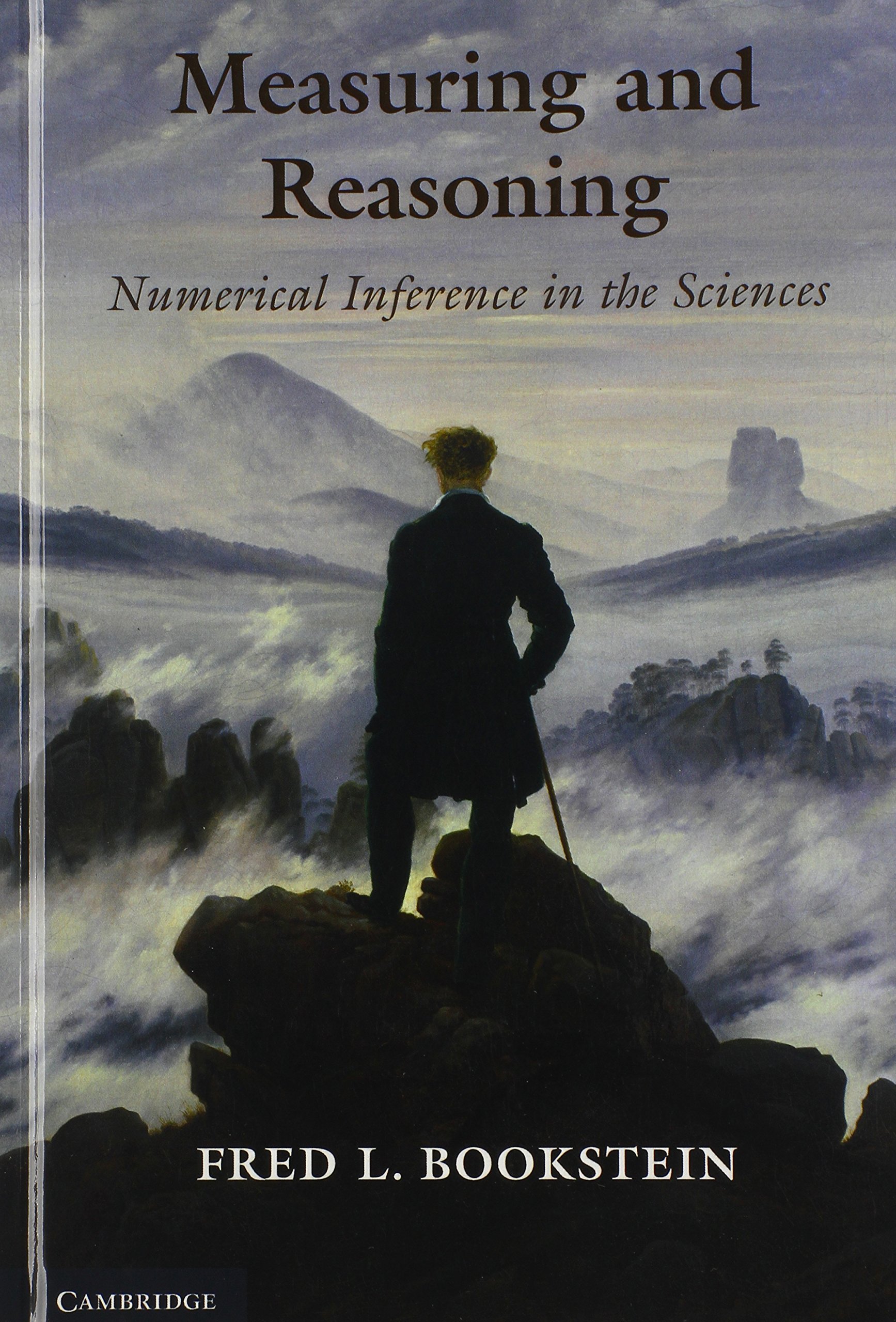
Measuring and Reasoning: Numerical Patterns in Scientific Understanding by Fred L. Bookstein
Inclusive of all applicable taxes. FREE shipping on all orders.
Available Offers
- 🚚Free Delivery — Free shipping on all orders
- 💵Cash on Delivery — Pay when your order arrives
- ↩️15-Day Easy Returns — Hassle-free return policy
- 🔒Cash on Delivery — Pay safely when your order arrives
Check Delivery
Product Description
Introduction
In the world of academic publishing, few books manage to bridge the gap between abstract mathematical reasoning and the practical realities of scientific inquiry. Measuring and Reasoning by Fred L. Bookstein is one such rare gem. Published by the prestigious Cambridge University Press, this hardcover edition is an indispensable resource for Indian students, researchers, and academics who wish to understand how numbers shape our understanding of the natural and social world. Whether you are pursuing a degree in statistics, psychology, biology, or economics, this book offers a deep and original perspective on the logic behind measurement and inference.
Book Overview
This book is not just another textbook on statistics or data analysis. Instead, it explores the philosophical and methodological foundations of how scientists transform raw numerical data into credible scientific knowledge. Bookstein introduces two powerful intellectual tools: abduction—the process of generating new hypotheses when existing ones fail to explain surprising findings—and consilience—the confirmation of numerical patterns across different levels of measurement. Through over 200 figures and diagrams, the author demonstrates how arithmetic and numerical patterns are not merely tools but are central to the very act of scientific persuasion and discovery. The book is a masterclass in reasoning from numbers, making it essential reading for anyone serious about empirical research.
Key Highlights
- Original Framework: Introduces abduction and consilience as twin pillars of numerical reasoning in science.
- Rich Visuals: More than 200 figures, diagrams, and illustrations that clarify complex concepts.
- Interdisciplinary Approach: Draws examples from biology, psychology, medicine, and the social sciences.
- Critical Thinking: Challenges readers to question how numerical claims are validated and communicated.
- Authoritative Publisher: Published by Cambridge University Press, a name synonymous with academic excellence.
Inside the Book
The book is structured to guide the reader from foundational principles to advanced applications. Early chapters lay out the basic arithmetic of measurement and the logic of hypothesis generation. Later chapters delve into case studies from morphometrics, epidemiology, and psychometrics, showing how patterns in data can be interpreted across different scales. The text is dense with examples, but Bookstein's clear writing and extensive use of diagrams make the journey accessible. Each chapter builds on the previous one, creating a coherent narrative about how scientists reason with numbers. The hardcover binding ensures durability for repeated reference.
Key Topics
- The role of arithmetic in scientific reasoning
- Abduction: generating new hypotheses from surprising data
- Consilience: confirming patterns across different measurements
- Measurement theory and its philosophical implications
- Numerical pattern recognition in empirical research
- Case studies from biology, psychology, and social sciences
- Visualization of data through diagrams and figures
Reader Benefits
By engaging with this book, readers will develop a deeper appreciation for how scientific facts are constructed and justified. You will learn to critically evaluate numerical claims in research papers, understand the limitations of statistical methods, and gain the intellectual tools to design more robust studies. The book also enhances your ability to communicate complex numerical ideas to non-specialists, a skill increasingly valued in academia and industry. For Indian students preparing for competitive exams or research careers, this book offers a unique edge in understanding the philosophy behind data analysis.
Learning Outcomes
- Understand the difference between correlation, causation, and consilience.
- Apply the concept of abduction to generate novel research hypotheses.
- Critique numerical evidence in published studies with greater confidence.
- Interpret visual data representations like graphs and scatterplots more accurately.
- Recognize how measurement choices influence scientific conclusions.
Who Should Read
This book is ideal for graduate students and advanced undergraduates in the empirical sciences—including biology, psychology, sociology, economics, and public health. It is also highly relevant for faculty members, researchers, and data scientists who wish to deepen their understanding of measurement theory. Professionals in market research, policy analysis, and any field that relies on quantitative evidence will find Bookstein's insights transformative. Indian readers, especially those in universities following a research-oriented curriculum, will benefit greatly from the book's rigorous yet accessible approach.
About the Author
Fred L. Bookstein is a distinguished statistician and morphometrician, known for his pioneering work in the analysis of shape and form. He has held academic positions at the University of Vienna, the University of Washington, and the University of Michigan. His research spans biology, medicine, and archaeology, and he is the author of several influential books on morphometrics and statistical reasoning. Bookstein's unique ability to combine mathematical rigor with philosophical depth makes him a leading voice in the field of measurement theory.
About the Publisher
Cambridge University Press is one of the oldest and most respected academic publishers in the world. Founded in 1534, it has a long tradition of publishing works that advance knowledge and education. The Press is known for its rigorous peer-review process and its commitment to scholarly excellence. For Indian readers, a Cambridge University Press book represents a guarantee of quality, accuracy, and intellectual depth. This hardcover edition is a testament to the Press's dedication to producing durable, well-designed books for serious readers.
Conclusion
Measuring and Reasoning is more than just a book—it is an intellectual journey into the heart of scientific method. Fred L. Bookstein challenges us to think differently about numbers, hypotheses, and evidence. In an age of big data and algorithmic decision-making, understanding how to reason from measurements is more important than ever. This book equips you with the philosophical and practical tools to navigate the complex world of quantitative research. Whether you are a student, a teacher, or a practising scientist, this volume will enrich your understanding and sharpen your analytical skills. Add it to your library today and begin a deeper conversation with the numbers that shape our world.
Quick Summary
Measuring and Reasoning by Fred L. Bookstein is a profound exploration of how numerical patterns become the bedrock of scientific understanding. The book introduces two essential forms of argument: abduction, which involves generating new hypotheses when findings surprise us, and consilience, the confirmation of numerical patterns across different levels of measurement. With over 200 figures and diagrams, the text makes complex ideas accessible. It is ideal for graduate students and researchers in empirical and social sciences who want to deepen their grasp of quantitative reasoning and research design. Readers will learn to critically evaluate data, design robust studies, and appreciate the philosophical underpinnings of measurement. Choosing Bookshops.in ensures you receive an authentic copy from a trusted Indian bookstore, with prompt service and fair pricing.
Book Highlights
Book Specifications
| ISBN-13 | 9781107024151 |
| ISBN-10 | 1107024153 |
| Publisher | Cambridge University Press |
| Language | English |
| Dimensions | 15.88 x 3.81 x 23.5 cm |
| Weight | 890 g |
| Country | India |
| Category | Biology & Life Sciences › Biology |
| Genre | Non-fiction |
| Reading Age | 18+ |
| Original Language | English |
Frequently Asked Questions
What is the main subject of Measuring and Reasoning?
Who is the author of this book?
Is this book suitable for beginners?
Does the book include illustrations?
What is abduction in the context of this book?
What does consilience mean here?
Can this book help with my research?
What disciplines benefit from this book?
What is the ISBN of this book?
Is this book used in Indian universities?
Does the book cover practical examples?
Why should I buy from Bookshops.in?
Readers Also Search For
Customers Also Bought
Mathematics
Stereotype Spaces and Algebras: 73 (De Gruyter Expositions in Mathematics, 73)

Mathematics
Semigroups in Algebra, Geometry and Analysis: 20 (De Gruyter Expositions in Mathematics, 20)

Mathematics
Geometry from the Pacific Rim: Proceedings of the Pacific Rim Geometry Conference held at National University of Singapore, Republic of Singapore, ... 1994 (De Gruyter Proceedings in Mathematics)

Mathematics
First International Tainan-Moscow Algebra Workshop: Proceedings of the International Conference held at National Cheng Kung University Tainan, Taiwan, ... 1994 (De Gruyter Proceedings in Mathematics)

Mathematics
Differential Geometry - Proceedings of the VIII International Colloquium (English, Jesus A. Alvarez Lopez | Eduardo Garcia-Rio)
Mathematics
Mathematical Theory of Optimal Processes (Classics of Soviet Mathematics)
Related Products
View All
Biology
Evolution: What the Fossils Say and Why It Matters by Donald R. Prothero

Biology
From Taxonomy to Phylogenetics – Life and Work of Willi Hennig

Biology
The Marine Biology of the South China Sea

Biology
Genetics Meets Metabolomics: from Experiment to Systems Biology

Biology
The Elements of Natural or Experimental Philosophy: 2

Biology