
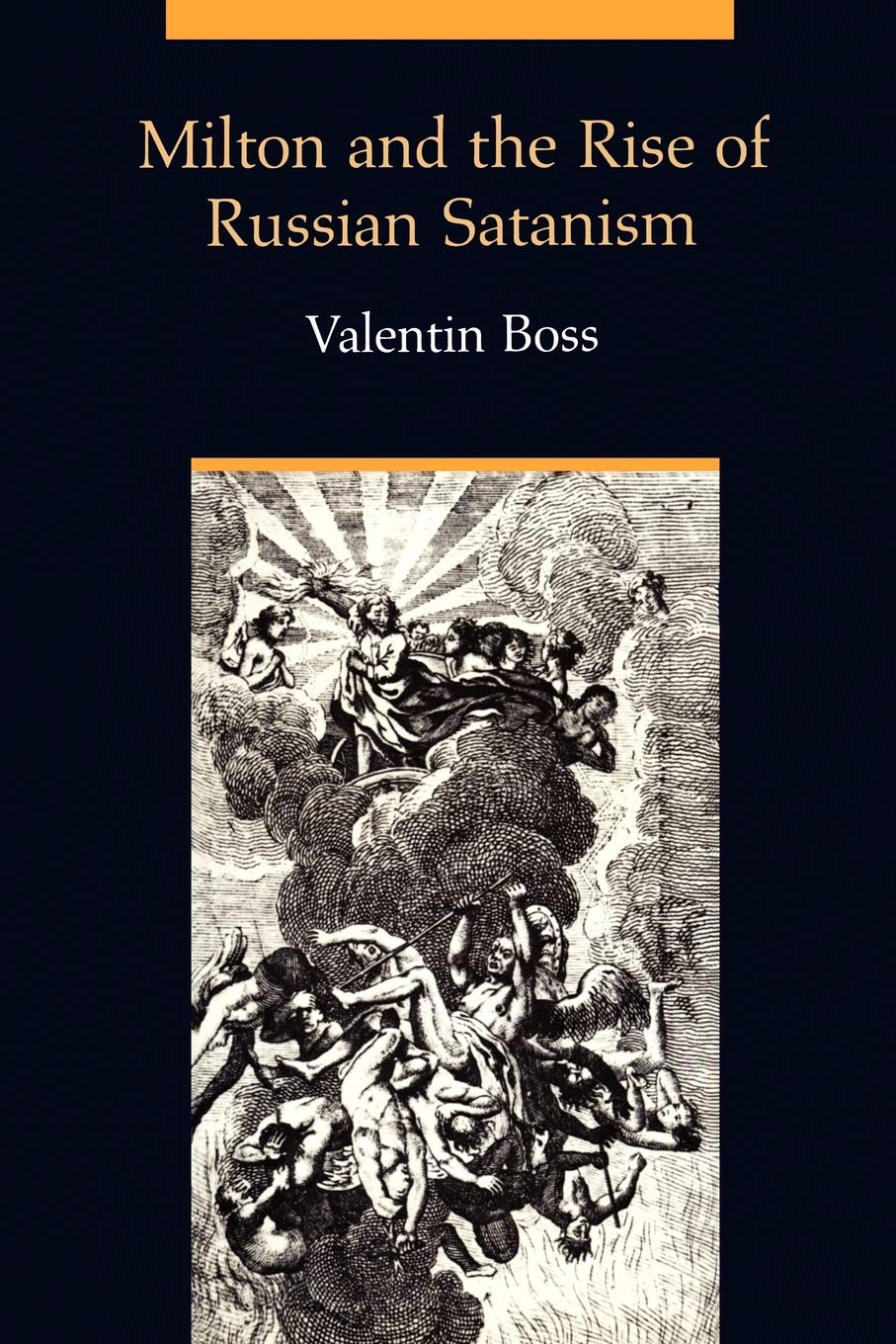
Milton and the Rise of Russian Satanism by Valentin Boss – A Groundbreaking Study of Milton's Influence on Russian Roman
Inclusive of all applicable taxes. FREE shipping on all orders.
Available Offers
- 🚚Free Delivery — Free shipping on all orders
- 💵Cash on Delivery — Pay when your order arrives
- ↩️15-Day Easy Returns — Hassle-free return policy
- 🔒Cash on Delivery — Pay safely when your order arrives
Check Delivery
Product Description
Introduction
In the vast landscape of literary influence, few figures have traversed cultural boundaries as dramatically as Milton's Satan. Milton and the Rise of Russian Satanism by Valentin Boss offers a groundbreaking exploration of how John Milton's Paradise Lost shaped Russian literature, poetry, and the very concept of the devil in Russian culture. For Indian readers fascinated by cross-cultural literary studies, this book unlocks a hidden chapter of European-Russian intellectual history.
Book Overview
This meticulously researched volume, published by the University of Toronto Press, is the first comprehensive study in any language of Milton's reception in Russia. Valentin Boss traces the journey of Milton's Satan from his arrival in Russian letters—before Russian readers even encountered Dante, Marlowe, or Tasso—to his transformation into a uniquely Russian literary figure. The book reveals how an early translation of Paradise Lost, uncovered by Boss in the Moscow archives, became the seed for a distinctly Russian satanic tradition that tsarist censors found morally subversive.
Key Highlights
- First-of-its-kind study examining Milton's impact on Russian literature across centuries
- Archival discovery of an early Russian translation of Paradise Lost from Moscow archives
- Detailed analysis of how Russian poets from Zhukovsky to Lermontov reinvented Milton's Satan
- Political dimensions of literary Satanism and its clash with tsarist censorship
- Comparative insights connecting British radical thought (Byron, Tom Moore) with Russian Romanticism
Inside the Book
The narrative unfolds across several fascinating dimensions. Boss begins by establishing how Russian poets encountered Milton's Satan before any other European literary devil. He then examines the moral and political implications of Russian literary Satanism, which developed its own unique characteristics distinct from Western traditions. The book explores how a brilliant constellation of poets—including Zhukovsky, Pushkin, and Lermontov—gave Milton's outcast from Heaven various modern masks. Boss also investigates how British radicals who believed Milton was 'of the Devil's party' influenced, or failed to influence, Pushkin and his contemporaries.
Key Topics
- Milton's Paradise Lost in Russian translation and adaptation
- The evolution of Russian Romantic Satanism
- Pushkin's engagement with Miltonic themes
- Lermontov's demonic heroes and their Miltonic roots
- Censorship and the subversive power of literary devils
- Comparative study of British and Russian Romanticism
- The political afterlife of Milton's Satan in Russian culture
Reader Benefits
This hardcover edition from the University of Toronto Press provides Indian scholars, students, and literature enthusiasts with a rare window into the transnational flow of literary ideas. You will gain a deeper understanding of how a single character—Milton's Satan—can be reinvented across cultures to serve different artistic, philosophical, and political purposes. The book enriches your appreciation of both Milton and the Russian literary tradition, revealing unexpected connections between English and Russian Romanticism.
Learning Outcomes
- Understand the historical trajectory of Milton's reception in Russia from the 18th to 19th centuries
- Analyze the unique characteristics of Russian literary Satanism versus its Western counterparts
- Identify key Russian poets and their adaptations of Miltonic themes
- Evaluate the role of censorship in shaping literary expression in tsarist Russia
- Develop comparative perspectives on British and Russian Romantic movements
- Appreciate how archival research can transform our understanding of literary history
Who Should Read
This book is essential reading for postgraduate students and researchers in English literature, Russian studies, comparative literature, and cultural history. It is equally valuable for undergraduate students pursuing advanced courses in Romanticism, literary influence, or the history of the devil in literature. Indian academics teaching courses on world literature, translation studies, or the reception of Western classics will find this volume an indispensable resource. General readers with a passion for literary detective work and cross-cultural connections will also be captivated.
About the Author
Valentin Boss is a distinguished scholar whose archival research has reshaped our understanding of Milton's global influence. His work bridges English and Russian literary traditions, bringing to light previously unknown connections. Boss's meticulous scholarship in Milton and the Rise of Russian Satanism demonstrates his mastery of both primary sources and theoretical frameworks, making this a landmark contribution to literary studies.
About the Publisher
The University of Toronto Press is one of the oldest and most respected academic publishers in North America. Known for its rigorous editorial standards and commitment to scholarly excellence, the press publishes works that advance knowledge across the humanities and social sciences. This hardcover edition reflects the press's tradition of producing durable, beautifully bound books that are built to last—perfect for library collections and personal libraries alike.
Conclusion
Milton and the Rise of Russian Satanism is more than a study of literary influence; it is a journey into how cultures remake foreign ideas in their own image. Valentin Boss has given us a masterful account of how Milton's Satan found a second home in Russia, acquiring new faces and new meanings. For anyone interested in the power of literature to cross borders and transform itself, this book is an essential addition to your shelf. Order your copy today from Bookshops.in and explore this remarkable chapter of literary history.
Quick Summary
'Milton and the Rise of Russian Satanism' by Valentin Boss is a groundbreaking academic work that explores how John Milton's portrayal of Satan in Paradise Lost profoundly shaped Russian literary culture. Unlike other European devils, Milton's Satan had a uniquely political and enduring influence on Russian poets, who encountered him before knowing Dante, Marlowe, or Tasso. Boss uncovers an early Russian translation of Paradise Lost from Moscow archives and traces how Russian Romantic writers—especially Pushkin—developed their own distinct tradition of literary Satanism. This book is ideal for students and scholars of comparative literature, Slavic studies, and literary history. Readers will learn how Russian poets adapted Milton's Satan to their own cultural and political contexts, creating a Satanic figure that diverged from Western models. By purchasing from Bookshops.in, you support a trusted Indian bookstore offering premium academic titles with reliable delivery across India.
Book Highlights
Book Specifications
| ISBN-13 | 9781442612938 |
| ISBN-10 | 1442612932 |
| Publisher | Univ of Toronto Pr |
| Language | English |
| Dimensions | 15.24 x 1.65 x 22.86 cm |
| Weight | 512 g |
| Category | World Literature › European |
| Genre | Literary Criticism |
| Reading Age | Adult |
| Original Language | English |
Frequently Asked Questions
What is 'Milton and the Rise of Russian Satanism' about?
Who is the author of this book?
Is this book suitable for undergraduate students?
What makes this book unique?
Does the book cover Pushkin's work?
What is the ISBN-13?
Is this book available in hardcover?
What language is the book in?
Who would benefit from reading this book?
Does the book compare Russian and European Satanism?
What is the price in INR?
Where can I buy this book in India?
Readers Also Search For
Customers Also Bought
Taylor & Francis Ltd
Oppositional Voices (English, Kronitiris Tina)

Routledge
Ordinary People and Extra-Ordinary Protections (English, Judith L. Mitrani)
Cambridge University Press
Jane Austen and the Enlightenment (English, Peter Knox-Shaw)

de Gruyter
Produktionswirtschaft (English, Günther Zäpfel)

de Gruyter
Register (English, Max Ebert)

Packt Publishing
Keyshot 3D Rendering (English, Jei Lee Jo)
Related Products
View All
University of Toronto Press
The Poetics of Imitation in the Italian Theatre of the Renaissance (Toronto Italian Studies)
University of Toronto Press
Befriending the Commedia dell'Arte of Flaminio Scala: The Comic Scenarios (Toronto Italian Studies)

University of Toronto Press
Hamilton Babylon | by Stephen Broomer | University of Toronto Press | by Stephen Broomer | University of Toronto Press | by Stephen Broomer | University of Toronto Press | by Stephen Broomer | University of Toronto Press | by Stephen Broomer | University of Toronto Press | by Stephen Broomer | University of Toronto Press | by Stephen Broomer | University of Toronto Press | by Stephen Broomer | University of Toronto Press | by Stephen Broomer | University of Toronto Press | by Stephen Broomer | U
University of Toronto Press
OuterSpeares: Shakespeare, Intermedia, and the Limits of Adaptation
University of Toronto Press
The Mystical Science of the Soul: Medieval Cognition in Bernardino De Laredo's Recollection Method (Toronto Iberic)
University of Toronto Press