
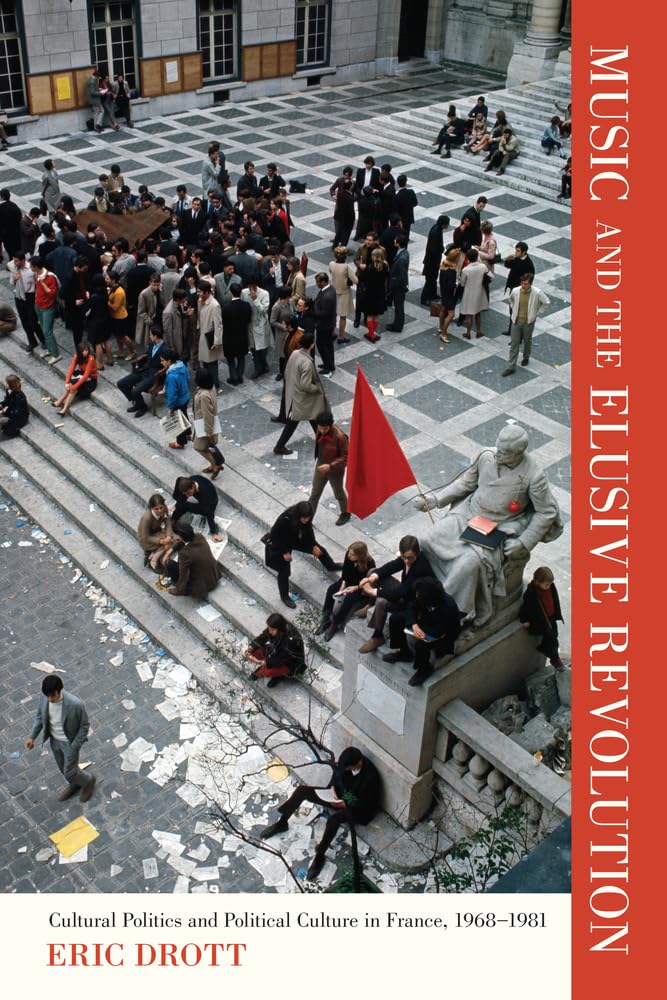
Music and the Elusive Revolution: Cultural Politics and Political Culture in France, 1968-1981 by Eric Drott – An In-Dep
Inclusive of all applicable taxes. FREE shipping on all orders.
Available Offers
- 🚚Free Delivery — Free shipping on all orders
- 💵Cash on Delivery — Pay when your order arrives
- ↩️15-Day Easy Returns — Hassle-free return policy
- 🔒Cash on Delivery — Pay safely when your order arrives
Check Delivery
Product Description
Introduction
In the turbulent wake of May 1968, France witnessed a seismic shift not only in its political landscape but also in its cultural and musical identity. Eric Drott’s Music and the Elusive Revolution: Cultural Politics and Political Culture in France, 1968-1981 offers a compelling exploration of how music became a battleground for revolutionary ideas, social change, and artistic expression. This meticulously researched volume bridges the gap between musicology and political history, making it an essential read for students, scholars, and anyone captivated by the interplay of art and activism.
Book Overview
Published by the University of California Press, this hardcover edition examines the profound impact of the 1968 protests on French musical life. Drott traces how diverse musical communities—from avant-garde composers to popular songwriters—responded to the revolutionary fervour that swept through France. The narrative stretches from the immediate aftermath of the general strike through the ‘long’ 1970s, culminating in François Mitterrand’s election in 1981. By analysing genres such as chanson, free jazz, and experimental electronic music, Drott reveals how music served as both a mirror and a motor for political transformation.
Key Highlights
- Original Research: Draws on extensive archival sources, including radio broadcasts, concert programmes, and underground publications, to reconstruct the musical landscape of post-1968 France.
- Interdisciplinary Approach: Blends music theory, cultural studies, and political history to provide a holistic understanding of the era.
- Focus on Genre: Offers pathbreaking reflections on how musical genres evolve in response to political upheaval and collective identity.
- Relevant Case Studies: Examines the work of key figures like Pierre Boulez, Michel Foucault (as a cultural commentator), and the collective rock group Gong.
Inside the Book
The book is structured around three thematic sections. The first part analyses the immediate musical responses to the May 1968 protests, including the occupation of the Paris Conservatoire and the formation of the Musique Populaire collective. The second section explores the diversification of musical genres during the 1970s, highlighting how punk, folk, and free jazz became vehicles for dissent. The final part examines the institutionalisation of revolutionary music under the socialist government, questioning whether true political change was ever achieved through sound. Each chapter is enriched with detailed musical examples and historical context.
Key Topics
- The role of music in the student protests and general strike of May 1968
- Political instrumentalisation of classical, jazz, and popular music
- Gender, race, and class dynamics in French musical communities
- The impact of state funding and cultural policy on avant-garde music
- Contradictions between revolutionary ideals and commercial music production
- Comparative analysis of French and global protest music traditions
Reader Benefits
This book offers more than historical insight—it equips readers with critical tools to understand contemporary music’s political dimensions. You will gain a nuanced appreciation of how music can both reinforce and challenge power structures. The detailed case studies provide practical models for analysing cultural texts, while the theoretical framework helps decode the complex relationships between art, identity, and activism. Whether you are a musician, a historian, or a politically engaged reader, this volume will deepen your understanding of music’s transformative potential.
Learning Outcomes
- Understand the historical significance of May 1968 for French cultural production
- Identify key musical genres and artists that shaped political discourse in France
- Analyse the intersections of music, ideology, and institutional power
- Critically evaluate the concept of ‘political music’ and its limitations
- Apply theoretical frameworks from cultural studies to musical analysis
Who Should Read
This book is ideal for undergraduate and postgraduate students in musicology, French studies, political science, and cultural history. It will also appeal to musicians and composers interested in the politics of sound, as well as general readers fascinated by the revolutionary spirit of the 1960s and 1970s. Indian readers will find parallels with their own histories of protest music, from the Bengali bandit songs to the folk movements of the Naxalite era, making this a globally resonant study.
About the Author
Eric Drott is a professor of music theory at the University of Texas at Austin. His research focuses on the intersections of music, politics, and cultural theory, with a particular emphasis on twentieth-century France. He has published extensively on topics ranging from musical minimalism to the aesthetics of protest. Drott’s work is known for its rigorous archival scholarship and its ability to make complex theoretical ideas accessible to a broad audience.
About the Publisher
University of California Press is a leading academic publisher renowned for its contributions to the humanities and social sciences. With a legacy spanning over a century, the press is committed to publishing works that challenge conventional thinking and foster intellectual dialogue. This hardcover edition reflects the press’s dedication to high-quality production and scholarly excellence.
Conclusion
Music and the Elusive Revolution is a masterful study that redefines our understanding of music’s role in political change. Eric Drott’s insightful analysis reminds us that revolutions are not only fought in the streets but also composed, performed, and heard. For anyone seeking to grasp the enduring power of music to shape history, this book is an indispensable resource. Order your copy from Bookshops.in today and explore the soundscapes of a revolutionary era.
Quick Summary
Music and the Elusive Revolution: Cultural Politics and Political Culture in France, 1968-1981 by Eric Drott is a scholarly exploration of how the seismic events of May 1968 reshaped the musical landscape of France over the following decade and a half. The book delves into the diverse responses of music communities—from classical to popular, avant-garde to traditional—as they grappled with political upheaval and cultural change. Drott argues that musical genre is not merely a stylistic label but a dynamic site of identity formation and political expression. Readers will gain a nuanced understanding of the interplay between music, politics, and society in a period of intense transformation. This book is ideal for students and researchers in musicology, French studies, cultural history, and political science, as well as anyone interested in the power of music to reflect and drive social change. By choosing Bookshops.in, you receive a quality hardcover edition delivered to your doorstep in India, supporting a local bookstore that values scholarly works.
Book Highlights
Book Specifications
| ISBN-13 | 9780520268975 |
| ISBN-10 | 0520268970 |
| Publisher | Univ of California Pr |
| Language | English |
| Dimensions | 15.24 x 2.31 x 22.86 cm |
| Weight | 499 g |
| Country | USA |
| Category | Region & Countries › Europe |
| Genre | Nonfiction |
| Original Language | English |
Frequently Asked Questions
What is Music and the Elusive Revolution about?
Who is the author of this book?
What time period does the book cover?
What types of music are discussed?
Is this book suitable for Indian students?
Does the book focus only on France?
What is the main argument of the book?
How is this book different from other studies of 1968?
What will I learn about musical genre?
Is the book based on original research?
Can this book help with academic research?
Does the book discuss the election of Mitterrand?
What is the reading level of this book?
Where can I buy this book in India?
Readers Also Search For
Related Products
View All
History
The Information Revolution: Transforming the World Through Technology (World History)
History
Human Nature and the French Revolution: From the Enlightenment to the Napoleonic Code: 3 (Polygons: Cultural Diversities and Intersections, 3)
History
The Unmaking of Home in Contemporary Art (Cultural Spaces)

History
Handbook to Life in Medieval and Early Modern Japan | by William E. Deal | Oxford University Press | by William E. Deal | Oxford University Press | by William E. Deal | Oxford University Press | by William E. Deal | Oxford University Press | by William E. Deal | Oxford University Press | by William E. Deal | Oxford University Press | by William E. Deal | Oxford University Press | by William E. Deal | Oxford University Press | by William E. Deal | Oxford University Press | by William E. Deal | Ox

History
The Narrators of Barbarian History (A.D. 550-800) | by Walter Goffart | University of Notre Dame Press | by Walter Goffart | University of Notre Dame Press | by Walter Goffart | University of Notre Dame Press | by Walter Goffart | University of Notre Dame Press | by Walter Goffart | University of Notre Dame Press | by Walter Goffart | University of Notre Dame Press | by Walter Goffart | University of Notre Dame Press | by Walter Goffart | University of Notre Dame Press | by Walter Goffart | Univ

History