
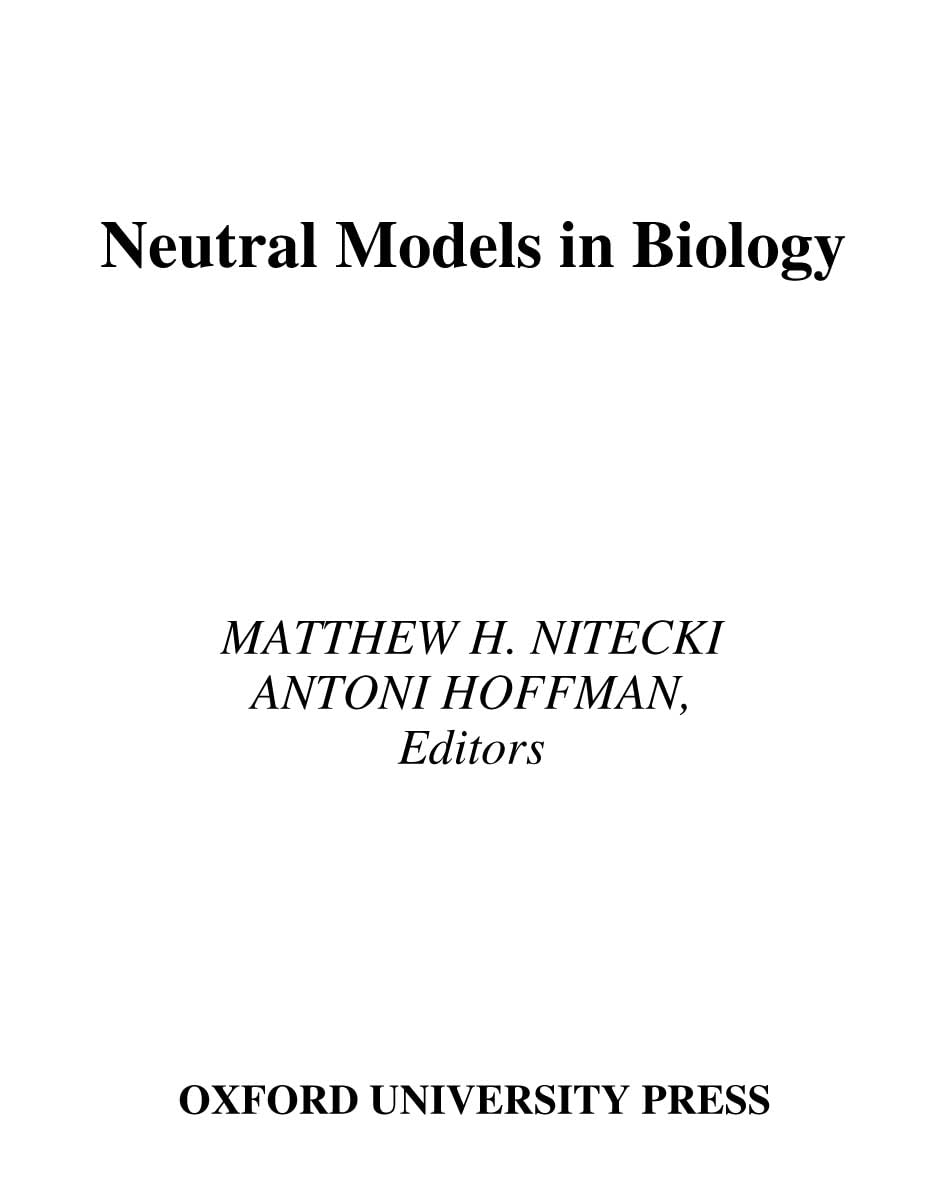
Neutral Models in Biology: A Comprehensive Study of Model Testing in Molecular Biology, Genetics, Ecology, Evolution, an
Inclusive of all applicable taxes. FREE shipping on all orders.
Available Offers
- 🚚Free Delivery — Free shipping on all orders
- 💵Cash on Delivery — Pay when your order arrives
- ↩️15-Day Easy Returns — Hassle-free return policy
- 🔒Cash on Delivery — Pay safely when your order arrives
Check Delivery
Product Description
Introduction
In the vast and intricate world of biological sciences, understanding the underlying mechanisms that shape life often requires stepping back from direct observation. Neutral Models in Biology, edited by Matthew H. Nitecki and published by Oxford University Press, offers a profound exploration into how scientists use theoretical frameworks to test biological hypotheses. This hardcover volume is an essential addition for Indian students and researchers delving into evolutionary biology, ecology, and paleontology, providing a rigorous yet accessible guide to model-based thinking in the life sciences.
Book Overview
This unique collection brings together eight distinguished scientists to examine the role of neutral models—mathematical or conceptual constructs that assume no selective advantage—in testing biological theories. The book bridges molecular biology, genetics, ecology, evolution, and paleontology, demonstrating how neutral models help disentangle complex patterns of form, structure, and behavior. Rather than copying direct observations, these models serve as null hypotheses, allowing scientists to assess whether observed phenomena result from deterministic processes or random chance. With contributions from luminaries like Stephen Stigler, David Raup, Paul Harvey, L.B. Slobodkin, Stuart Kauffman, William Wimsatt, and James Crow, this volume is a treasure trove of intellectual rigor.
Key Highlights
- Interdisciplinary Approach: Covers applications across molecular biology, genetics, ecology, evolution, and paleontology, making it relevant for diverse fields.
- Expert Contributions: Features insights from eight leading scientists, including pioneers in neutral theory and evolutionary dynamics.
- Practical Methodology: Offers clear principles for constructing and testing neutral models, with real-world examples from research.
- Critical Thinking: Encourages readers to question assumptions and evaluate evidence through null hypotheses.
- Timeless Relevance: Published by Oxford University Press, ensuring authoritative content for academic study.
Inside the Book
The volume is structured around core principles of model testing, with each chapter delving into specific applications. Readers will explore how neutral models illuminate patterns in fossil records, genetic drift, species diversity, and molecular evolution. The book balances theoretical foundations with case studies, making complex ideas tangible. For instance, David Raup’s chapter on paleontology uses neutral models to analyze extinction patterns, while Stuart Kauffman explores self-organization and randomness in biological systems. The editors ensure a cohesive narrative, guiding readers from basic concepts to advanced applications without losing clarity.
Key Topics
- Principles of null hypothesis testing in biology
- Neutral models in molecular evolution and genetics
- Randomness versus selection in ecological communities
- Paleontological applications: extinction and diversification
- Self-organization and complexity in biological systems
- Statistical methods for model comparison
- Historical perspectives on neutral theory
Reader Benefits
Indian students and researchers will find this book invaluable for developing analytical skills in biological research. It provides a toolkit for designing experiments and interpreting data without bias, crucial for fields like conservation biology, evolutionary studies, and bioinformatics. The hardcover format ensures durability for frequent reference, while the clear language makes advanced concepts accessible to postgraduate learners. By understanding neutral models, readers can critically evaluate published studies and design robust research projects that stand up to peer review.
Learning Outcomes
- Master the concept of neutral models and their role as null hypotheses in biology
- Apply model-testing frameworks to real-world biological problems
- Distinguish between deterministic and stochastic processes in evolution and ecology
- Critically analyze research papers that use neutral theory
- Develop original hypotheses using neutral model methodology
Who Should Read
This book is ideal for postgraduate students in biology, ecology, genetics, and paleontology, as well as early-career researchers seeking a solid grounding in theoretical biology. Indian university faculty teaching courses in evolutionary biology, biostatistics, or ecological modeling will find it a valuable resource for curriculum design. It also suits advanced undergraduates with a strong interest in quantitative biology and anyone curious about how randomness shapes the natural world.
About the Author
Matthew H. Nitecki is a respected paleontologist and editor known for his work on neutral models and evolutionary theory. He has curated contributions from leading scientists, ensuring the book reflects diverse perspectives. His editorial expertise brings coherence to complex interdisciplinary topics, making this volume a landmark reference in theoretical biology.
About the Publisher
Oxford University Press (OUP) is a globally renowned academic publisher with a strong presence in India. Known for its rigorous editorial standards, OUP produces authoritative texts that support higher education and research. This hardcover edition reflects OUP’s commitment to quality, making it a trusted choice for libraries, institutions, and individual scholars across India.
Conclusion
Neutral Models in Biology is more than a textbook—it is a gateway to deeper scientific thinking. By challenging readers to consider what randomness means in biology, it equips them with tools to ask better questions and find more reliable answers. Whether you are a student navigating evolutionary theory or a researcher refining your methodology, this Oxford University Press hardcover will serve as a lasting companion in your intellectual journey. Order your copy from Bookshops.in today and add a cornerstone of theoretical biology to your library.
Quick Summary
Neutral Models in Biology, edited by Matthew H. Nitecki, is an authoritative volume that brings together eight distinguished scientists to explore the use of neutral models in testing biological theories. Neutral models serve as null hypotheses, allowing researchers to determine whether observed patterns in nature are due to random processes or specific deterministic mechanisms. The book covers a wide range of disciplines including molecular biology, genetics, ecology, evolution, and paleontology, with contributions from notable figures such as Stephen Stigler, David Raup, Paul Harvey, and Stuart Kauffman. Readers will gain a thorough understanding of how to construct and apply neutral models, enhancing their ability to design experiments and interpret complex biological data. This book is ideal for graduate students, researchers, and academics who want to deepen their theoretical foundation in biology. By purchasing from Bookshops.in, Indian readers receive a premium hardcover edition with fast delivery and excellent customer support, making it a valuable addition to any scientific library.
Book Highlights
Book Specifications
| ISBN-13 | 9780195050998 |
| ISBN-10 | 0195050991 |
| Publisher | Oxford Univ Pr on Demand |
| Language | English |
| Dimensions | 16.03 x 1.94 x 24.28 cm |
| Weight | 454 g |
| Category | Biology & Life Sciences › Biology |
| Genre | Non-fiction |
| Original Language | English |
Frequently Asked Questions
What is a neutral model in biology?
Who edited Neutral Models in Biology?
Which topics does this book cover?
Is this book suitable for undergraduate students?
Who are the contributors to this volume?
What is the ISBN of this book?
Why are neutral models important in biology?
Can this book help in ecological research?
Is this book available in hardcover?
What is the price of this book in India?
Does the book include case studies?
What is the language of the book?
Where can I buy this book in India?
Readers Also Search For
Customers Also Bought
Mathematics
Stereotype Spaces and Algebras: 73 (De Gruyter Expositions in Mathematics, 73)

Mathematics
Semigroups in Algebra, Geometry and Analysis: 20 (De Gruyter Expositions in Mathematics, 20)

Mathematics
Geometry from the Pacific Rim: Proceedings of the Pacific Rim Geometry Conference held at National University of Singapore, Republic of Singapore, ... 1994 (De Gruyter Proceedings in Mathematics)
Mathematics
First International Tainan-Moscow Algebra Workshop: Proceedings of the International Conference held at National Cheng Kung University Tainan, Taiwan, ... 1994 (De Gruyter Proceedings in Mathematics)
Mathematics
Group Theory, Algebra, and Number Theory: Colloquium in Memory of Hans Zassenhaus held in Saarbrücken, Germany, June 4-5, 1993
Mathematics
Mathematical Theory of Optimal Processes (Classics of Soviet Mathematics)
Related Products
View All
Biology
Evolution: What the Fossils Say and Why It Matters by Donald R. Prothero
Biology
From Taxonomy to Phylogenetics – Life and Work of Willi Hennig

Biology
The Marine Biology of the South China Sea
Biology
Genetics Meets Metabolomics: from Experiment to Systems Biology
Biology
The Elements of Natural or Experimental Philosophy: 2
Biology