
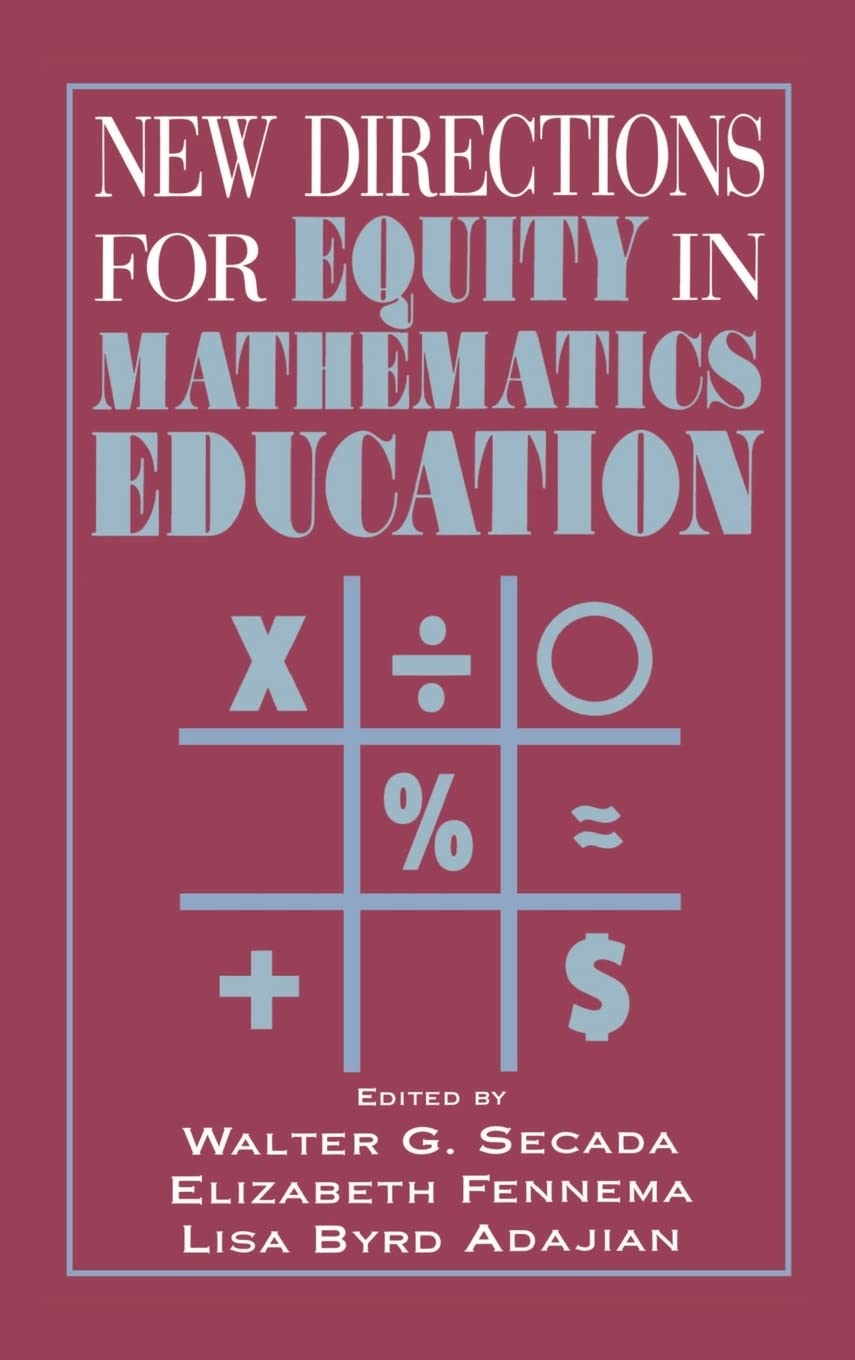
New Directions for Equity in Mathematics Education by Walter G. Secada – A Critical Examination of Social Class, Gender,
Inclusive of all applicable taxes. FREE shipping on all orders.
Available Offers
- 🚚Free Delivery — Free shipping on all orders
- 💵Cash on Delivery — Pay when your order arrives
- ↩️15-Day Easy Returns — Hassle-free return policy
- 🔒Cash on Delivery — Pay safely when your order arrives
Check Delivery
Product Description
Introduction
In classrooms across India and the world, the question of who gets to succeed in mathematics is often answered not by ability, but by background. New Directions for Equity in Mathematics Education, edited by Walter G. Secada, is a landmark volume that confronts this uncomfortable truth head-on. Published by Cambridge University Press, this hardcover edition brings together leading researchers to examine how systemic inequities based on class, gender, and language shape mathematical learning outcomes. For educators, policymakers, and students of education in India, this book offers a rigorous and deeply relevant framework for rethinking mathematics instruction as a tool for social justice.
Book Overview
This collection of scholarly essays moves beyond surface-level discussions of achievement gaps to explore the deep structures that perpetuate inequality in mathematics education. The book is organized into three major sections: the first examines broad cultural and socioeconomic forces, including how notions of merit and social class influence educational opportunities. The second section focuses on gender, analyzing why girls and women continue to face barriers in mathematics classrooms and careers. The third section delves into the role of language, particularly for ethnic and linguistic minority students. Across these sections, recurring themes emerge—critiques of reform movements, the dynamics of classroom power, and the urgent need for teacher empowerment and re-skilling.
Key Highlights
- Multidimensional analysis that connects equity to class, gender, and language in one cohesive volume.
- Critique of reform movements in mathematics education, questioning whether current changes truly serve all students.
- Focus on teacher empowerment and the professional development needed to create equitable classrooms.
- Quantifiable evidence that makes the case for equity both compelling and measurable.
- International perspectives with direct relevance to India’s diverse linguistic and social landscape.
Inside the Book
Readers will find a carefully curated set of chapters that balance theoretical depth with practical insight. The opening chapters interrogate how the very concept of merit is constructed and how it can exclude marginalized students. Later chapters present case studies and classroom-based research that reveal the real-world impact of inequitable practices. The language section is particularly valuable for Indian educators working in multilingual contexts, exploring how mathematical understanding is mediated by the language of instruction. Throughout, the contributors challenge the reader to see mathematics not as a neutral subject, but as a cultural and political space where equity must be actively built.
Key Topics
- Social class and the construction of merit in mathematics education
- Gender disparities in mathematical achievement and participation
- Language, bilingualism, and mathematics learning
- Critique of standards-based reform and its equity implications
- Teacher empowerment, professional development, and classroom dynamics
- Ethnic and linguistic minority students in mathematics classrooms
- Quantitative and qualitative approaches to studying equity
Reader Benefits
This book equips readers with a critical lens to analyze their own educational contexts. Teachers will gain a deeper understanding of how their classroom practices can either reinforce or challenge inequity. Education students will find a rich theoretical foundation for their research or teaching careers. Policymakers will discover evidence-based arguments for systemic change. The interdisciplinary approach ensures that whether your background is in mathematics, sociology, or curriculum studies, you will find actionable insights that go beyond mere statistics.
Learning Outcomes
- Understand the multifaceted nature of equity in mathematics education, including class, gender, and language dimensions.
- Critically evaluate current reform movements and their impact on marginalized students.
- Identify classroom practices that promote or hinder equitable participation in mathematics.
- Develop strategies for teacher empowerment and inclusive pedagogy.
- Apply research findings to real-world educational settings in India and abroad.
Who Should Read
This book is essential for mathematics educators at all levels, from primary school teachers to university faculty. It is equally valuable for education researchers, curriculum developers, and policymakers focused on social justice in education. Students pursuing degrees in education, sociology, or mathematics will find it a thought-provoking resource. Teacher training institutes and B.Ed. programmes in India will benefit from including this volume in their syllabi, as it directly addresses the challenges of teaching mathematics in a linguistically and socially diverse country like ours.
About the Author
Walter G. Secada is a prominent scholar in mathematics education and equity. He has served as a professor and researcher at leading universities, contributing extensively to the discourse on how schooling can be made more just for all students. His work focuses on the intersections of race, class, gender, and language in educational settings, and he has edited multiple influential volumes. Secada’s leadership in this field has shaped policy and practice in the United States and internationally, making him a trusted voice for educators worldwide.
About the Publisher
Cambridge University Press is one of the oldest and most respected academic publishers in the world. With a history spanning over four centuries, it is renowned for producing high-quality scholarly works that advance knowledge across disciplines. This hardcover edition reflects the Press’s commitment to rigorous peer review and enduring academic value. For Indian readers, Cambridge University Press books represent a gold standard in educational and research publishing.
Conclusion
New Directions for Equity in Mathematics Education is not just a book—it is a call to action. In a country as diverse as India, where language, gender, and economic background can determine a child’s mathematical future, this volume provides the critical analysis and practical direction needed to create classrooms that truly serve everyone. Whether you are a teacher, a student, or a policymaker, this book will change how you see mathematics and its role in building a more equitable society. Add this essential hardcover to your library today.
Quick Summary
New Directions for Equity in Mathematics Education, edited by Walter G. Secada and published by Cambridge University Press, is a seminal work that tackles the pressing issue of equitable schooling for ethnic and linguistic minorities through the lens of mathematics education. The book brings together top researchers to explore how social class, gender, and language shape math learning and performance. It critiques the reform movement and offers data-driven insights into disparities that persist in classrooms. This hardcover volume is ideal for educators, policymakers, and researchers who seek to understand and address inequities in mathematics. Readers will learn about the cultural and structural barriers that affect student achievement and discover pathways to create more inclusive math environments. By purchasing from Bookshops.in, Indian readers gain access to a trusted source for academic books that support professional growth and educational reform.
Book Highlights
Book Specifications
| ISBN-13 | 9780521471527 |
| ISBN-10 | 0521471524 |
| Publisher | Cambridge University Press |
| Language | English |
| Dimensions | 16.51 x 1.91 x 24.13 cm |
| Weight | 694 g |
| Country | India |
| Category | Science & Mathematics › Mathematics |
| Genre | Non-fiction |
| Original Language | English |
Frequently Asked Questions
What is New Directions for Equity in Mathematics Education about?
Who is the author of this book?
Is this book suitable for Indian educators?
What topics are covered in the book?
Who is the target audience for this book?
Does the book include case studies?
Is this book a hardcover edition?
Can this book help in curriculum development?
Does the book address gender issues in math?
Is the book based on empirical research?
What is the price of this book?
Where can I buy this book in India?
Does the book discuss language barriers in math?
Is this book suitable for undergraduate students?
Readers Also Search For
Customers Also Bought
Mathematics
Stereotype Spaces and Algebras: 73 (De Gruyter Expositions in Mathematics, 73)

Chemistry
Concise Encyclopedia of Biochemistry

Chemistry
Proceedings of the Third USSR - FRG Symposium, Makhachkala (USSR), October 2–6, 1980: 001

Physics
Quantum Theory at the Crossroads by Guido Bacciagaluppi – Quantum Mechanics History

Physics
The Quantum and Cosmic Codes of the Universe
Mathematics
Mathematical Theory of Optimal Processes (Classics of Soviet Mathematics)
Related Products
View AllMathematics
Stereotype Spaces and Algebras: 73 (De Gruyter Expositions in Mathematics, 73)
Mathematics
Semigroups in Algebra, Geometry and Analysis: 20 (De Gruyter Expositions in Mathematics, 20)
Mathematics
Geometry from the Pacific Rim: Proceedings of the Pacific Rim Geometry Conference held at National University of Singapore, Republic of Singapore, ... 1994 (De Gruyter Proceedings in Mathematics)
Mathematics
First International Tainan-Moscow Algebra Workshop: Proceedings of the International Conference held at National Cheng Kung University Tainan, Taiwan, ... 1994 (De Gruyter Proceedings in Mathematics)

Mathematics
Differential Geometry - Proceedings of the VIII International Colloquium (English, Jesus A. Alvarez Lopez | Eduardo Garcia-Rio)
Mathematics