
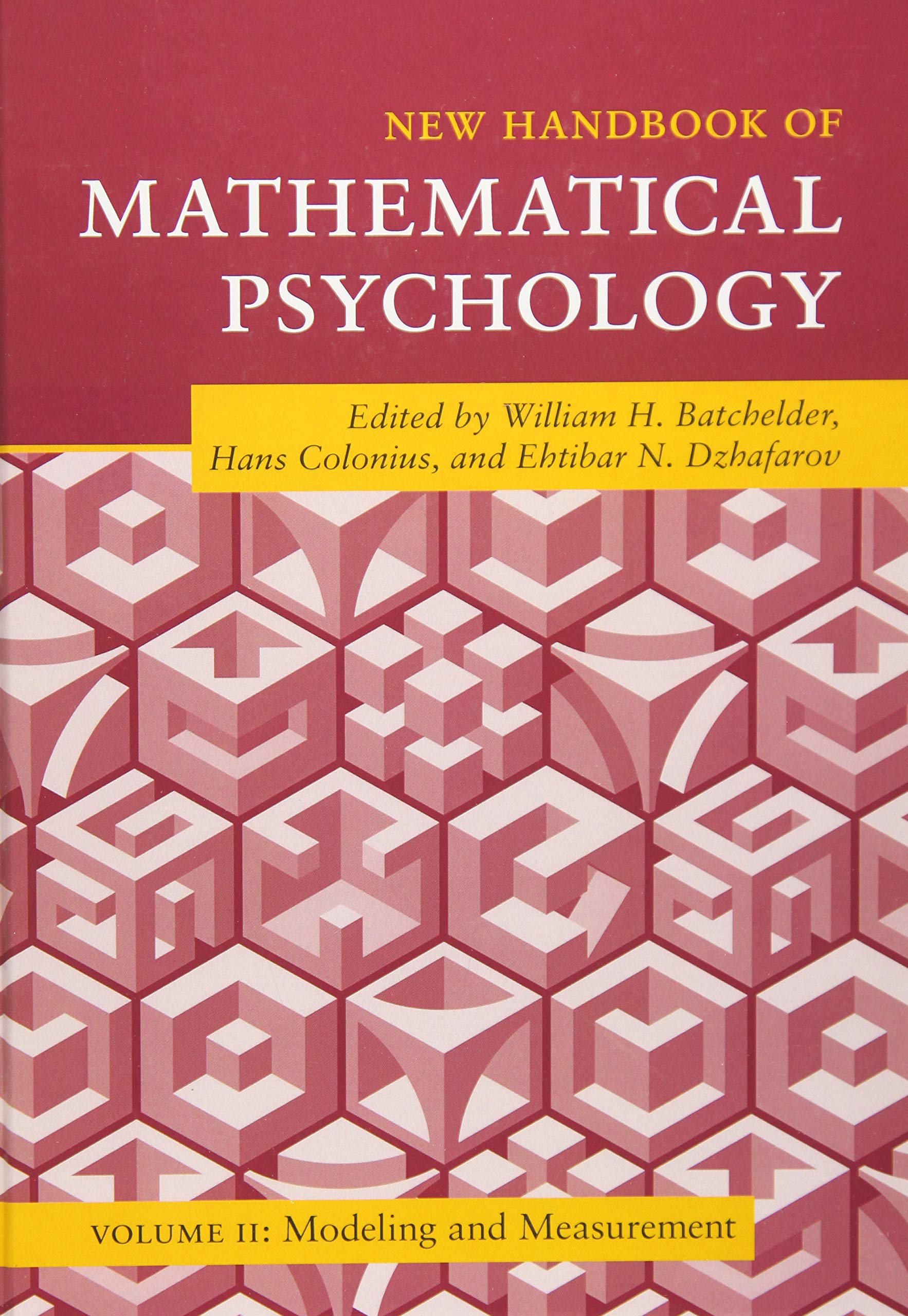
New Handbook of Mathematical Psychology: Modeling and Measurement by William H. Batchelder – A Comprehensive Guide for A
Inclusive of all applicable taxes. FREE shipping on all orders.
Available Offers
- 🚚Free Delivery — Free shipping on all orders
- 💵Cash on Delivery — Pay when your order arrives
- ↩️15-Day Easy Returns — Hassle-free return policy
- 🔒Cash on Delivery — Pay safely when your order arrives
Check Delivery
Product Description
Introduction
Welcome to the definitive guide for students, researchers, and professionals who seek a deep understanding of how mathematics shapes modern psychology. The New Handbook of Mathematical Psychology: Volume 2, Modeling and Measurement is an essential volume that bridges rigorous mathematical theory with practical psychological measurement. Published by Cambridge University Press and edited by William H. Batchelder, this hardbound edition is a treasure trove for those who wish to explore the quantitative foundations of cognitive science and decision-making.
Book Overview
This second volume in the acclaimed New Handbook series focuses specifically on the mathematical and computational tools used to construct models of human cognition and behaviour. It also delves into the critical role of measurement in psychological research. Building on the legacy of the original Handbook from the 1960s, this volume reflects half a century of progress, integrating modern advances in statistics, probability theory, and computational modelling. It is a comprehensive reference for anyone serious about the quantitative aspects of psychology.
Key Highlights
- Authoritative Content: Edited by William H. Batchelder, a leading figure in mathematical psychology, with contributions from top international scholars.
- Focus on Measurement: A dedicated section on measurement theory, including latent variable models, item response theory, and psychometrics.
- Modern Computational Approaches: Coverage of Bayesian methods, Markov chain Monte Carlo, and machine learning as applied to psychological modelling.
- Rigorous yet Accessible: Written for advanced students and researchers, with clear explanations of complex mathematical concepts.
- Indian Context: Ideal for Indian universities and research institutes where quantitative psychology is gaining momentum.
Inside the Book
Open the cover to find a structured journey through the mathematics behind human behaviour. The book is divided into thematic parts that cover foundational mathematics, modelling of cognitive processes, and advanced measurement techniques. Each chapter is self-contained yet builds on the previous, making it suitable for both course adoption and self-study. Real-world examples and exercises help solidify understanding, while the extensive bibliography points to further reading.
Key Topics
- Mathematical Foundations: Probability theory, stochastic processes, and linear algebra tailored for psychological applications.
- Cognitive Modelling: Models of memory, attention, perception, and decision-making, including signal detection theory and reinforcement learning.
- Measurement Theory: Classical test theory, item response theory, and Rasch models.
- Computational Methods: Bayesian inference, hierarchical modelling, and simulation techniques.
- Psychometrics: Scaling, dimensionality reduction, and latent variable models.
Reader Benefits
- Deepen Your Expertise: Gain a thorough grounding in the mathematics that underpin modern psychological research.
- Enhance Your Research: Learn to apply sophisticated modelling and measurement techniques to your own studies.
- Stay Current: Understand the latest developments in psychometrics and computational psychology.
- Career Advancement: Ideal for those pursuing careers in academia, data science, or research in psychology and neuroscience.
- Trusted Source: Cambridge University Press ensures the highest editorial standards.
Learning Outcomes
By working through this volume, readers will be able to: construct and evaluate mathematical models of cognitive processes; apply advanced measurement theories to psychological data; use Bayesian and computational methods for model fitting; critically assess the strengths and limitations of different modelling approaches; and design experiments with a solid quantitative foundation. This book transforms theoretical knowledge into practical skills.
Who Should Read
- Graduate Students: In psychology, cognitive science, neuroscience, or statistics who need a rigorous mathematical background.
- Researchers: In academia or industry who work with behavioural data and want to improve their modelling techniques.
- Psychometricians: Professionals involved in test development, educational measurement, or survey design.
- Data Scientists: With an interest in human behaviour and cognitive modelling.
- Indian Academics: Faculty and students at Indian universities where quantitative psychology is part of the curriculum.
About the Author
William H. Batchelder is a distinguished professor of cognitive sciences and mathematical psychology at the University of California, Irvine. His research spans memory models, decision-making, and psychometrics. He has served as editor of leading journals and is known for his pioneering work on stochastic models of cognition. His editorial leadership ensures that this volume meets the highest standards of scholarship.
About the Publisher
Cambridge University Press is a world-renowned academic publisher with a legacy of excellence in science and mathematics. Their books are trusted by scholars and students globally for their accuracy, depth, and clarity. This volume is part of their prestigious series that advances the frontiers of psychological science.
Conclusion
The New Handbook of Mathematical Psychology: Volume 2, Modeling and Measurement is more than a textbook—it is an investment in your intellectual growth. Whether you are a student navigating the complexities of psychometrics or a researcher seeking robust modelling tools, this book will serve as your trusted companion. Order your hardcover copy from Bookshops.in today and join the ranks of those who master the mathematics of the mind.
Quick Summary
The New Handbook of Mathematical Psychology: Volume 2, Modeling and Measurement, authored by William H. Batchelder and published by Cambridge University Press, is an advanced reference work that explores the mathematical and computational foundations of modern psychological science. Building on the legacy of the original Handbook from the 1960s, this volume addresses contemporary developments in psychometrics, cognitive modeling, decision theory, and statistical methodology. It is intended for graduate students, academic researchers, and professionals in psychology, cognitive science, and related fields who seek rigorous quantitative tools for understanding human behavior. Readers will gain deep insights into latent variable models, Bayesian inference, signal detection theory, and neural network approaches, all presented with clarity and mathematical precision. This hardcover edition is ideal for long-term reference and study. By purchasing from Bookshops.in, Indian customers receive an authentic imported copy with secure packaging and timely delivery, backed by a trusted domestic bookstore dedicated to academic and professional titles.
Book Highlights
Book Specifications
| ISBN-13 | 9781107029071 |
| ISBN-10 | 1107029074 |
| Publisher | Cambridge University Press |
| Language | English |
| Dimensions | 17.78 x 2.54 x 24.77 cm |
| Weight | 1 kg 100 g |
| Category | Science & Mathematics › Mathematics |
| Series | New Handbook of Mathematical Psychology |
| Genre | Non-fiction |
| Original Language | English |
Frequently Asked Questions
What is the New Handbook of Mathematical Psychology about?
Who is the author of this book?
Is this book suitable for beginners?
What mathematical background is required?
Does this book cover Bayesian methods?
Is this a standalone book or part of a series?
What types of psychological models are discussed?
Can this book be used for course instruction?
Does the book include exercises or problems?
Is this book available in Indian bookstores?
What is the price of this book?
Does the book cover item response theory?
Why should I buy from Bookshops.in?
Readers Also Search For
Customers Also Bought

Mathematics
Stereotype Spaces and Algebras: 73 (De Gruyter Expositions in Mathematics, 73)

Mathematics
Semigroups in Algebra, Geometry and Analysis: 20 (De Gruyter Expositions in Mathematics, 20)

Mathematics
Geometry from the Pacific Rim: Proceedings of the Pacific Rim Geometry Conference held at National University of Singapore, Republic of Singapore, ... 1994 (De Gruyter Proceedings in Mathematics)

Mathematics
First International Tainan-Moscow Algebra Workshop: Proceedings of the International Conference held at National Cheng Kung University Tainan, Taiwan, ... 1994 (De Gruyter Proceedings in Mathematics)

Mathematics
Differential Geometry - Proceedings of the VIII International Colloquium (English, Jesus A. Alvarez Lopez | Eduardo Garcia-Rio)
Mathematics
Mathematical Theory of Optimal Processes (Classics of Soviet Mathematics)
Related Products
View AllMathematics
Stereotype Spaces and Algebras: 73 (De Gruyter Expositions in Mathematics, 73)
Mathematics
Semigroups in Algebra, Geometry and Analysis: 20 (De Gruyter Expositions in Mathematics, 20)
Mathematics
Geometry from the Pacific Rim: Proceedings of the Pacific Rim Geometry Conference held at National University of Singapore, Republic of Singapore, ... 1994 (De Gruyter Proceedings in Mathematics)
Mathematics
First International Tainan-Moscow Algebra Workshop: Proceedings of the International Conference held at National Cheng Kung University Tainan, Taiwan, ... 1994 (De Gruyter Proceedings in Mathematics)
Mathematics
Differential Geometry - Proceedings of the VIII International Colloquium (English, Jesus A. Alvarez Lopez | Eduardo Garcia-Rio)
Mathematics