
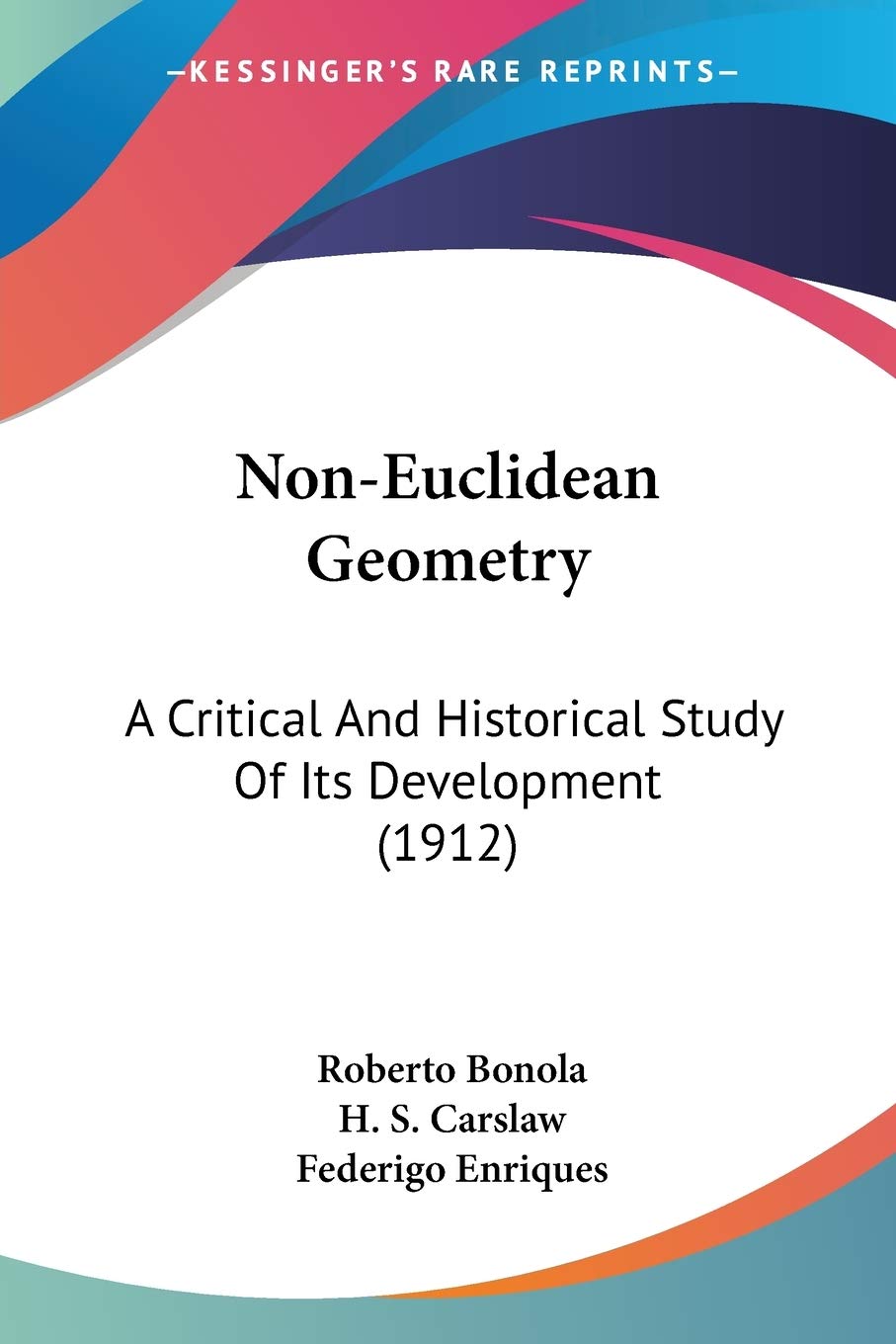
Non-Euclidean Geometry: A Critical and Historical Study of Its Development by Roberto Bonola – A Comprehensive Explorati
Inclusive of all applicable taxes. FREE shipping on all orders.
Available Offers
- 🚚Free Delivery — Free shipping on all orders
- 💵Cash on Delivery — Pay when your order arrives
- ↩️15-Day Easy Returns — Hassle-free return policy
- 🔒Cash on Delivery — Pay safely when your order arrives
Check Delivery
Product Description
Introduction
Non-Euclidean geometry stands as one of the most transformative ideas in the history of mathematics, reshaping our understanding of space, truth, and the very foundations of geometry. In Non-Euclidean Geometry: A Critical and Historical Study of Its Development, Roberto Bonola offers a masterful exploration of this revolutionary subject. Originally published in 1912, this hardcover edition from Kessinger Publishing brings back a classic text that remains essential for students, mathematicians, and history enthusiasts alike. Bonola’s work is not merely a dry exposition of theorems; it is a vivid narrative that traces the intellectual journey from Euclid’s parallel postulate to the groundbreaking insights of Gauss, Lobachevsky, Bolyai, Riemann, and others. For Indian readers seeking a deep, scholarly yet accessible guide to non-Euclidean geometry, this book is an invaluable addition to any library.
Book Overview
Bonola’s book is a comprehensive study that combines rigorous mathematical analysis with rich historical context. It begins by examining the ancient attempts to prove Euclid’s parallel postulate, then moves through the pivotal moments when mathematicians dared to imagine geometries where parallel lines behaved differently. The text covers the independent discoveries of János Bolyai and Nikolai Lobachevsky, the contributions of Carl Friedrich Gauss, and later developments by Bernhard Riemann, Eugenio Beltrami, and Felix Klein. Bonola does not stop at mathematics alone; he delves into the philosophical and cultural implications of non-Euclidean geometry, discussing how it challenged long-held notions of absolute space and influenced modern physics, especially Einstein’s theory of relativity. This hardcover edition preserves the original’s clarity and depth, making it a perfect reference for both academic study and personal enrichment.
Key Highlights
- Comprehensive Historical Narrative: Traces the evolution of non-Euclidean geometry from ancient Greece to the late 19th century, highlighting key breakthroughs and controversies.
- Critical Analysis: Offers more than a simple chronology; Bonola critically evaluates the ideas, proofs, and philosophical debates that shaped the field.
- Original Source Material: Includes translations of important original papers and letters, giving readers direct access to the thoughts of pioneering mathematicians.
- Accessible Yet Scholarly: Written for both advanced students and curious readers, with clear explanations that do not sacrifice mathematical rigor.
- Enduring Relevance: The ideas presented remain foundational for modern geometry, topology, and theoretical physics.
Inside the Book
Inside this volume, readers will find a carefully structured journey. The opening chapters discuss the ancient and medieval attempts to prove the parallel postulate, setting the stage for the revolutionary 19th-century discoveries. Bonola then presents the work of Gauss, Bolyai, and Lobachevsky in detail, including their correspondence and key publications. The middle sections explore the development of hyperbolic geometry, the introduction of models by Beltrami and Klein, and the unification of geometries by Riemann. Later chapters examine the impact of non-Euclidean geometry on the philosophy of mathematics and its role in Einstein’s general relativity. Appendices include historical notes, bibliographic references, and excerpts from rare documents. The hardcover binding ensures durability, making this a lasting resource for repeated study.
Key Topics
- The parallel postulate and its historical attempts at proof
- Gauss’s private investigations and his reluctance to publish
- The independent discovery of hyperbolic geometry by Bolyai and Lobachevsky
- Riemann’s elliptic geometry and the concept of curved space
- Beltrami’s pseudosphere model and Klein’s projective model
- The relationship between non-Euclidean geometry and the foundations of mathematics
- Philosophical implications for space, truth, and reality
- Connections to modern physics, especially relativity theory
Reader Benefits
By reading this book, you will gain a deep appreciation for how non-Euclidean geometry emerged from centuries of intellectual struggle. You will understand the key ideas without needing advanced mathematical training, as Bonola writes with clarity and passion. The historical perspective helps contextualize modern geometry, making abstract concepts feel alive and relevant. Indian students preparing for competitive exams or pursuing higher studies in mathematics will find this book an excellent supplement to standard textbooks. It also benefits teachers and professors seeking engaging historical material to enrich their lectures. Moreover, the philosophical discussions encourage critical thinking about the nature of knowledge and reality—a skill valuable beyond mathematics.
Learning Outcomes
- Understand the historical development of non-Euclidean geometry from its origins to its modern form
- Analyze the logical structure of Euclidean and non-Euclidean geometries and their differences
- Evaluate the contributions of key mathematicians like Gauss, Bolyai, Lobachevsky, Riemann, Beltrami, and Klein
- Recognize the philosophical and cultural impact of non-Euclidean geometry on science and thought
- Apply historical insights to deepen your understanding of contemporary geometry and physics
Who Should Read
This book is ideal for undergraduate and postgraduate students of mathematics, especially those studying geometry, history of mathematics, or foundations of mathematics. It is equally valuable for teachers and professors looking to incorporate historical perspectives into their curriculum. Philosophy students interested in the nature of space and truth will find the discussions enlightening. Additionally, self-learners and enthusiasts with a passion for mathematical history will enjoy Bonola’s engaging narrative. Even physics students curious about the geometric foundations of relativity will benefit from this thorough exposition.
About the Author
Roberto Bonola (1874–1911) was an Italian mathematician and historian of mathematics. He studied at the University of Pavia and later taught at the University of Bologna. Bonola is best known for his deep research into the history of non-Euclidean geometry, which culminated in this seminal work. His ability to blend rigorous mathematics with accessible historical storytelling has made his book a classic. Though he passed away at a young age, his contributions continue to inspire generations of mathematicians and historians.
About the Publisher
Kessinger Publishing is a renowned publisher of rare and classic books, dedicated to preserving important works of scholarship and literature. By issuing high-quality hardcover editions of historical texts, Kessinger ensures that timeless knowledge remains available to modern readers. This edition of Bonola’s work is carefully reproduced to maintain the original’s integrity, making it a reliable and durable addition to any personal or institutional library.
Conclusion
Non-Euclidean Geometry: A Critical and Historical Study of Its Development is more than a book—it is a gateway to understanding a pivotal moment in intellectual history. Roberto Bonola’s meticulous research, clear writing, and philosophical depth make this hardcover edition a treasure for anyone fascinated by the evolution of mathematical ideas. Whether you are a student, teacher, researcher, or curious reader, this book will transform how you think about space, geometry, and the nature of truth. Add it to your collection today from Bookshops.in and embark on a journey through one of mathematics’ most revolutionary stories.
Quick Summary
Non-Euclidean Geometry: A Critical and Historical Study of Its Development by Roberto Bonola is a seminal work that chronicles one of the most profound revolutions in mathematical thought. Originally published in 1912, this book takes readers on a journey from the early speculations of Gauss through the independent discoveries of Lobachevsky and Bolyai, who first formulated consistent non-Euclidean geometries. Bonola then explores the deeper contributions of Riemann, who generalized geometry to curved spaces, and the model-building work of Beltrami and Klein that solidified the field. The book is not merely a historical timeline; it critically analyzes the logical foundations, philosophical implications, and the gradual acceptance of these ideas. For Indian students of mathematics and physics, this book offers an invaluable perspective on how geometry evolved from an absolute system to a flexible tool that underpins modern cosmology and relativity. The hardcover edition from Kessinger Publishing is a durable addition to any academic library. Whether you are preparing for competitive exams or simply fascinated by the history of science, this book provides a rich, engaging narrative that connects abstract mathematics to the physical universe. Order your copy from Bookshops.in and explore the geometry that changed our understanding of space itself.
Book Highlights
Book Specifications
| ISBN-13 | 9780548632437 |
| ISBN-10 | 054863243X |
| Publisher | Kessinger Pub Co |
| Language | English |
| Dimensions | 15.24 x 1.63 x 22.86 cm |
| Weight | 417 g |
| Country | India |
| Category | Mathematics › Geometry |
| Genre | Non-fiction |
| Reading Age | 18+ |
| Original Language | Italian |
Frequently Asked Questions
What is Non-Euclidean Geometry: A Critical and Historical Study about?
Who is the author of this book?
Is this book suitable for Indian mathematics students?
What topics are covered in the book?
Is this a textbook or a historical account?
Does the book require prior knowledge of advanced mathematics?
Is this edition a hardcover?
Why is non-Euclidean geometry important?
Can this book help with competitive exams in India?
Are there any exercises or problems in the book?
What is the ISBN of this book?
Is this book available in Indian bookstores?
What is the price of this book?
Readers Also Search For
Customers Also Bought
Mathematics
Stereotype Spaces and Algebras: 73 (De Gruyter Expositions in Mathematics, 73)
Mathematics
Semigroups in Algebra, Geometry and Analysis: 20 (De Gruyter Expositions in Mathematics, 20)
Mathematics
Geometry from the Pacific Rim: Proceedings of the Pacific Rim Geometry Conference held at National University of Singapore, Republic of Singapore, ... 1994 (De Gruyter Proceedings in Mathematics)
Mathematics
First International Tainan-Moscow Algebra Workshop: Proceedings of the International Conference held at National Cheng Kung University Tainan, Taiwan, ... 1994 (De Gruyter Proceedings in Mathematics)
Mathematics
Differential Geometry - Proceedings of the VIII International Colloquium (English, Jesus A. Alvarez Lopez | Eduardo Garcia-Rio)
Mathematics
Mathematical Theory of Optimal Processes (Classics of Soviet Mathematics)
Related Products
View AllMathematics
Stereotype Spaces and Algebras: 73 (De Gruyter Expositions in Mathematics, 73)
Mathematics
Semigroups in Algebra, Geometry and Analysis: 20 (De Gruyter Expositions in Mathematics, 20)
Mathematics
Geometry from the Pacific Rim: Proceedings of the Pacific Rim Geometry Conference held at National University of Singapore, Republic of Singapore, ... 1994 (De Gruyter Proceedings in Mathematics)
Mathematics
First International Tainan-Moscow Algebra Workshop: Proceedings of the International Conference held at National Cheng Kung University Tainan, Taiwan, ... 1994 (De Gruyter Proceedings in Mathematics)
Mathematics
Differential Geometry - Proceedings of the VIII International Colloquium (English, Jesus A. Alvarez Lopez | Eduardo Garcia-Rio)
Mathematics