
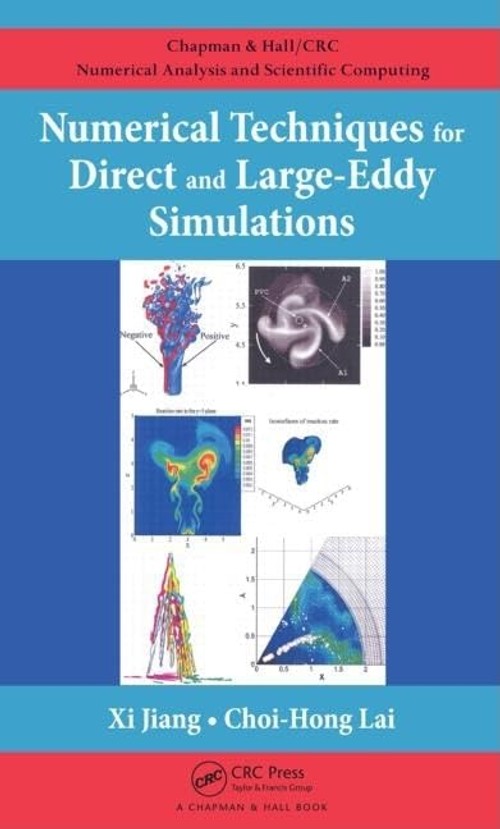
Numerical Techniques for Direct and Large-Eddy Simulations by Xi Jiang – A Comprehensive Guide to Advanced Computational
Inclusive of all applicable taxes. FREE shipping on all orders.
Available Offers
- 🚚Free Delivery — Free shipping on all orders
- 💵Cash on Delivery — Pay when your order arrives
- ↩️15-Day Easy Returns — Hassle-free return policy
- 🔒Cash on Delivery — Pay safely when your order arrives
Check Delivery
Product Description
Introduction
In the ever-evolving field of computational fluid dynamics (CFD), the ability to capture unsteady flow features with high fidelity has become indispensable. Numerical Techniques for Direct and Large-Eddy Simulations by Xi Jiang offers a rigorous yet accessible guide to the advanced numerical methods that underpin direct numerical simulation (DNS) and large-eddy simulation (LES). This hardcover volume from CRC Press is an essential resource for Indian graduate students, researchers, and practicing engineers who seek to master the computational tools required for simulating turbulent flows and combustion phenomena.
Book Overview
This book systematically bridges the gap between fundamental CFD theory and the practical implementation of DNS and LES. It begins with the Navier–Stokes equations and the philosophical underpinnings of DNS and LES, then moves into boundary conditions, time integration, and spatial discretization techniques. The author pays special attention to the numerical challenges unique to incompressible and compressible flows, providing algorithms that can be directly applied to real-world problems. The text is designed to be self-contained, making it suitable for both classroom instruction and self-study.
Key Highlights
- Comprehensive coverage of numerical techniques for both DNS and LES in a single volume.
- Practical focus on boundary conditions and time integration methods critical for stable simulations.
- Detailed treatment of incompressible and compressible flow solvers with worked examples.
- Application-oriented chapters on turbulent combustion and multiphase flows.
- Algorithmic clarity with step-by-step explanations suitable for Indian engineering curricula.
Inside the Book
The book is structured into twelve chapters that progress logically from fundamentals to advanced topics. Early chapters establish the mathematical foundation of the Navier–Stokes equations and the conceptual framework of DNS and LES. Subsequent chapters delve into numerical discretization schemes, including finite difference, finite volume, and spectral methods. A significant portion is devoted to the treatment of boundary conditions—a common source of error in simulations. The latter half of the book explores LES subgrid-scale models, hybrid RANS-LES methods, and the specific numerical requirements for reacting flows and combustion.
Key Topics
- Navier–Stokes equations and turbulence modeling basics
- Direct numerical simulation methodology for incompressible flows
- Large-eddy simulation techniques and subgrid-scale modeling
- Boundary conditions: inflow, outflow, wall, and periodic
- Time integration: explicit, implicit, and fractional-step methods
- Spatial discretization: high-order schemes and compact differencing
- Compressible flow DNS: shock capturing and numerical stability
- LES for turbulent combustion and reacting flows
Reader Benefits
Readers will gain a deep understanding of how to design, implement, and validate numerical codes for DNS and LES. The book emphasizes error analysis and stability criteria, helping researchers avoid common pitfalls. By working through the algorithms presented, students will be able to simulate complex flows—such as jet flames, boundary layer transitions, and bluff-body wakes—with confidence. The practical tips on parallel computing and data post-processing further enhance the book's utility in high-performance computing environments common in Indian research labs.
Learning Outcomes
- Ability to formulate and discretize the Navier–Stokes equations for DNS and LES.
- Proficiency in selecting appropriate boundary conditions and time integration schemes.
- Skill in implementing high-order numerical methods for accurate flow resolution.
- Competence in analyzing simulation results and validating against experimental data.
- Understanding of the limitations and best practices for LES in industrial applications.
Who Should Read
This book is ideal for postgraduate students in aerospace, mechanical, chemical, and civil engineering who are specializing in fluid dynamics or combustion. It is also a valuable reference for PhD scholars and faculty members working on turbulence modeling, renewable energy systems, or propulsion. Practicing engineers in the Indian automotive, energy, and defense sectors who use CFD tools will find the numerical insights directly applicable to their work. The book assumes a basic knowledge of fluid mechanics and numerical methods, making it accessible to senior undergraduate students as well.
About the Author
Xi Jiang is a distinguished researcher and academic with extensive experience in computational fluid dynamics and turbulent combustion. Currently affiliated with a leading university, Dr. Jiang has published numerous peer-reviewed papers on DNS and LES of reacting flows. His teaching and research focus on developing robust numerical algorithms for complex flow phenomena, and this book distills his years of expertise into a coherent pedagogical framework.
About the Publisher
CRC Press is a globally respected publisher of scientific and technical books, known for its rigorous editorial standards and commitment to advancing engineering knowledge. With a strong catalog in fluid mechanics, combustion, and numerical methods, CRC Press ensures that this volume meets the highest quality benchmarks for academic and professional readers in India and worldwide.
Conclusion
Numerical Techniques for Direct and Large-Eddy Simulations is more than a textbook—it is a practical toolkit for anyone serious about high-fidelity flow simulation. Whether you are a student embarking on your first DNS project or a seasoned researcher refining your LES code, Xi Jiang's clear explanations and algorithm-focused approach will accelerate your learning and enhance your results. Add this essential hardcover to your library today and unlock the full potential of direct and large-eddy simulation.
Quick Summary
Numerical Techniques for Direct and Large-Eddy Simulations by Xi Jiang is a comprehensive guide to the numerical methods underlying direct numerical simulation (DNS) and large-eddy simulation (LES) for fluid flow, turbulence, and combustion. The book begins with the Navier-Stokes equations and progresses through DNS and LES methodologies, boundary conditions, numerical schemes, grid generation, and parallel computing. It is designed for graduate students, researchers, and practicing engineers in mechanical, aerospace, and chemical engineering who need to perform high-fidelity simulations of unsteady and turbulent flows. Readers will learn to implement accurate numerical techniques, handle complex geometries, and model reacting flows. The book's practical orientation, including case studies and validation strategies, makes it an essential resource for anyone involved in computational fluid dynamics. By purchasing from Bookshops.in, Indian readers receive a genuine hardcover copy with reliable delivery and customer support, ensuring a valuable addition to their academic or professional library.
Book Highlights
Book Specifications
| ISBN-13 | 9781420075786 |
| ISBN-10 | 1420075780 |
| Publisher | CRC Pr I Llc |
| Language | English |
| Dimensions | 15.75 x 2.54 x 23.62 cm |
| Weight | 612 g |
| Category | Mathematics › Algebra & Trigonometry |
| Genre | Academic |
| Original Language | English |
Frequently Asked Questions
What is the main focus of this book?
Who is the author of this book?
Is this book suitable for beginners in CFD?
Does the book cover combustion modeling?
What type of numerical schemes are discussed?
Are boundary conditions explained in detail?
Does the book include parallel computing techniques?
Is this book useful for Indian engineering students?
What is the ISBN of this book?
Is the book available in hardcover?
Does the book provide practical examples?
Can this book be used for self-study?
What is the price of the book?
Where can I buy this book in India?
Readers Also Search For
Customers Also Bought
Mathematics
Stereotype Spaces and Algebras: 73 (De Gruyter Expositions in Mathematics, 73)

Mathematics
Semigroups in Algebra, Geometry and Analysis: 20 (De Gruyter Expositions in Mathematics, 20)
Mathematics
Geometry from the Pacific Rim: Proceedings of the Pacific Rim Geometry Conference held at National University of Singapore, Republic of Singapore, ... 1994 (De Gruyter Proceedings in Mathematics)
Mathematics
First International Tainan-Moscow Algebra Workshop: Proceedings of the International Conference held at National Cheng Kung University Tainan, Taiwan, ... 1994 (De Gruyter Proceedings in Mathematics)

Mathematics
Differential Geometry - Proceedings of the VIII International Colloquium (English, Jesus A. Alvarez Lopez | Eduardo Garcia-Rio)
Mathematics
Mathematical Theory of Optimal Processes (Classics of Soviet Mathematics)
Related Products
View AllMathematics
Stereotype Spaces and Algebras: 73 (De Gruyter Expositions in Mathematics, 73)
Mathematics
Semigroups in Algebra, Geometry and Analysis: 20 (De Gruyter Expositions in Mathematics, 20)
Mathematics
Geometry from the Pacific Rim: Proceedings of the Pacific Rim Geometry Conference held at National University of Singapore, Republic of Singapore, ... 1994 (De Gruyter Proceedings in Mathematics)
Mathematics
First International Tainan-Moscow Algebra Workshop: Proceedings of the International Conference held at National Cheng Kung University Tainan, Taiwan, ... 1994 (De Gruyter Proceedings in Mathematics)
Mathematics
Differential Geometry - Proceedings of the VIII International Colloquium (English, Jesus A. Alvarez Lopez | Eduardo Garcia-Rio)
Mathematics