
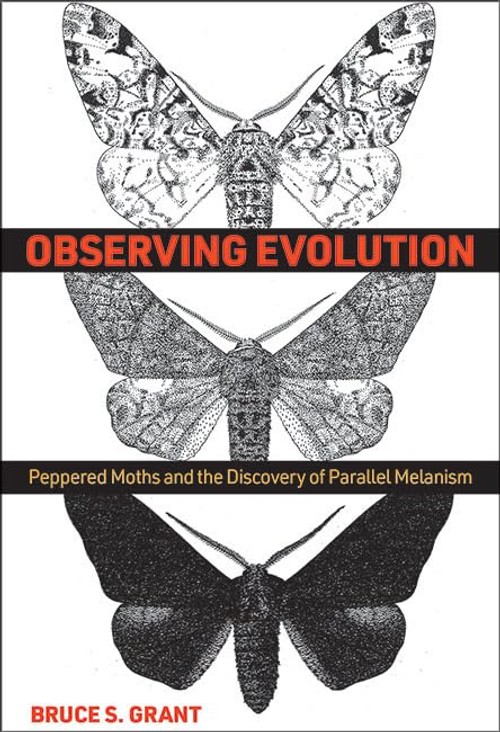
Observing Evolution: Peppered Moths and the Discovery of Parallel Melanism by Bruce S. Grant – A Definitive Account of N
Inclusive of all applicable taxes. FREE shipping on all orders.
Available Offers
- 🚚Free Delivery — Free shipping on all orders
- 💵Cash on Delivery — Pay when your order arrives
- ↩️15-Day Easy Returns — Hassle-free return policy
- 🔒Cash on Delivery — Pay safely when your order arrives
Check Delivery
Product Description
Introduction
In the vast theatre of evolutionary biology, few stories are as compelling as that of the peppered moth. Observing Evolution: Peppered Moths and the Discovery of Parallel Melanism by Bruce S. Grant brings to life the remarkable journey of how a small, unassuming moth became a cornerstone of Darwin’s theory of natural selection. Published by Johns Hopkins University Press, this hardcover volume is an essential addition to the library of every Indian student, teacher, and science enthusiast who wishes to understand the real-world evidence behind evolution.
Book Overview
This book is not merely a scientific account; it is a firsthand narrative of scientific discovery, controversy, and vindication. Bruce S. Grant, an evolutionary biologist with decades of field experience, recounts how the peppered moth (Biston betularia) transformed from a speckled grey insect into a black form during Britain’s Industrial Revolution. The soot-covered trees made the lighter moths visible to predators, while the darker variants thrived—a textbook example of natural selection in action. But the story does not end there. Grant details the challenges posed by creationist critiques and how modern research, including his own meticulous fieldwork, ultimately reaffirmed this classic case of industrial melanism.
Key Highlights
- Firsthand Account: Bruce S. Grant shares his personal journey of studying peppered moths across continents, offering readers an authentic scientist’s perspective.
- Parallel Melanism: The book reveals how similar dark forms of the peppered moth appeared independently in different regions, providing powerful evidence for parallel evolution.
- Historical Context: From the early twentieth-century discoveries to the creationist controversies of the 1990s, this work places the peppered moth story in its full historical and cultural context.
- Rigorous Science: Grant presents decades of data, including predation experiments and genetic studies, making the science accessible yet thorough.
Inside the Book
Readers will journey through the fields of England, the forests of North America, and the laboratories where genetic secrets were unlocked. The book includes detailed descriptions of field experiments, photographs of moths in their natural habitats, and clear explanations of the genetic basis of melanism. Grant does not shy away from the controversies: he addresses the criticisms of early experiments and shows how new techniques—like computer vision and molecular genetics—settled the debate. The narrative is enriched with anecdotes about fellow scientists, the thrill of discovery, and the persistence required to defend a foundational idea.
Key Topics
- Industrial melanism and its role as a model for natural selection
- The genetics of wing coloration in peppered moths
- Parallel evolution: how similar traits evolve independently
- The history of evolutionary biology in the twentieth century
- Creationist challenges to evolutionary science
- Fieldwork techniques: observation, collection, and predation experiments
- The impact of pollution on species adaptation
Reader Benefits
By reading this book, you will gain a deep appreciation for how science works—through observation, hypothesis testing, and revision. You will understand why the peppered moth remains one of the most important examples of evolution in action. The book equips you to critically evaluate arguments against evolution, making it a valuable resource for debates and discussions. For Indian readers, the parallels with local examples of adaptation—such as the colour changes in urban birds or insects—become clear, enriching your understanding of biology in your own environment.
Learning Outcomes
- Understand the mechanism of natural selection using a real-world case study
- Learn how genetic variation leads to adaptive traits in populations
- Recognize the role of environmental change in driving evolution
- Develop skills to evaluate scientific evidence and counter misinformation
- Gain insight into the life and work of a dedicated field biologist
Who Should Read
This book is ideal for undergraduate and postgraduate students of biology, zoology, and genetics. It is equally valuable for high school teachers looking for engaging examples to illustrate evolution in the classroom. Science communicators, naturalists, and anyone curious about how life adapts will find this narrative both enlightening and inspiring. For Indian readers preparing for competitive exams like NEET, CSIR-NET, or GATE in life sciences, this book offers a deep dive into a classic evolutionary example that often appears in syllabi.
About the Author
Bruce S. Grant is an emeritus professor of biology at the College of William & Mary in Virginia, USA. With over forty years of research on the peppered moth, he is one of the world’s leading authorities on industrial melanism. His work has been published in top scientific journals, and he has spent countless nights in the field observing moths. This book is the culmination of his lifetime of study, written with both scientific rigour and a storyteller’s flair.
About the Publisher
Johns Hopkins University Press is one of the oldest and most respected academic publishers in the United States. Known for its high-quality science, medicine, and history titles, the press has a reputation for bringing authoritative works to a global audience. This hardcover edition reflects their commitment to excellence in publishing.
Conclusion
Observing Evolution is more than a book about moths; it is a testament to the power of careful observation and the resilience of scientific truth. Bruce S. Grant’s narrative will leave you with a profound respect for the natural world and the scientists who dedicate their lives to understanding it. Whether you are a student, a teacher, or a lifelong learner, this book will deepen your understanding of evolution and inspire you to look at the living world with new eyes. Order your copy from Bookshops.in today and witness the story of evolution unfold.
Quick Summary
Observing Evolution: Peppered Moths and the Discovery of Parallel Melanism by Bruce S. Grant is a riveting scientific narrative that takes readers behind the scenes of one of biology's most iconic case studies. The book chronicles how the peppered moth (Biston betularia) became a living proof of Darwin's theory of natural selection, as its coloration shifted from speckled to black during the Industrial Revolution. Grant, an evolutionary biologist who personally studied these moths, provides a firsthand account of the research, the controversies, and the eventual confirmation of parallel melanism. This book is ideal for Indian students of life sciences, educators, and anyone fascinated by evolution. Readers will learn how environmental change drives genetic adaptation, how science corrects its own errors, and why the peppered moth remains a powerful symbol of evolution in action. By purchasing from Bookshops.in, you get a premium hardcover edition delivered across India, supporting a trusted local bookstore.
Book Highlights
Book Specifications
| ISBN-13 | 9781421441658 |
| ISBN-10 | 1421441659 |
| Publisher | Johns Hopkins University Press |
| Language | English |
| Dimensions | 15.24 x 2.74 x 22.86 cm |
| Weight | 590 g |
| Country | USA |
| Category | Biology & Life Sciences › Biology |
| Genre | Non-fiction |
| Reading Age | 18+ |
| Original Language | English |
Frequently Asked Questions
What is Observing Evolution about?
Who is Bruce S. Grant?
Is this book suitable for Indian students?
Does the book cover the creationism controversy?
What is parallel melanism?
Is this a textbook or a narrative?
Can I buy this book from Bookshops.in?
What is the price of this book in India?
Does the book include illustrations?
What is the reading level?
Does it discuss other examples of evolution?
Why is the peppered moth important?
Readers Also Search For
Customers Also Bought

Mathematics
Stereotype Spaces and Algebras: 73 (De Gruyter Expositions in Mathematics, 73)

Mathematics
Semigroups in Algebra, Geometry and Analysis: 20 (De Gruyter Expositions in Mathematics, 20)

Mathematics
Geometry from the Pacific Rim: Proceedings of the Pacific Rim Geometry Conference held at National University of Singapore, Republic of Singapore, ... 1994 (De Gruyter Proceedings in Mathematics)

Mathematics
First International Tainan-Moscow Algebra Workshop: Proceedings of the International Conference held at National Cheng Kung University Tainan, Taiwan, ... 1994 (De Gruyter Proceedings in Mathematics)

Mathematics
Differential Geometry - Proceedings of the VIII International Colloquium (English, Jesus A. Alvarez Lopez | Eduardo Garcia-Rio)

Mathematics
Mathematical Theory of Optimal Processes (Classics of Soviet Mathematics)
Related Products
View All
Biology
Evolution: What the Fossils Say and Why It Matters by Donald R. Prothero
Biology
From Taxonomy to Phylogenetics – Life and Work of Willi Hennig

Biology
The Marine Biology of the South China Sea

Biology
Genetics Meets Metabolomics: from Experiment to Systems Biology
Biology
The Elements of Natural or Experimental Philosophy: 2

Biology