
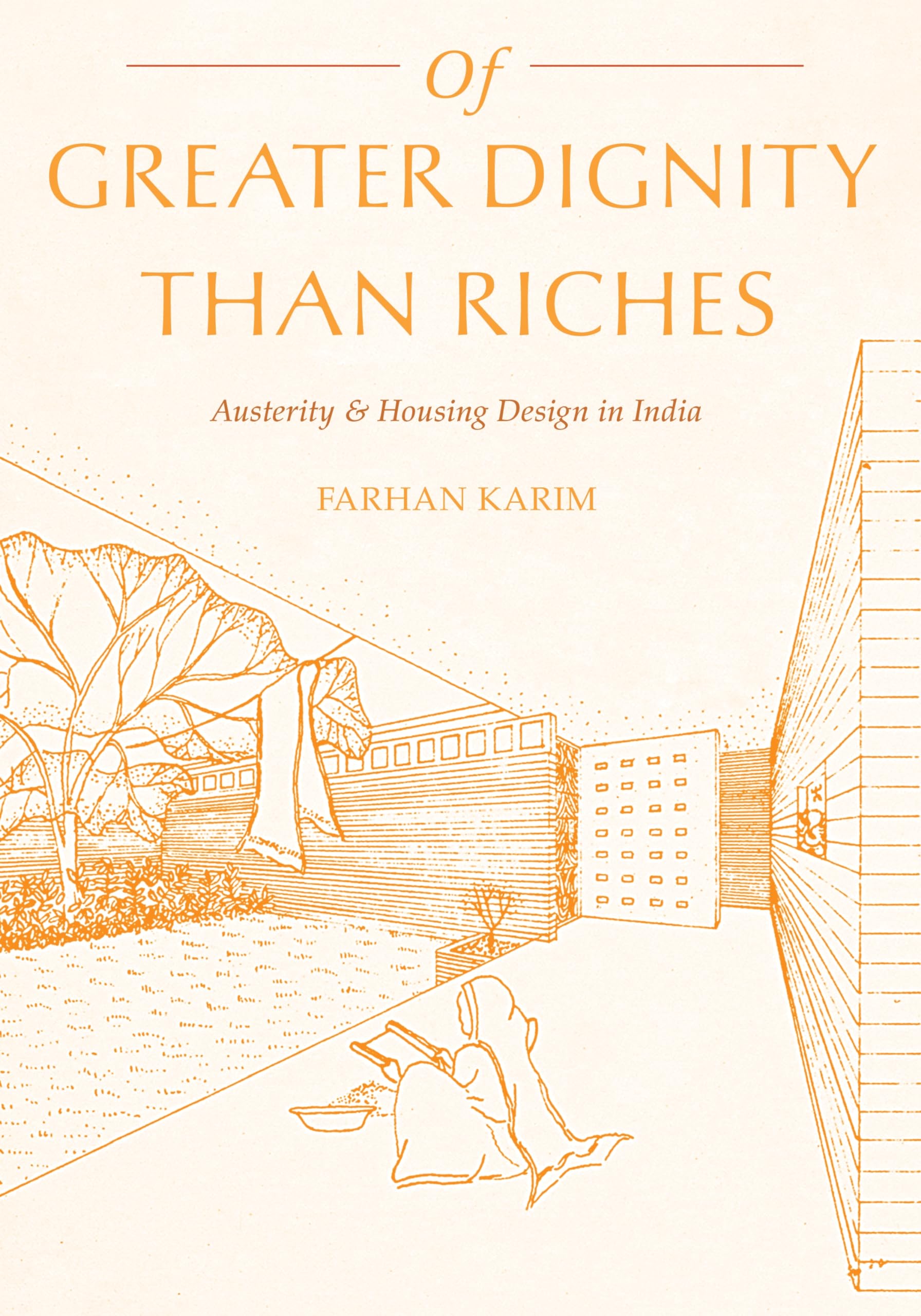
Of Greater Dignity Than Riches: Austerity & Housing Design in India by Farhan Karim – A Study of Architecture, Scarcity,
Inclusive of all applicable taxes. FREE shipping on all orders.
Available Offers
- 🚚Free Delivery — Free shipping on all orders
- 💵Cash on Delivery — Pay when your order arrives
- ↩️15-Day Easy Returns — Hassle-free return policy
- 🔒Cash on Delivery — Pay safely when your order arrives
Check Delivery
Product Description
Introduction
Of Greater Dignity Than Riches: Austerity & Housing Design in India by Farhan Karim is a groundbreaking exploration of how economic scarcity shaped architectural modernism and housing policy in India. Published by the University of Pittsburgh Press, this hardcover volume offers a critical lens on the intersection of poverty, design, and postcolonial development. It challenges readers to rethink austerity not as a limitation, but as a creative force that redefined the domestic spaces of India’s working class and urban poor from the 1920s through independence and beyond.
Book Overview
This meticulously researched work traces the international origins of austerity as a guiding principle in Indian housing design. Karim examines how architects, engineers, government bodies, and international agencies collaborated to create model villages, communities, and ideal homes for low-income populations. By turning scarcity into a stylized architectural representation, the book reveals how poverty itself became a design problem—and a political statement. It is a must-read for anyone interested in the social history of architecture, urban planning, and development studies in India.
Key Highlights
- Original Research: Draws on archival materials from India, the UK, and the US to uncover untold stories of modernist housing experiments.
- Interdisciplinary Approach: Bridges architecture, history, economics, and postcolonial theory.
- Visual Documentation: Includes photographs, plans, and diagrams of housing projects from colonial and postcolonial India.
- Critical Perspective: Challenges conventional narratives of modernism as a purely Western import.
Inside the Book
The book is divided into thematic chapters that move chronologically from the 1920s to the 1960s. It begins with colonial-era responses to urban poverty, then shifts to post-independence initiatives by the Indian government and international organizations like the Ford Foundation. Karim examines specific case studies, such as the design of industrial workers’ colonies in Bombay and Calcutta, and the vision of model villages in rural India. Each chapter unpacks how austerity was encoded into floor plans, building materials, and community layouts.
Key Topics
- Colonial Poverty and Housing: The impact of famine, disease, and exploitation on urban slums.
- Architectural Modernism: How scarcity inspired minimalist, functional designs.
- Postcolonial Development: The role of the state and NGOs in housing reform.
- Stylized Austerity: The transformation of poverty into a visual and spatial language.
- International Networks: Collaboration between Indian architects and global experts.
Reader Benefits
- Deepen Your Understanding: Gain insights into the social and political forces behind India’s built environment.
- Enhance Your Studies: Ideal supplementary reading for courses in architecture, urban studies, and South Asian history.
- Critical Thinking: Develop a nuanced view of how design can both reflect and reinforce economic inequalities.
- Practical Knowledge: Learn from historical examples that remain relevant to contemporary housing challenges.
Learning Outcomes
After reading this book, you will be able to: articulate the connection between economic scarcity and architectural innovation in modern India; analyze the role of international agencies in shaping domestic spaces; critique the representation of poverty in design discourse; and identify key moments in the history of Indian housing policy from the colonial to the postcolonial era.
Who Should Read
- Architecture Students & Professionals: Those interested in modernism, housing, and design ethics.
- Historians & Researchers: Scholars of South Asia, colonialism, and development studies.
- Urban Planners & Policy Makers: Practitioners looking for historical context on affordable housing.
- General Readers: Anyone curious about how India’s cities and homes were shaped by poverty and aspiration.
About the Author
Farhan Karim is an architectural historian and educator whose research focuses on the global history of modern architecture, with a special emphasis on South Asia. He has taught at universities in the United States and India, and his work has been published in leading journals. Karim brings a unique perspective that combines rigorous archival research with a deep commitment to social justice.
About the Publisher
University of Pittsburgh Press is a respected academic publisher known for its contributions to architecture, urban studies, and global history. With a reputation for producing high-quality, scholarly works, the press ensures that this hardcover edition is both durable and beautifully produced—perfect for library collections or personal study.
Conclusion
Of Greater Dignity Than Riches is an essential addition to the library of anyone passionate about Indian architecture, urban history, or the politics of development. Farhan Karim’s original research and compelling narrative reveal how austerity, far from being a mere constraint, became a powerful tool for imagining a more equitable future. Order your copy from Bookshops.in today and explore the hidden stories behind India’s modernist housing.
Quick Summary
Of Greater Dignity Than Riches by Farhan Karim is a groundbreaking study that repositions economic scarcity as a central driver of architectural modernism in India. The book begins in the 1920s, when extreme poverty—exacerbated by colonial exploitation, famine, and disease—prompted architects, engineers, and city authorities to propose new housing models for the urban poor and industrial workers. Karim traces how austerity became an essential ingredient of postcolonial development, as the Indian government, businesses, NGOs, and intergovernmental agencies took major initiatives to modernize housing conditions. This work is ideal for architecture students, urban planners, historians, and anyone interested in the intersection of economics, design, and social justice. Readers will learn how scarcity inspired innovative design solutions and how colonial legacies continued to shape housing policy after independence. By purchasing from Bookshops.in, you support a premium Indian bookstore that offers authentic imported editions, secure delivery, and excellent customer service.
Book Highlights
Book Specifications
| ISBN-13 | 9780822965695 |
| ISBN-10 | 0822965690 |
| Publisher | Univ of Pittsburgh Pr |
| Language | English |
| Dimensions | 15.24 x 2.54 x 22.86 cm |
| Weight | 1 kg 20 g |
| Category | Region & Countries › Asia |
| Genre | Architecture, History, Urban Studies |
| Original Language | English |
Frequently Asked Questions
What is the main theme of Of Greater Dignity Than Riches?
Who is the author of this book?
What time period does the book cover?
Is this book suitable for academic research?
Does the book discuss international influences on Indian housing?
What kind of housing does the book focus on?
How does the book connect austerity to architecture?
Is this book only about India?
What is the binding of this book?
Can I use this book for coursework?
Does the book include images or illustrations?
What is the price of the book?
Is the book available in other languages?
Who is the publisher?
Readers Also Search For
Related Products
View All
History
The Information Revolution: Transforming the World Through Technology (World History)

History
Human Nature and the French Revolution: From the Enlightenment to the Napoleonic Code: 3 (Polygons: Cultural Diversities and Intersections, 3)
History
The Unmaking of Home in Contemporary Art (Cultural Spaces)

History
Handbook to Life in Medieval and Early Modern Japan | by William E. Deal | Oxford University Press | by William E. Deal | Oxford University Press | by William E. Deal | Oxford University Press | by William E. Deal | Oxford University Press | by William E. Deal | Oxford University Press | by William E. Deal | Oxford University Press | by William E. Deal | Oxford University Press | by William E. Deal | Oxford University Press | by William E. Deal | Oxford University Press | by William E. Deal | Ox

History
The Narrators of Barbarian History (A.D. 550-800) | by Walter Goffart | University of Notre Dame Press | by Walter Goffart | University of Notre Dame Press | by Walter Goffart | University of Notre Dame Press | by Walter Goffart | University of Notre Dame Press | by Walter Goffart | University of Notre Dame Press | by Walter Goffart | University of Notre Dame Press | by Walter Goffart | University of Notre Dame Press | by Walter Goffart | University of Notre Dame Press | by Walter Goffart | Univ

History