
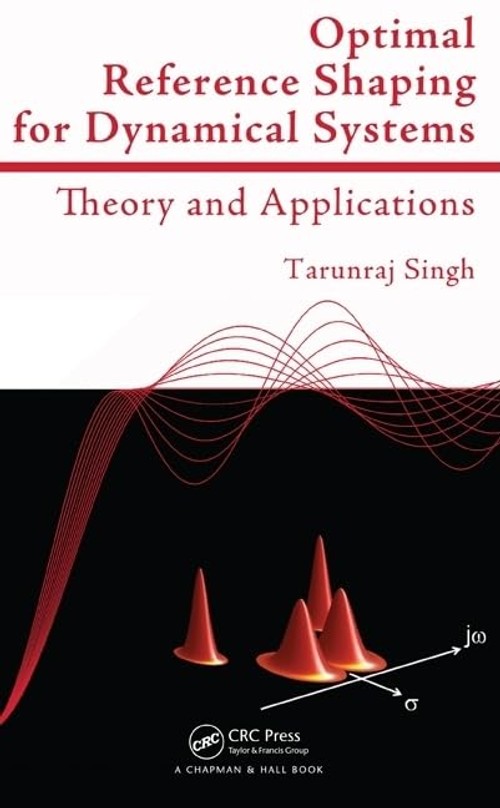
Optimal Reference Shaping for Dynamical Systems: Theory and Applications by Tarunraj Singh – A Comprehensive Guide to Fe
Inclusive of all applicable taxes. FREE shipping on all orders.
Available Offers
- 🚚Free Delivery — Free shipping on all orders
- 💵Cash on Delivery — Pay when your order arrives
- ↩️15-Day Easy Returns — Hassle-free return policy
- 🔒Cash on Delivery — Pay safely when your order arrives
Check Delivery
Product Description
Introduction
In the realm of modern control systems, the integration of feedforward and feedback control has emerged as a transformative approach to enhance performance beyond what feedback alone can achieve. Optimal Reference Shaping for Dynamical Systems: Theory and Applications by Tarunraj Singh offers a comprehensive exploration of feedforward control techniques, with a special focus on shaping reference inputs to suppress residual oscillations. This hardcover volume, published by CRC Press, is an essential resource for engineers, researchers, and students in India who seek to master the art of reference shaping for stable or marginally stable systems.
Book Overview
This book systematically bridges the gap between theoretical foundations and practical implementations. It begins by developing models for applications where dynamics are dominated by lightly damped poles—common in flexible structures, robotics, and precision motion systems. The text then introduces the time-delay filter (input shaper) design technique, followed by a thorough review of the calculus of variations. From there, it delves into four core control problems: time-optimal, fuel/time-optimal, fuel-limited time-optimal, and jerk-limited time-optimal control. Each concept is illustrated through benchmark problems, making the material accessible and immediately applicable.
Key Highlights
- Comprehensive coverage of reference shaping algorithms for attenuating residual oscillations in dynamical systems.
- Integration of theory and practice with numerous benchmark problems and real-world examples.
- Focus on feedforward control as a complement to feedback systems, enhancing overall control performance.
- Detailed treatment of time-delay filters and calculus of variations for optimal control design.
- Hardcover edition from CRC Press, ensuring durability for repeated reference in academic and professional settings.
Inside the Book
The book is structured to guide readers from foundational concepts to advanced applications. Early chapters establish the mathematical groundwork, including state-space representations and the principles of optimal control. Subsequent chapters explore specific shaping techniques, such as input shaping for vibration reduction and reference profiling for motion systems. The final sections present case studies that demonstrate how these methods are applied to real-world problems, from robotic arms to aerospace structures. Each chapter includes exercises and problems that reinforce learning and encourage hands-on experimentation.
Key Topics
- Time-delay filter design and input shaping for residual vibration suppression.
- Time-optimal and fuel-optimal control strategies for dynamical systems.
- Fuel-limited and jerk-limited optimal control formulations.
- Calculus of variations and its role in reference shaping optimization.
- Application of shaping techniques to stable and marginally stable systems.
- Benchmark problems illustrating practical implementation in engineering domains.
Reader Benefits
Readers will gain a deep understanding of how to design reference inputs that minimize unwanted oscillations, leading to faster settling times and improved precision in control systems. The book equips professionals with tools to enhance the performance of feedback-controlled systems without requiring extensive hardware modifications. Students will appreciate the clear explanations and step-by-step derivations, which build confidence in tackling complex control problems. Researchers will find the latest algorithmic insights useful for advancing the field of feedforward control.
Learning Outcomes
- Ability to model dynamical systems with lightly damped poles for reference shaping.
- Proficiency in designing time-delay filters and input shapers for vibration control.
- Understanding of time-optimal, fuel-optimal, and jerk-limited control frameworks.
- Skill in applying calculus of variations to optimize reference trajectories.
- Competence in implementing reference shaping techniques in real-world engineering applications.
Who Should Read
This book is ideal for graduate students and researchers in control engineering, mechanical engineering, aerospace engineering, and robotics. Practicing engineers working on motion control, vibration suppression, and precision positioning systems will find it invaluable. It is also suitable for advanced undergraduate students with a background in linear systems and feedback control. Indian readers, especially those involved in automotive, defence, and industrial automation sectors, will benefit from the practical focus on real-world benchmark problems.
About the Author
Tarunraj Singh is a distinguished academic and researcher in the field of control systems. With years of experience teaching and developing advanced control algorithms, he has contributed significantly to the understanding of optimal reference shaping. His work bridges theoretical rigor and practical application, making complex concepts accessible to a wide audience. This book reflects his commitment to equipping the next generation of engineers with cutting-edge tools for dynamical system control.
About the Publisher
CRC Press is a globally renowned publisher of scientific and technical books, known for its high-quality content in engineering, mathematics, and applied sciences. With a legacy of publishing authoritative works, CRC Press ensures that each title meets rigorous academic and professional standards. This hardcover edition is a testament to the publisher's dedication to providing durable, well-edited resources for scholars and practitioners alike.
Conclusion
Optimal Reference Shaping for Dynamical Systems: Theory and Applications is a definitive guide for anyone serious about advancing their knowledge of feedforward control and vibration suppression. By blending theory with practical examples, Tarunraj Singh delivers a resource that is both intellectually stimulating and directly applicable to engineering challenges. Whether you are a student, researcher, or professional engineer, this CRC Press hardcover will serve as a valuable addition to your library, helping you design smarter, more efficient control systems.
Quick Summary
Optimal Reference Shaping for Dynamical Systems: Theory and Applications by Tarunraj Singh is a definitive guide on feedforward control techniques designed to minimize residual oscillations in dynamical systems. The book delves into time-delay filters and input shaping algorithms, which are essential for improving the performance of stable and marginally stable systems—including those already stabilized by feedback control. Through benchmark problems and detailed mathematical derivations, readers learn to model systems dominated by lightly damped poles and apply reference shaping to achieve superior control. This text is ideal for graduate students, researchers, and practicing engineers in fields like robotics, aerospace, and mechanical engineering who seek to enhance system precision and reduce vibration. By purchasing from Bookshops.in, Indian readers gain access to an authoritative CRC Press hardcover edition, ensuring a durable and reliable resource for academic and professional growth.
Book Highlights
Book Specifications
| ISBN-13 | 9781439805626 |
| ISBN-10 | 1439805628 |
| Publisher | CRC Pr I Llc |
| Language | English |
| Dimensions | 15.88 x 2.54 x 23.5 cm |
| Weight | 726 g |
| Country | India |
| Category | Electrical & Electronic Engineering › Electronics |
| Genre | Engineering |
| Original Language | English |
Frequently Asked Questions
What is the main focus of this book?
Who is the author of Optimal Reference Shaping for Dynamical Systems?
Is this book suitable for beginners in control theory?
Does the book cover practical applications?
What type of systems can benefit from the techniques in this book?
Is this book available in hardcover?
What is the ISBN-13 of this book?
Does the book include mathematical derivations?
Can this book help in reducing vibrations in robotic systems?
Is this book relevant for aerospace engineering?
Does the book require prior knowledge of feedback control?
Are there any review ratings for this book?
Where can I buy this book in India?
Readers Also Search For
Customers Also Bought
Computer Science
Spring 2.5 Aspect Oriented Programming (English, Massimiliano Dess� | Massimiliano Dessi)
Computer Science
Asterisk 1.4 - the Professional's Guide (English, Colman Carpenter | David Duffett | Nik Middleton)
Computer Science
Advances In Natural Language Processing: 4th International Conference, Estal 2004, Alicante, Spain, October 20-22, 2004. Proceedings: 3230 (Lecture Notes in Computer Science)
Computer Science
Multimedia, Communication and Computing Application: Proceedings of the 2014 International Conference on Multimedia, Communication and Computing ... 2014), Xiamen, China, October 16-17, 2014
Computer Science
Cases on Database Technologies and Applications (Cases on Information Technology Series)
Computer Science
ASP.Net 3.5 Social Networking (English, Andrew Siemer)
Related Products
View All
Electronics
Multiprocessor System-on-Chip: Hardware Design and Tool Integration
Electronics
Robust Sram Designs and Analysis
Electronics
Computational Accelerator Physics 2003 (English, M. Berz | K. Makino)
Electronics
Tiny Machine Learning Techniques for Constrained Devices (English, Khalid El-Makkaoui | Ismail Lamaakal | Ibrahim Ouahbi)
Electronics
Applied Computer Vision and Soft Computing with Interpretable AI (English, Swati V. Shinde | Darshan V. Medhane | Oscar Castillo)

Electronics