
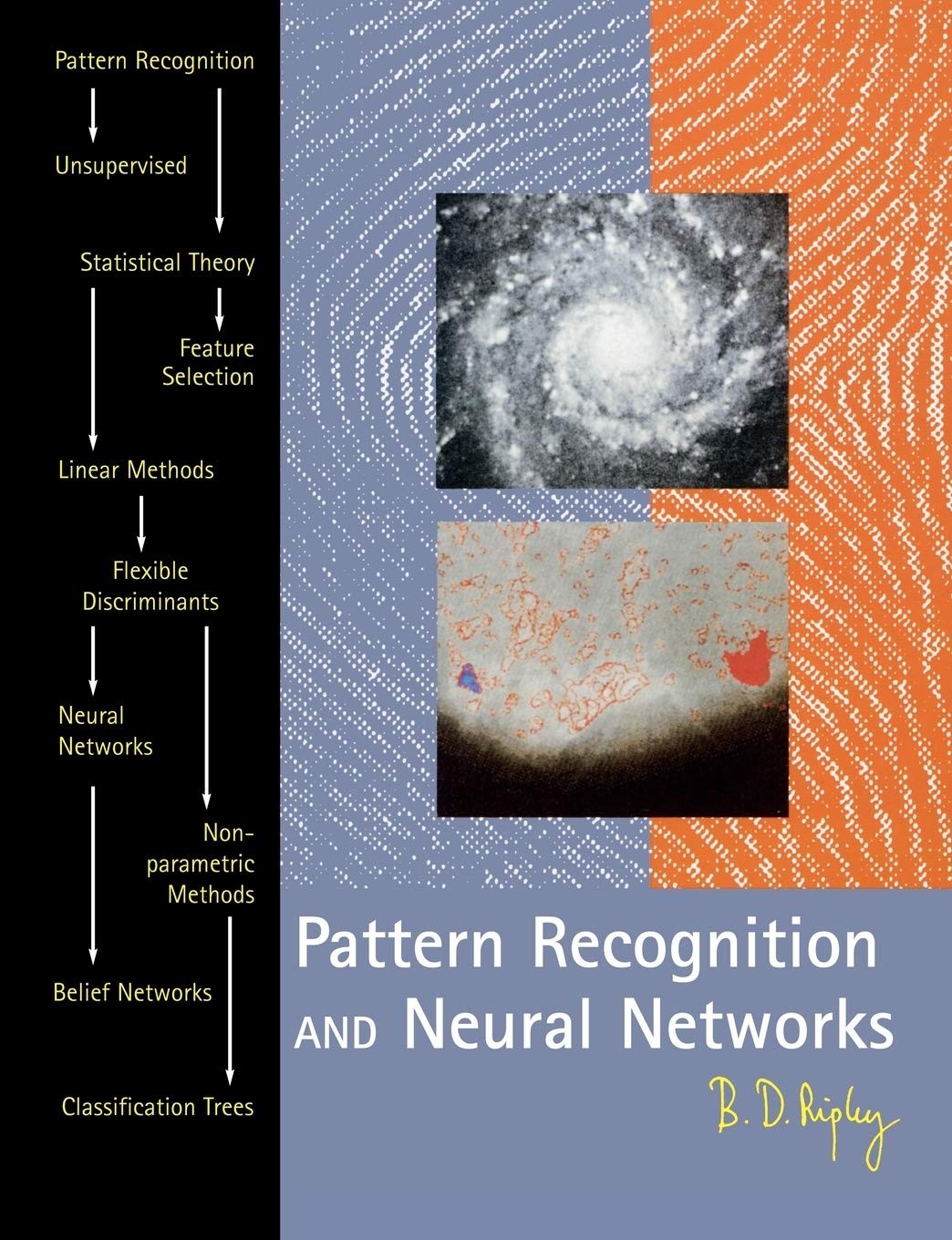
Pattern Recognition and Neural Networks: A Statistical Framework for Machine Learning by Brian D. Ripley
Inclusive of all applicable taxes. FREE shipping on all orders.
Available Offers
- 🚚Free Delivery — Free shipping on all orders
- 💵Cash on Delivery — Pay when your order arrives
- ↩️15-Day Easy Returns — Hassle-free return policy
- 🔒Cash on Delivery — Pay safely when your order arrives
Check Delivery
Product Description
Introduction
Pattern recognition and neural networks form the backbone of modern artificial intelligence, and few books explain their statistical foundations as clearly as Brian D. Ripley's classic work. This hardcover edition from Cambridge University Press is an essential resource for Indian students, researchers, and professionals who want a rigorous yet accessible introduction to the subject. Whether you are preparing for advanced studies in machine learning or applying pattern recognition in fields like remote sensing, medical imaging, or engineering, this book offers timeless insights that remain relevant decades after its first publication.
Book Overview
First published in 1996, Pattern Recognition and Neural Networks provides a comprehensive statistical framework for understanding how machines learn from data. Ripley masterfully bridges theory and practice, covering both classical pattern recognition techniques and neural network architectures. The book is renowned for its wealth of real-world case studies, drawn from diverse domains such as astrophysics, medicine, and engineering. Each example is accompanied by actual datasets, many of which are freely available online, allowing readers to replicate results and deepen their understanding. The writing is clear and methodical, making it suitable for both specialists and newcomers to the field.
Key Highlights
- Statistical Rigour: A thorough grounding in probability, decision theory, and estimation methods that underpin all modern machine learning.
- Extensive Case Studies: Over 30 real datasets from fields like handwriting recognition, satellite imagery, and medical diagnosis illustrate practical applications.
- Unifying Principles: Highlights common themes across different algorithms, helping readers see the big picture rather than memorising isolated techniques.
- Author's Website: Access to the original datasets used in the book for hands-on learning and experimentation.
- Enduring Relevance: Despite being over two decades old, the fundamental concepts remain essential for anyone serious about AI and statistics.
Inside the Book
The book is organised into nine chapters, each building on the previous one. Early chapters introduce basic concepts like Bayes decision theory, density estimation, and linear discriminant analysis. Later chapters delve into multilayer perceptrons, radial basis functions, and support vector machines—all explained from a probabilistic perspective. Ripley also covers important topics like model selection, overfitting, and cross-validation, which are crucial for building reliable systems. Numerous exercises and examples are integrated throughout, ensuring that theoretical knowledge is immediately applied to concrete problems.
Key Topics
- Bayesian decision theory and classification
- Density estimation and non-parametric methods
- Linear and quadratic discriminant analysis
- Neural network architectures: perceptrons, MLPs, RBFs
- Learning algorithms: backpropagation, conjugate gradients
- Model complexity, regularisation, and validation
- Mixture models and hidden Markov models
- Applications in image analysis, speech recognition, and bioinformatics
Reader Benefits
Indian readers will appreciate the book's focus on foundational mathematics rather than fleeting trends. It is ideal for self-study, with clear derivations and intuitive explanations that do not assume prior knowledge of neural networks. The case studies use datasets that are easy to relate to, such as handwritten digit recognition and medical diagnosis, making the material immediately relevant. By working through the examples and exercises, you will develop a deep understanding of how pattern recognition algorithms work—and why they sometimes fail. This book will also prepare you for more advanced texts in statistical learning and deep learning.
Learning Outcomes
- Understand the statistical principles behind pattern recognition and neural networks
- Implement and evaluate classifiers using real-world datasets
- Choose appropriate models and avoid common pitfalls like overfitting
- Interpret results with confidence using probabilistic reasoning
- Appreciate the connections between classical statistics and modern machine learning
Who Should Read
This book is perfect for postgraduate students in statistics, computer science, and engineering who are taking courses in machine learning or pattern recognition. It is also invaluable for researchers and industry professionals who want a solid theoretical foundation without sacrificing practical relevance. Indian faculty members teaching AI or data science courses will find it a reliable reference for lectures and assignments. Even self-taught practitioners who have worked with neural networks will gain new insights by revisiting the statistical underpinnings.
About the Author
Brian D. Ripley is a distinguished statistician and Emeritus Professor of Applied Statistics at the University of Oxford. He is widely recognised for his contributions to spatial statistics, pattern recognition, and computational statistics. His research has influenced fields ranging from ecology to machine learning, and he has authored several seminal textbooks. Ripley's clear, no-nonsense writing style makes complex topics accessible without oversimplifying them.
About the Publisher
Cambridge University Press is one of the oldest and most respected academic publishers in the world. With a history dating back to 1534, it has a strong tradition of publishing authoritative works in science, mathematics, and technology. This hardcover edition is printed on high-quality paper, ensuring durability for years of frequent use. For Indian readers, Cambridge University Press books are widely available through trusted retailers like Bookshops.in, offering genuine editions at competitive prices.
Conclusion
Pattern Recognition and Neural Networks by Brian D. Ripley is more than a textbook—it is a masterclass in statistical thinking. Its combination of rigorous theory, practical examples, and accessible writing makes it a must-have for anyone serious about AI and machine learning. Whether you are a student in Bangalore, a researcher in Delhi, or a professional in Mumbai, this book will equip you with the tools to understand and build intelligent systems. Add it to your library today and discover why it remains a trusted reference for generations of data scientists.
Quick Summary
Pattern Recognition and Neural Networks by Brian D. Ripley is a classic statistical textbook that provides a rigorous foundation for understanding pattern recognition and machine learning. Written by a leading Oxford statistician, the book bridges theory and practice through numerous real-world case studies from fields such as remote sensing, astrophysics, engineering, and medicine. Readers will learn about discriminant analysis, neural network architectures, Bayesian decision theory, kernel methods, clustering, and model validation techniques. The author emphasizes unifying principles and offers practical advice for applying these methods to real data. With datasets available on the author's website, this book is ideal for graduate students, researchers, and data scientists who want a deep statistical understanding of pattern recognition. By purchasing from Bookshops.in, Indian readers get a premium hardcover edition at a competitive price, delivered reliably across the country.
Book Highlights
Book Specifications
| ISBN-13 | 9780521717700 |
| ISBN-10 | 0521717701 |
| Publisher | Cambridge University Press |
| Language | English |
| Dimensions | 18.9 x 2.39 x 24.61 cm |
| Weight | 880 g |
| Country | United Kingdom |
| Category | Mathematics › Statistics |
| Genre | Non-fiction |
| Original Language | English |
Frequently Asked Questions
Is this book suitable for beginners in machine learning?
Does the book cover deep learning?
Are there exercises in the book?
Can I use this book for a university course?
Does the book include practical coding examples?
Is the book still relevant given newer ML books?
Does the author provide online resources?
What subjects does the book cover besides neural networks?
Who is Brian D. Ripley?
Can I use this for self-study?
What is the price of this book?
Does the book cover unsupervised learning?
Readers Also Search For
Customers Also Bought
Mathematics
Stereotype Spaces and Algebras: 73 (De Gruyter Expositions in Mathematics, 73)
Mathematics
Semigroups in Algebra, Geometry and Analysis: 20 (De Gruyter Expositions in Mathematics, 20)

Mathematics
Geometry from the Pacific Rim: Proceedings of the Pacific Rim Geometry Conference held at National University of Singapore, Republic of Singapore, ... 1994 (De Gruyter Proceedings in Mathematics)

Mathematics
First International Tainan-Moscow Algebra Workshop: Proceedings of the International Conference held at National Cheng Kung University Tainan, Taiwan, ... 1994 (De Gruyter Proceedings in Mathematics)

Mathematics
Differential Geometry - Proceedings of the VIII International Colloquium (English, Jesus A. Alvarez Lopez | Eduardo Garcia-Rio)
Mathematics
Mathematical Theory of Optimal Processes (Classics of Soviet Mathematics)
Related Products
View All
Statistics
Asymptotics in Statistics and Probability: Papers in Honor of George Gregory Roussas

Statistics
Inequalities in Analysis and Probability: 3rd Edition
Statistics
Random Graphs, Geometry and Asymptotic Structure
Statistics
Inference for Functional Data With Applications: 200 (Springer Series in Statistics, 692)
Statistics
High-Dimensional Probability: An Introduction with Applications in Data Science (Cambridge Series in Statistical and Probabilistic Mathematics)
Statistics