
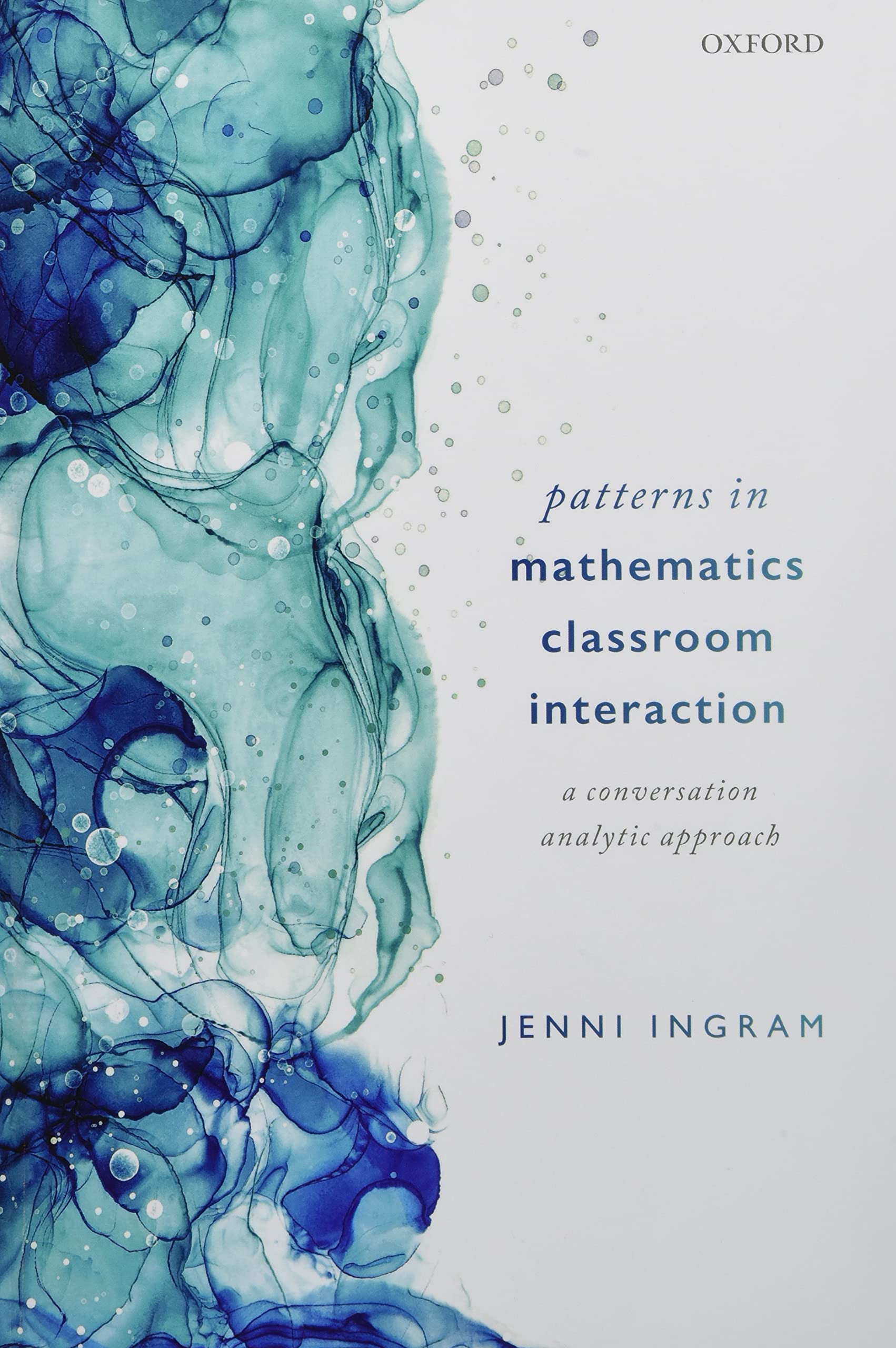
Patterns in Mathematics Classroom Interaction: A Conversation Analytic Approach by Jenni Ingram – Understanding Talk, Er
Inclusive of all applicable taxes. FREE shipping on all orders.
Available Offers
- 🚚Free Delivery — Free shipping on all orders
- 💵Cash on Delivery — Pay when your order arrives
- ↩️15-Day Easy Returns — Hassle-free return policy
- 🔒Cash on Delivery — Pay safely when your order arrives
Check Delivery
Product Description
Introduction
In the landscape of mathematics education, the rhythm of classroom talk often determines how deeply students absorb concepts, reason through problems, and build lasting mathematical intuition. Patterns in Mathematics Classroom Interaction: A Conversation Analytic Approach by Jenni Ingram offers a groundbreaking lens into the subtle yet powerful structures of teacher-student dialogue. Published by Oxford University Press, this hardbound volume is an essential resource for educators, researchers, and teacher-educators across India who seek to understand how everyday interactions shape mathematical learning.
Book Overview
This scholarly work takes a Conversation Analytic (CA) perspective to dissect the moment-by-moment exchanges that occur in mathematics classrooms. Rather than focusing solely on curriculum or pedagogy, Ingram zeroes in on the turn-taking, pauses, repairs, and sequences that define how mathematical ideas are co-constructed. The book reveals that patterns such as how errors are handled, how silence is used, and how knowledge is treated can either open or close opportunities for deep understanding. With real classroom data and transcript excerpts, it bridges theory and practice, making complex interactional patterns accessible to readers.
Key Highlights
- A Conversation Analytic framework applied specifically to mathematics teaching and learning
- Detailed examination of how errors and difficulties are managed in real-time classroom talk
- Insights into the role of silence—how pauses and waiting time influence student reasoning
- Analysis of how teachers and students treat knowledge, understanding, and explanation during lessons
- Rich transcript examples from actual mathematics classrooms, illustrating interactional patterns
Inside the Book
The book is structured to guide readers from foundational concepts to nuanced applications. Early chapters introduce the principles of Conversation Analysis and its relevance to mathematics education. Subsequent chapters explore specific interactional phenomena: how teachers initiate and respond to student contributions, how students explain their reasoning, and how the classroom environment shapes the mathematics that is experienced. Each chapter includes annotated transcripts and reflective questions, encouraging readers to connect the analysis with their own teaching contexts. The final chapters consider implications for teacher training and classroom practice, offering actionable insights for improving mathematical discourse.
Key Topics
- Conversation Analysis in educational settings
- Turn-taking and sequence organization in math classrooms
- Handling of student errors and misconceptions
- The function of silence and wait time in promoting thinking
- Co-construction of mathematical knowledge through dialogue
- Interactional resources for explaining, justifying, and reasoning
Reader Benefits
By engaging with this book, readers will develop a heightened awareness of the subtle dynamics that influence learning. Teachers can refine their questioning techniques and response strategies to foster more inclusive and productive discussions. Researchers will gain a robust methodological toolkit for analyzing classroom talk. Teacher educators will find rich material for training programmes focused on discourse-based pedagogies. Ultimately, this book empowers readers to see classroom interaction not just as a medium for teaching, but as the very fabric of mathematical meaning-making.
Learning Outcomes
- Understand the core principles of Conversation Analysis and its application to mathematics education
- Identify common interactional patterns that support or hinder mathematical reasoning
- Analyze transcript data to uncover how errors and explanations are managed
- Apply insights to design more dialogic and student-centred mathematics lessons
- Evaluate the role of silence, repetition, and reformulation in building conceptual understanding
Who Should Read
This book is ideal for mathematics teachers at primary, secondary, and tertiary levels who wish to deepen their understanding of classroom discourse. It is equally valuable for teacher educators, curriculum developers, and postgraduate students in mathematics education, applied linguistics, or educational research. School administrators and policy makers interested in evidence-based teaching practices will also find the interactional insights transformative for professional development programmes.
About the Author
Jenni Ingram is a respected researcher in mathematics education, known for her expertise in Conversation Analysis and classroom interaction. She has published extensively on how talk shapes learning in mathematics, and her work bridges linguistic analysis with pedagogical practice. Her research has influenced teacher training programmes and contributed to a deeper understanding of the social dynamics of learning.
About the Publisher
Oxford University Press (OUP) is a globally renowned academic publisher with a strong commitment to advancing knowledge through high-quality scholarly and educational books. With a presence in India for over a century, OUP publishes works that support research, teaching, and learning across disciplines. This hardcover edition reflects OUP's dedication to rigorous scholarship and lasting value for the academic community.
Conclusion
Patterns in Mathematics Classroom Interaction is more than a research monograph—it is a practical guide for anyone who believes that the way we talk in class profoundly influences what students learn. Jenni Ingram's careful analysis offers a fresh perspective on familiar classroom moments, turning everyday interactions into opportunities for growth. For Indian educators striving to create more engaging and equitable mathematics classrooms, this book provides both the theoretical foundation and the practical tools to transform teaching and learning. Order your copy from Bookshops.in today and begin your journey into the hidden patterns of classroom talk.
Quick Summary
Patterns in Mathematics Classroom Interaction: A Conversation Analytic Approach by Jenni Ingram is a groundbreaking book that delves into the intricate ways teachers and students talk during mathematics lessons. Using the lens of Conversation Analysis, the author dissects real classroom recordings to reveal how interaction patterns—such as questioning, error correction, and silence—directly influence what and how students learn math. The book is not just a theoretical treatise; it offers practical insights for educators who want to foster deeper mathematical understanding through better communication. It shows that errors, often seen as setbacks, can be powerful learning catalysts when handled with care, and that silence can indicate contemplation rather than confusion. This volume is ideal for mathematics teachers, teacher trainers, education researchers, and postgraduate students in India who seek evidence-based strategies to improve classroom discourse. By choosing Bookshops.in, you support a local bookstore that values academic excellence and prompt delivery across the country. Whether you are a seasoned educator or a budding researcher, this book will transform how you view every exchange in your classroom.
Book Highlights
Book Specifications
| ISBN-13 | 9780198869313 |
| ISBN-10 | 0198869312 |
| Publisher | OUP Oxford |
| Language | English |
| Dimensions | 23.37 x 2.03 x 15.49 cm |
| Weight | 431 g |
| Category | Science & Mathematics › Mathematics |
| Genre | Non-fiction |
| Original Language | English |
Frequently Asked Questions
What is this book about?
Who is the author?
Is this book suitable for Indian teachers?
What makes this book different from other teaching guides?
Does the book cover error handling?
Is there a focus on silence in class?
What is Conversation Analysis?
Can this help me improve my teaching?
Is this book research-based?
What age group does it cover?
Is it a textbook or a research monograph?
Does it include practical examples?
Where can I buy this book in India?
Is the book hardcover?
Readers Also Search For
Customers Also Bought
Mathematics
Stereotype Spaces and Algebras: 73 (De Gruyter Expositions in Mathematics, 73)
Mathematics
Semigroups in Algebra, Geometry and Analysis: 20 (De Gruyter Expositions in Mathematics, 20)
Mathematics
Geometry from the Pacific Rim: Proceedings of the Pacific Rim Geometry Conference held at National University of Singapore, Republic of Singapore, ... 1994 (De Gruyter Proceedings in Mathematics)
Mathematics
First International Tainan-Moscow Algebra Workshop: Proceedings of the International Conference held at National Cheng Kung University Tainan, Taiwan, ... 1994 (De Gruyter Proceedings in Mathematics)

Mathematics
Differential Geometry - Proceedings of the VIII International Colloquium (English, Jesus A. Alvarez Lopez | Eduardo Garcia-Rio)
Mathematics
Mathematical Theory of Optimal Processes (Classics of Soviet Mathematics)
Related Products
View AllMathematics
Mathematical Theory of Optimal Processes (Classics of Soviet Mathematics)
Mathematics
Stereotype Spaces and Algebras: 73 (De Gruyter Expositions in Mathematics, 73)
Mathematics
Semigroups in Algebra, Geometry and Analysis: 20 (De Gruyter Expositions in Mathematics, 20)
Mathematics
Geometry from the Pacific Rim: Proceedings of the Pacific Rim Geometry Conference held at National University of Singapore, Republic of Singapore, ... 1994 (De Gruyter Proceedings in Mathematics)
Mathematics
First International Tainan-Moscow Algebra Workshop: Proceedings of the International Conference held at National Cheng Kung University Tainan, Taiwan, ... 1994 (De Gruyter Proceedings in Mathematics)
Mathematics