
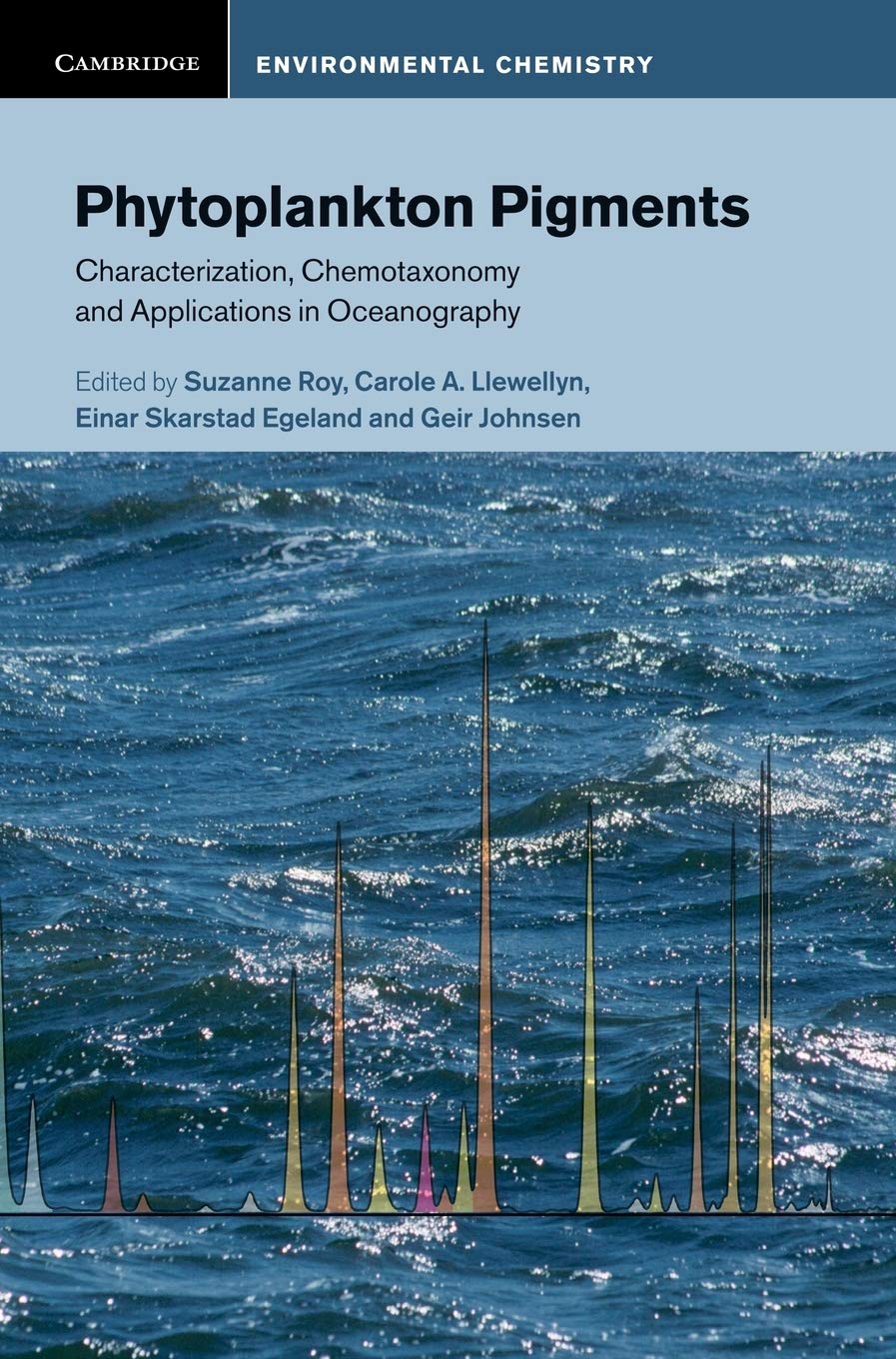
PHYTOPLANKTON PIGMENTS: Characterization, Chemotaxonomy and Applications in Oceanography by Suzanne Roy – A Cambridge Un
Inclusive of all applicable taxes. FREE shipping on all orders.
Available Offers
- 🚚Free Delivery — Free shipping on all orders
- 💵Cash on Delivery — Pay when your order arrives
- ↩️15-Day Easy Returns — Hassle-free return policy
- 🔒Cash on Delivery — Pay safely when your order arrives
Check Delivery
Product Description
Introduction
Phytoplankton are the microscopic engines of the ocean, driving primary production and influencing global climate patterns. Their pigments—ranging from familiar chlorophylls to lesser-known carotenoids—serve as powerful tracers for understanding marine ecosystems, carbon cycling, and water quality. Phytoplankton Pigments: Characterization, Chemotaxonomy and Applications in Oceanography by Suzanne Roy is an essential reference that bridges cutting-edge research with practical applications. Published by Cambridge University Press, this hardcover volume brings together the latest advances in pigment analysis, chemotaxonomic classification, and remote sensing, making it indispensable for students, researchers, and professionals in aquatic science across India and the world.
Book Overview
This authoritative work is a follow-up to the landmark 1997 UNESCO volume, incorporating two decades of rapid progress in phytoplankton research. It covers the discovery of new algal classes—especially among picoplankton—and novel pigments that have reshaped our understanding of marine biodiversity. The book provides a comprehensive update on analytical techniques, including liquid chromatography-mass spectrometry (LC-MS), and mathematical methods for interpreting pigment data. With a focus on both theory and hands-on methodology, it equips readers to extract detailed information about phytoplankton community composition from seawater samples, satellite observations, and field studies.
Key Highlights
- Comprehensive coverage of all major phytoplankton pigment groups, from chlorophylls to accessory pigments.
- Updated chemotaxonomy reflecting recent discoveries in picoplankton and nanoflagellate classes.
- Advanced analytical methods including LC-MS, HPLC, and spectrophotometric techniques.
- Mathematical tools for pigment-based community analysis, such as CHEMTAX and matrix factorization.
- Applications in oceanography, remote sensing, and biogeochemical cycling.
- Richly illustrated with spectra, chromatograms, and field data examples.
Inside the Book
The book is structured to guide readers from fundamental principles to advanced applications. Early chapters introduce pigment chemistry, biosynthesis, and the role of pigments in photosynthesis and photoprotection. Subsequent sections delve into chemotaxonomic markers for major phytoplankton groups—diatoms, dinoflagellates, haptophytes, cyanobacteria, and more. A major portion is devoted to analytical protocols, including sample preparation, quality control, and troubleshooting. The final chapters explore how pigment data are used to model carbon fluxes, track harmful algal blooms, and calibrate satellite sensors for ocean colour monitoring.
Key Topics
- Pigment extraction, separation, and quantification techniques.
- Chemotaxonomic assignment of pigments to algal classes.
- Advances in LC-MS and mass spectrometric identification.
- Statistical and computational methods for pigment data analysis.
- Remote sensing of phytoplankton biomass and functional types.
- Pigment-based indicators of physiological state and stress.
- Global and regional applications in oceanography and limnology.
Reader Benefits
By studying this book, readers will gain the ability to design and execute pigment-based studies with confidence. They will learn to interpret chromatograms, identify pigments by retention time and spectral characteristics, and apply chemotaxonomic algorithms to field data. The book also provides practical guidance on setting up a pigment laboratory, selecting appropriate standards, and avoiding common pitfalls. For Indian researchers working in coastal zones, estuaries, or the Indian Ocean, the methodologies are directly transferable to local ecosystems.
Learning Outcomes
- Understand the biochemical diversity and ecological significance of phytoplankton pigments.
- Master modern analytical techniques for pigment characterization.
- Apply chemotaxonomic approaches to map phytoplankton communities.
- Integrate pigment data with satellite remote sensing for large-scale ocean monitoring.
- Contribute to studies on climate change, carbon cycling, and marine resource management.
Who Should Read
This book is tailored for postgraduate students in marine biology, oceanography, and environmental science. It is equally valuable for early-career researchers, laboratory technicians, and established scientists who need a thorough update on pigment methodology. Professionals involved in water quality assessment, fisheries management, and climate modelling will also find the applications highly relevant. Indian academic institutions with marine science programmes will benefit from this definitive resource.
About the Author
Suzanne Roy is a distinguished marine scientist with decades of experience in phytoplankton ecology and pigment chemotaxonomy. She has contributed significantly to the development of analytical protocols and the discovery of new pigment markers. Her work has been instrumental in advancing our understanding of picoplankton diversity and its role in ocean biogeochemistry. Dr. Roy has collaborated with leading oceanographic institutions worldwide and has authored numerous peer-reviewed papers in high-impact journals.
About the Publisher
Cambridge University Press is one of the world's oldest and most respected academic publishers, known for its rigorous peer-review process and high-quality scientific books. Their Earth and Environmental Science catalogue includes foundational texts that shape research and education globally. This hardcover edition reflects their commitment to producing durable, well-edited references that stand the test of time.
Conclusion
Phytoplankton Pigments: Characterization, Chemotaxonomy and Applications in Oceanography is more than a textbook—it is a gateway to understanding the invisible forests of the sea. Whether you are a student embarking on a research career or a seasoned oceanographer seeking to refine your techniques, this book offers the depth and breadth you need. With its blend of fundamental science, modern methodology, and real-world applications, it deserves a place on every marine scientist's shelf. Order your copy from Bookshops.in today and dive into the colourful world of phytoplankton pigments.
Quick Summary
PHYTOPLANKTON PIGMENTS: Characterization, Chemotaxonomy and Applications in Oceanography by Suzanne Roy is an authoritative reference that delves into the role of phytoplankton pigments as tracers in marine ecosystems. Building on the foundational 1997 UNESCO volume, this updated work incorporates recent discoveries, including new algal classes, picoplankton, and novel pigments, along with advanced analytical techniques like liquid chromatography-mass spectrometry (LC-MS). The book explains how pigments are used for chemotaxonomic classification of phytoplankton, enabling scientists to track algal biomass and community composition through ocean colour remote sensing. It also connects pigment studies to broader biogeochemical cycles, particularly carbon dynamics. This volume is essential for oceanographers, marine biologists, remote sensing experts, and environmental scientists in India and worldwide. Readers will gain practical knowledge of pigment extraction, analysis, and data interpretation, along with updated mathematical methods. By purchasing from Bookshops.in, Indian customers receive a genuine hardcover edition with timely delivery, supporting their academic and research needs in marine science.
Book Highlights
Book Specifications
| ISBN-13 | 9781107000667 |
| ISBN-10 | 1107000661 |
| Publisher | Cambridge University Press |
| Language | English |
| Dimensions | 18.42 x 5.08 x 25.4 cm |
| Weight | 1 kg 690 g |
| Country | India |
| Category | Biology & Life Sciences › Biology |
| Genre | Science |
| Original Language | English |
Frequently Asked Questions
What is this book about?
Who is the author of this book?
Is this book suitable for Indian students?
What are the main topics covered?
Does this book include recent discoveries?
What analytical techniques are discussed?
Can this book help with remote sensing studies?
Is this a textbook or a reference work?
What is the ISBN of this book?
Is this book available in hardcover?
What is the price in India?
Why buy from Bookshops.in?
Readers Also Search For
Customers Also Bought

Mathematics
Stereotype Spaces and Algebras: 73 (De Gruyter Expositions in Mathematics, 73)

Mathematics
Semigroups in Algebra, Geometry and Analysis: 20 (De Gruyter Expositions in Mathematics, 20)

Mathematics
Geometry from the Pacific Rim: Proceedings of the Pacific Rim Geometry Conference held at National University of Singapore, Republic of Singapore, ... 1994 (De Gruyter Proceedings in Mathematics)

Mathematics
First International Tainan-Moscow Algebra Workshop: Proceedings of the International Conference held at National Cheng Kung University Tainan, Taiwan, ... 1994 (De Gruyter Proceedings in Mathematics)

Mathematics
Differential Geometry - Proceedings of the VIII International Colloquium (English, Jesus A. Alvarez Lopez | Eduardo Garcia-Rio)

Mathematics
Mathematical Theory of Optimal Processes (Classics of Soviet Mathematics)
Related Products
View All
Biology
Evolution: What the Fossils Say and Why It Matters by Donald R. Prothero
Biology
From Taxonomy to Phylogenetics – Life and Work of Willi Hennig
Biology
The Marine Biology of the South China Sea
Biology
Genetics Meets Metabolomics: from Experiment to Systems Biology
Biology
The Elements of Natural or Experimental Philosophy: 2
Biology