
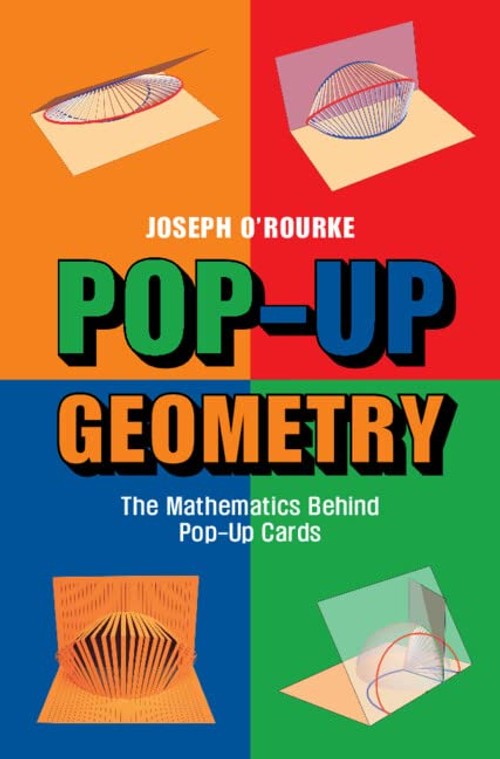
Pop-Up Geometry: The Mathematics Behind Pop-Up Cards
Inclusive of all applicable taxes. FREE shipping on all orders.
Available Offers
- 🚚Free Delivery — Free shipping on all orders
- 💵Cash on Delivery — Pay when your order arrives
- ↩️15-Day Easy Returns — Hassle-free return policy
- 🔒Cash on Delivery — Pay safely when your order arrives
Check Delivery
Product Description
Introduction
Pop-up cards are more than delightful surprises tucked inside an envelope—they are intricate puzzles of paper, geometry, and motion. Pop-Up Geometry: The Mathematics Behind Pop-Up Cards by Joseph O'Rourke invites readers into a world where art meets algebra, and every fold tells a mathematical story. Published by Cambridge University Press, this hardcover edition is a treasure for Indian students, teachers, and curious minds who want to see how high-school mathematics powers the magic of pop-up engineering.
Book Overview
This book peels back the paper layers to reveal the geometric principles that make pop-up cards spring to life. From the 19th-century nephroid curve to modern rigid origami, O'Rourke connects simple algebraic equations to the complex movements of cones, spheres, and linkages. Designed for readers familiar with high-school math—no calculus required—the text uses over 140 illustrations to explain how circles intersect, how three spheres meet (a calculation used in GPS), and how these ideas translate into real pop-up mechanisms. Each chapter builds a bridge between abstract mathematics and tangible paper engineering.
Key Highlights
- Accessible Mathematics: Only high-school algebra and geometry are needed—no advanced calculus.
- Rich Visuals: Over 140 diagrams and illustrations clarify every concept.
- Real-World Connections: See how pop-up motions rely on the same math behind GPS and rigid origami.
- Historical Depth: Traces the evolution from the 19th-century nephroid to cutting-edge computational complexity.
- Hands-On Insight: Understand the geometry of linkages, spheres, and cones through practical card examples.
Inside the Book
The journey begins with the classic nephroid curve—the heart-shaped pattern in many pop-ups—and moves through the intersection of circles and cones. You will explore how three spheres intersect to determine a point in space, a computation that mirrors GPS satellite positioning. Later chapters dive into the mechanics of linkages and the constraints of rigid origami, where paper folds without bending. O'Rourke uses clear, step-by-step reasoning to show how algebraic equations model the opening and closing of a pop-up card, making the invisible math visible.
Key Topics
- Nephroid curves and their geometric origins
- Intersection of circles, cones, and spheres
- Three-sphere intersection and GPS analogy
- Linkages and mechanical movements in pop-ups
- Rigid origami and foldability constraints
- Algebraic modeling of card dynamics
- Computational complexity in paper design
- Historical evolution of pop-up mathematics
Reader Benefits
By reading this book, you will gain a new appreciation for the hidden structure in everyday objects. You will learn to see pop-up cards not just as crafts, but as demonstrations of geometry in action. The book strengthens your algebraic and spatial reasoning skills without overwhelming you with advanced math. For students preparing for competitive exams or pursuing science streams, this practical application of geometry makes abstract concepts memorable and engaging. Teachers can use the examples to spark curiosity in classrooms.
Learning Outcomes
- Describe the geometric principles behind common pop-up mechanisms.
- Model card movements using algebraic equations.
- Explain the three-sphere intersection and its real-world use.
- Analyze linkages and rigid origami constraints.
- Connect historical geometry to modern computational design.
- Apply high-school math to solve paper-engineering problems.
Who Should Read
This book is ideal for Indian high-school and undergraduate students passionate about mathematics, especially those in Classes 11 and 12 or pursuing B.Sc./B.A. in Mathematics. It is also perfect for teachers looking for engaging ways to teach geometry and algebra, hobbyists who love paper crafts and origami, and anyone curious about the hidden logic behind everyday designs.
About the Author
Joseph O'Rourke is a renowned mathematician and professor emeritus at Smith College, USA. He has authored several influential books on computational geometry and origami mathematics. His research spans geometric folding algorithms, rigid origami, and the mathematics of paper. With a gift for making complex ideas accessible, O'Rourke brings decades of expertise to this unique exploration of pop-up geometry.
About the Publisher
Cambridge University Press is one of the world's oldest and most respected academic publishers. Known for rigorous scholarship and clear presentation, Cambridge produces books that inspire learning across disciplines. This hardcover edition reflects their commitment to quality—perfect for libraries, classrooms, and personal collections in India.
Conclusion
Pop-Up Geometry: The Mathematics Behind Pop-Up Cards is a rare book that turns a childhood wonder into a gateway to deeper mathematical understanding. Whether you are a student, teacher, or lifelong learner, Joseph O'Rourke's clear writing and rich illustrations will change the way you see paper, folds, and the geometry that shapes our world. Add this hardcover to your shelf at Bookshops.in and discover the math behind the magic.
Quick Summary
Pop-Up Geometry: The Mathematics Behind Pop-Up Cards by Joseph O'Rourke is a unique exploration of the hidden math that makes pop-up cards spring to life. Published by Cambridge University Press, this hardcover book delves into the geometry of circles, cones, and spheres, as well as the algebraic equations that model card movements. Readers will discover how the intersection of three spheres—a calculation also used in GPS—underlies many pop-up mechanisms. The book traces the history of the nephroid curve from the 19th century and shows how abstract mathematics performs tangible calculations. Ideal for Indian students, teachers, and STEM enthusiasts, it bridges classroom learning with creative design. By connecting mathematical theory to real-world pop-up cards, O'Rourke makes geometry accessible and exciting. Whether you are a student looking to strengthen your math skills or a hobbyist curious about card engineering, this book offers deep insights. Purchase from Bookshops.in for a reliable, premium experience with fast delivery across India.
Book Highlights
Book Specifications
| ISBN-13 | 9781009098403 |
| ISBN-10 | 1009098403 |
| Publisher | Cambridge University Press |
| Language | English |
| Dimensions | 15.24 x 1.27 x 22.86 cm |
| Weight | 340 g |
| Country | India |
| Category | Mathematics › Geometry |
| Genre | Non-fiction |
| Original Language | English |
Frequently Asked Questions
What is Pop-Up Geometry about?
Who is the author of Pop-Up Geometry?
Is this book suitable for beginners?
Does the book include practical pop-up card designs?
What mathematical topics are covered?
How is this book relevant to Indian readers?
Is this book available in hardcover?
What is the publication date?
What is the ISBN?
Can I use this book for self-study?
Does the book include exercises or problems?
What is the nephroid curve?
How does GPS relate to pop-up cards?
Is this book part of a series?
Where can I buy this book in India?
Readers Also Search For
Customers Also Bought
Mathematics
Stereotype Spaces and Algebras: 73 (De Gruyter Expositions in Mathematics, 73)
Mathematics
Semigroups in Algebra, Geometry and Analysis: 20 (De Gruyter Expositions in Mathematics, 20)
Mathematics
Geometry from the Pacific Rim: Proceedings of the Pacific Rim Geometry Conference held at National University of Singapore, Republic of Singapore, ... 1994 (De Gruyter Proceedings in Mathematics)
Mathematics
First International Tainan-Moscow Algebra Workshop: Proceedings of the International Conference held at National Cheng Kung University Tainan, Taiwan, ... 1994 (De Gruyter Proceedings in Mathematics)
Mathematics
Differential Geometry - Proceedings of the VIII International Colloquium (English, Jesus A. Alvarez Lopez | Eduardo Garcia-Rio)
Mathematics
Mathematical Theory of Optimal Processes (Classics of Soviet Mathematics)
Related Products
View AllMathematics
Mathematical Theory of Optimal Processes (Classics of Soviet Mathematics)
Mathematics
Stereotype Spaces and Algebras: 73 (De Gruyter Expositions in Mathematics, 73)
Mathematics
Semigroups in Algebra, Geometry and Analysis: 20 (De Gruyter Expositions in Mathematics, 20)
Mathematics
Geometry from the Pacific Rim: Proceedings of the Pacific Rim Geometry Conference held at National University of Singapore, Republic of Singapore, ... 1994 (De Gruyter Proceedings in Mathematics)
Mathematics
First International Tainan-Moscow Algebra Workshop: Proceedings of the International Conference held at National Cheng Kung University Tainan, Taiwan, ... 1994 (De Gruyter Proceedings in Mathematics)
Mathematics