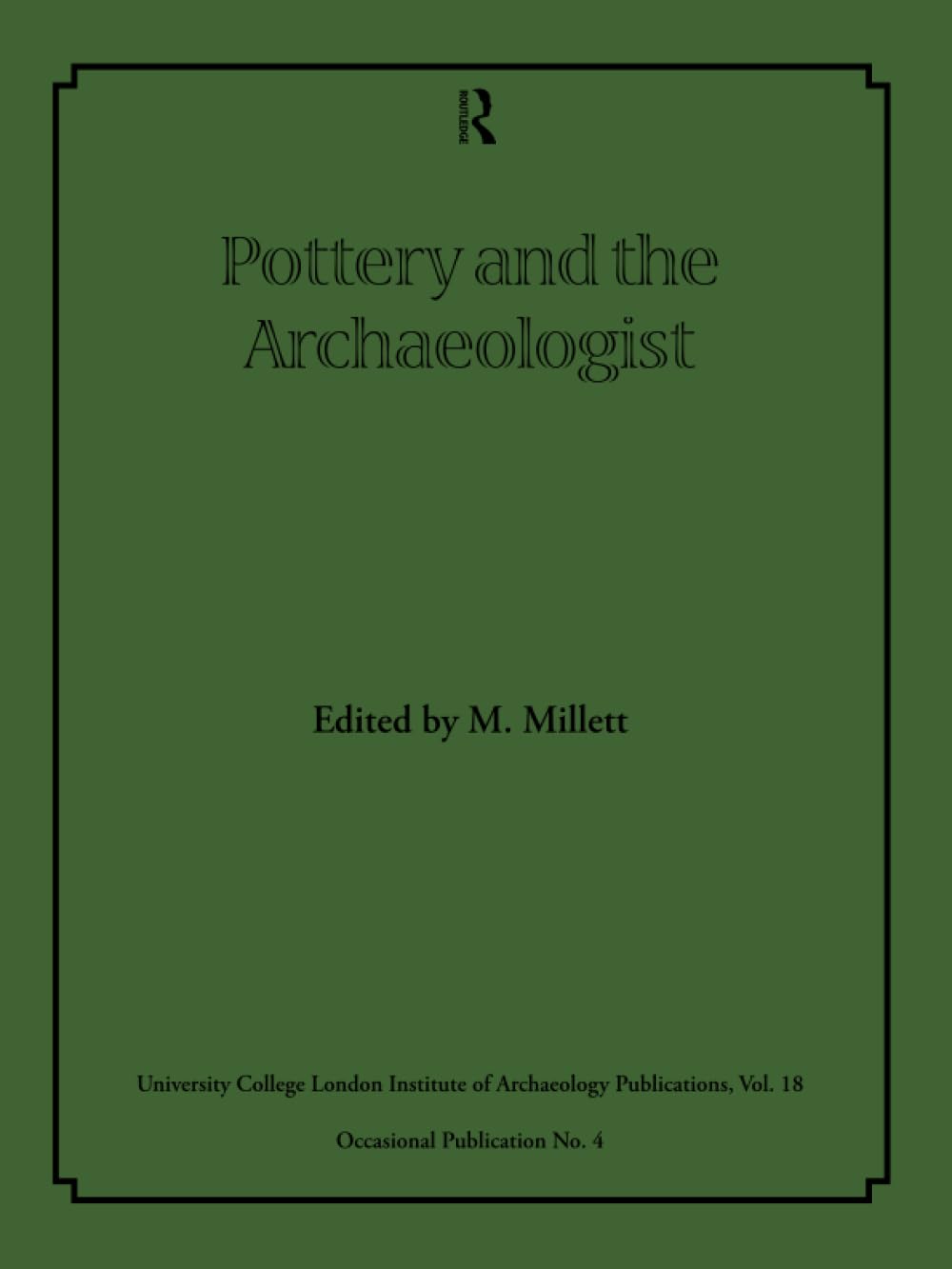
Pottery and Archaeologist by Martin Millett – A Comprehensive Guide to Ceramic Studies in Archaeology
Inclusive of all applicable taxes. FREE shipping on all orders.
Available Offers
- 🚚Free Delivery — Free shipping on all orders
- 💵Cash on Delivery — Pay when your order arrives
- ↩️15-Day Easy Returns — Hassle-free return policy
- 🔒Cash on Delivery — Pay safely when your order arrives
Check Delivery
Product Description
Introduction
Pottery is often the most abundant and enduring material unearthed in archaeological excavations, offering a unique window into the past. In the Indian subcontinent, where millennia of ceramic traditions have shaped our understanding of ancient trade, daily life, and cultural exchange, a rigorous study of pottery is indispensable. Pottery and Archaeologist by Martin Millett, published by Routledge, is a seminal work that bridges the gap between fieldwork and interpretation. This hardcover edition is an essential resource for students and professionals seeking to master the analysis of ceramic assemblages in archaeological contexts.
Book Overview
This authoritative volume provides a comprehensive framework for the study of pottery from excavation to publication. Martin Millett, a distinguished archaeologist, draws on decades of field experience to demystify the processes of classification, quantification, and interpretation. The book is structured to guide readers through the entire lifecycle of ceramic analysis, from the moment a sherd is lifted from the soil to its final presentation in a research report. It emphasises practical, hands-on techniques while grounding them in robust theoretical foundations, making it equally valuable for classroom learning and fieldwork in Indian archaeology.
Key Highlights
- Practical Methodology: Step-by-step guidance on handling, recording, and analysing pottery from excavation contexts.
- Quantitative Approaches: Clear explanations of statistical methods for ceramic quantification, including sherd count, weight, and minimum number of vessels.
- Typology and Classification: Systems for creating and using pottery typologies that are adaptable to diverse regional traditions, including Indian wares.
- Publication Standards: Advice on how to present ceramic data in academic reports and monographs, with examples from real excavations.
- Case Studies: Illustrative examples from British and Mediterranean archaeology that can be readily applied to South Asian contexts.
Inside the Book
The book is divided into logically progressing chapters that cover every aspect of ceramic study. It begins with the fundamental question of why pottery matters to archaeologists, then moves through field recovery techniques, laboratory processing, and the creation of fabric and form typologies. A significant portion is dedicated to quantification methods, enabling readers to ask meaningful questions about chronology, trade, and function. Later chapters address the challenges of drawing pottery, photography, and digital recording. The final sections focus on interpretation, showing how ceramic data can illuminate social organisation, economic networks, and cultural identity. Throughout, Millett emphasises the importance of integrating pottery studies with other archaeological evidence.
Key Topics
- Recovery and processing of ceramic assemblages in the field and lab
- Fabric analysis: paste, temper, firing, and surface treatment
- Form and function: understanding vessel shapes and their uses
- Quantification and statistical analysis for chronological and spatial studies
- Building and testing ceramic typologies
- Drawing, photography, and digital documentation of pottery
- Integrating pottery data with stratigraphy and other finds
- Writing and publishing ceramic reports for Indian and global audiences
Reader Benefits
Readers will gain a systematic, replicable method for studying pottery that can be applied immediately to their own research or fieldwork. The book saves time by offering proven techniques, reducing the trial-and-error often faced by beginners. It builds confidence in handling large assemblages, making it easier to extract meaningful historical insights from even the most fragmented sherds. For Indian students, the principles outlined are directly transferable to the study of Northern Black Polished Ware, Painted Grey Ware, and other iconic ceramic traditions. The clear, jargon-free writing ensures that complex concepts remain accessible, while the rigorous academic foundation satisfies the demands of university coursework and professional practice.
Learning Outcomes
- Ability to design and execute a pottery recording system for any excavation project
- Proficiency in creating and applying ceramic typologies tailored to specific sites
- Skill in quantifying pottery assemblages to answer research questions about chronology, trade, and function
- Competence in preparing ceramic data for publication in journals and monographs
- Understanding of how pottery analysis contributes to broader archaeological interpretations
- Knowledge of ethical and conservation considerations when handling ancient ceramics
Who Should Read
This book is indispensable for postgraduate students in archaeology, especially those specialising in South Asian ceramic studies. It is equally valuable for field directors, museum curators, and heritage professionals who regularly work with pottery collections. Undergraduate students taking courses in archaeological methods will find it a clear and comprehensive textbook. Independent researchers and amateur archaeologists with a serious interest in ceramics will also benefit from its practical approach. The book is particularly recommended for those involved in excavations across India, where pottery forms the backbone of chronological and cultural frameworks.
About the Author
Martin Millett is a leading figure in classical and provincial Roman archaeology, with extensive fieldwork experience in Britain, Spain, and the Mediterranean. He has held professorships at the University of Cambridge and the University of Oxford, and his research has profoundly influenced modern archaeological practice. His work on pottery quantification and publication standards is widely cited, and he has trained generations of archaeologists in rigorous ceramic analysis. Millett's ability to translate complex methodological concepts into accessible guidance makes this book a classic in the field.
About the Publisher
Routledge, a world-renowned academic publisher, is committed to producing high-quality scholarly works in archaeology, history, and the social sciences. With a legacy spanning over a century, Routledge books are known for their editorial excellence and contribution to advancing knowledge. This hardcover edition upholds that tradition, offering durable binding and clear typography suitable for heavy use in the field and library. For Indian readers, Routledge provides a trusted source of authoritative archaeological literature that meets global academic standards.
Conclusion
Pottery and Archaeologist is more than a manual; it is a companion for anyone serious about uncovering the stories hidden in ancient ceramics. Martin Millett's systematic approach empowers archaeologists to transform piles of broken potsherds into coherent narratives of human activity. Whether you are a student preparing for your first excavation or a seasoned professional refining your methods, this book offers enduring value. Add this essential hardcover to your collection and elevate your understanding of one of archaeology's most vital materials.
Quick Summary
Pottery and Archaeologist by Martin Millett is an essential academic guide that explores the critical role of ceramics in archaeological research. Written by a leading authority from the University of Cambridge, this book provides a thorough introduction to the methods of pottery analysis, including typology, fabric study, decoration, and dating techniques. It is designed for archaeology students, professional excavators, museum curators, and heritage managers who seek to interpret past societies through their material culture. Readers will learn how to systematically classify ceramic artifacts, understand their technological and cultural significance, and apply these insights to site interpretation. The book bridges theory and practice, making it a valuable resource for both classroom learning and fieldwork. Published by Routledge, a trusted academic publisher, this hardcover edition is built to last. By purchasing from Bookshops.in, Indian readers gain access to authentic imported titles with reliable delivery and customer support, supporting their academic journey with quality resources.
Book Highlights
Book Specifications
| ISBN-13 | 9780905853086 |
| ISBN-10 | 0905853083 |
| Publisher | Routledge |
| Language | English |
| Dimensions | 21.01 x 0.58 x 27.99 cm |
| Weight | 272 g |
| Country | India |
| Category | Ancient History › Archaeology |
| Genre | Non-fiction |
| Original Language | English |