
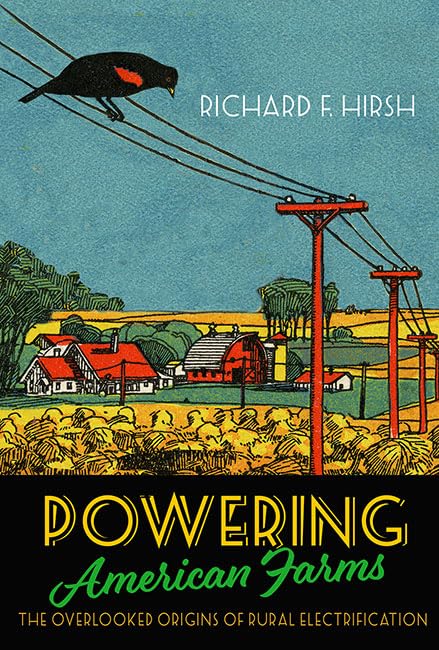
Powering American Farms: The Untold Story of Rural Electrification and the Power Industry by Richard F. Hirsh
Inclusive of all applicable taxes. FREE shipping on all orders.
Available Offers
- 🚚Free Delivery — Free shipping on all orders
- 💵Cash on Delivery — Pay when your order arrives
- ↩️15-Day Easy Returns — Hassle-free return policy
- 🔒Cash on Delivery — Pay safely when your order arrives
Check Delivery
Product Description
Introduction
In the annals of American history, few transformations have been as profound as the electrification of the nation's farms. Yet, the story is far more complex than the simple narrative of government intervention rescuing a neglected rural population. Richard F. Hirsh's Powering American Farms offers a deeply researched and original account that challenges conventional wisdom. This hardcover volume from Johns Hopkins University Press is an essential read for anyone interested in the intersection of technology, business, and social change.
Book Overview
Before the New Deal programs of the 1930s, a quiet revolution was already underway. Powering American Farms uncovers the untold history of how private power companies, often dismissed as indifferent, actively worked to bring electricity to agricultural communities. Hirsh reveals that these utilities faced enormous technical and financial hurdles, including low population density, high infrastructure costs, and the seasonal nature of farm demand. The book traces this early, often overlooked, effort and repositions it within the larger story of American industrial and rural development. It is a nuanced, balanced, and eye-opening narrative that will change how you understand the electrification of the American countryside.
Key Highlights
- Challenges the Standard Narrative: Presents a revisionist history that credits private utilities with significant, though imperfect, efforts to electrify farms before government programs.
- Rich Historical Detail: Draws on archival research, corporate records, and personal accounts to paint a vivid picture of early 20th-century rural America.
- Technological and Business Insights: Explores the engineering challenges of extending power lines over vast distances and the economic models that made (or failed to make) rural electrification viable.
- Human Impact: Goes beyond statistics to show how electricity transformed daily life on the farm—from lighting and water pumps to milking machines and radio.
Inside the Book
Readers will journey through the early decades of the 20th century, meeting the engineers, executives, and farmers who shaped the electric landscape. Hirsh details the experiments with isolated generating plants, the development of cooperative power systems, and the lobbying efforts that eventually led to the Rural Electrification Administration. The book also examines the resistance from some farmers who were skeptical of the new technology and the high costs involved. Each chapter is a carefully woven tapestry of policy, innovation, and human ambition.
Key Topics
- The early electrical industry and its urban focus
- Technical barriers to rural electrification
- Private utility initiatives and their limitations
- The role of state and local governments
- The Great Depression and the birth of the REA
- The social and economic impact of farm electrification
- Comparative perspectives on rural power systems
Reader Benefits
This book offers more than a history lesson. It provides a framework for understanding how large-scale infrastructure projects succeed or fail. Students of business, policy, and engineering will gain insights into the interplay of market forces, government intervention, and technological innovation. For anyone fascinated by American history, Powering American Farms delivers a fresh, compelling perspective on a pivotal era. It is also a valuable resource for Indian readers interested in rural development and the challenges of bringing modern utilities to dispersed populations.
Learning Outcomes
- Understand the complex origins of rural electrification in the United States.
- Critically evaluate the roles of private enterprise and government in infrastructure development.
- Analyze the technological and economic factors that shaped energy access.
- Gain a deeper appreciation for the social transformation brought by electricity.
- Apply historical lessons to contemporary issues of energy equity and rural development.
Who Should Read
Powering American Farms is ideal for students and scholars of American history, economic history, and the history of technology. It is equally valuable for professionals in the energy sector, policy makers, and anyone interested in rural studies. The book's accessible prose and compelling narrative also make it a rewarding read for history enthusiasts and general readers who enjoy well-told stories of innovation and social change.
About the Author
Richard F. Hirsh is a distinguished historian of technology and business. A professor at Virginia Tech, he has written extensively on the history of the electric power industry, including his acclaimed work Technology and Transformation in the American Electric Utility Industry. His expertise brings authority and depth to this revisionist account.
About the Publisher
Johns Hopkins University Press is one of the oldest and most respected academic publishers in the United States. Known for its rigorous scholarship and high-quality production, the press has been a leading voice in history, science, and medicine for over 140 years. This hardcover edition reflects their commitment to excellence.
Conclusion
Powering American Farms is a masterful work that illuminates a forgotten chapter of American history. By giving credit where it is due—and critique where it is warranted—Richard F. Hirsh provides a balanced, insightful, and ultimately hopeful story of how the nation brought light and power to the land. It is an indispensable addition to any serious collection on American history, energy, and rural life.
Quick Summary
Powering American Farms by Richard F. Hirsh is a groundbreaking historical work that reexamines the electrification of rural America. Contrary to the popular belief that only Depression-era government programs like the TVA and REA brought power to farms, Hirsh reveals that private utility companies had already been actively working to electrify agricultural areas. The book delves into the economic, political, and technological challenges of extending power lines to sparsely populated regions, and how these efforts shaped the modern energy landscape. Readers will learn about the motivations of utility executives, the experiences of farmers, and the eventual collaboration between public and private sectors. This book is ideal for students of American history, energy policy, and rural studies, as well as anyone interested in the untold stories behind technological change. By purchasing from Bookshops.in, Indian readers can access this authoritative hardcover edition with fast, reliable shipping.
Book Highlights
Book Specifications
| ISBN-13 | 9781421443621 |
| ISBN-10 | 1421443627 |
| Publisher | Johns Hopkins Univ Pr |
| Language | English |
| Dimensions | 15.24 x 3.15 x 22.86 cm |
| Weight | 658 g |
| Category | Chemical Engineering › Energy & Fuel Engineering |
| Genre | History |
| Original Language | English |
Frequently Asked Questions
What is Powering American Farms about?
Who wrote Powering American Farms?
Is this book only about government programs?
What time period does the book cover?
Does the book discuss the Rural Electrification Administration?
Is the book suitable for academic use?
What makes this book different from other rural electrification histories?
What is the price of Powering American Farms?
Who is the publisher?
Is this book available in hardcover?
Does the book include photographs?
Can I use this book for a research paper?
Why should I buy from Bookshops.in?
Readers Also Search For
Customers Also Bought

de Gruyter Mouton
Regional Development (English, John H. Cumberland)

British Archaeological Reports Oxford Ltd
Copies of the Fel Temp Reparatio Coinage in Britain | by R. J. Brickstock | British Archaeological Reports Oxford Ltd | by R. J. Brickstock | British Archaeological Reports Oxford Ltd | by R. J. Brickstock | British Archaeological Reports Oxford Ltd | by R. J. Brickstock | British Archaeological Reports Oxford Ltd | by R. J. Brickstock | British Archaeological Reports Oxford Ltd | by R. J. Brickstock | British Archaeological Reports Oxford Ltd | by R. J. Brickstock | British Archaeological Repor

de Gruyter
Baby - Cutter (English, Gerhard Strau | Heidrun Kamper-Jensen | Isolde Nortmeyer)

de Gruyter Mouton
Stratégies Et Choix Dans La Recherche (English, G. Lemaine | M. Clémençon | A. Gomis)
Fordham University Press
Charms That Soothe: Classical Music and the Narrative Film (Communications and Media Studies, 9)

Atheneum Books
Ghost | by Jason Reynolds | Atheneum Books | by Jason Reynolds | Atheneum Books | by Jason Reynolds | Atheneum Books | by Jason Reynolds | Atheneum Books | by Jason Reynolds | Atheneum Books | by Jason Reynolds | Atheneum Books | by Jason Reynolds | Atheneum Books | by Jason Reynolds | Atheneum Books | by Jason Reynolds | Atheneum Books | by Jason Reynolds | Atheneum Books | by Jason Reynolds | Atheneum Books | by Jason Reynolds | Atheneum Books | by Jason Reynolds | Atheneum Books | by Jason Re
Related Products
View All
Johns Hopkins University Press
Academia Next | by Bryan Alexander | Johns Hopkins University Press | by Bryan Alexander | Johns Hopkins University Press | by Bryan Alexander | Johns Hopkins University Press | by Bryan Alexander | Johns Hopkins University Press | by Bryan Alexander | Johns Hopkins University Press | by Bryan Alexander | Johns Hopkins University Press | by Bryan Alexander | Johns Hopkins University Press | by Bryan Alexander | Johns Hopkins University Press | by Bryan Alexander | Johns Hopkins University Press

Johns Hopkins University Press
The College Stress Test | by Robert Zemsky | Susan Shaman | Susan Campbell Baldridge | Johns Hopkins University Press | by Robert Zemsky | Susan Shaman | Susan Campbell Baldridge | Johns Hopkins University Press | by Robert Zemsky | Susan Shaman | Susan Campbell Baldridge | Johns Hopkins University Press | by Robert Zemsky | Susan Shaman | Susan Campbell Baldridge | Johns Hopkins University Press | by Robert Zemsky | Susan Shaman | Susan Campbell Baldridge | Johns Hopkins University Press | by R

Johns Hopkins University Press
Melodies Unheard | by Anthony Hecht | Johns Hopkins University Press | by Anthony Hecht | Johns Hopkins University Press | by Anthony Hecht | Johns Hopkins University Press | by Anthony Hecht | Johns Hopkins University Press | by Anthony Hecht | Johns Hopkins University Press | by Anthony Hecht | Johns Hopkins University Press | by Anthony Hecht | Johns Hopkins University Press | by Anthony Hecht | Johns Hopkins University Press | by Anthony Hecht | Johns Hopkins University Press | by Anthony He

Johns Hopkins University Press
Health Plans Unmasked | by Martin Lustick | Johns Hopkins University Press | by Martin Lustick | Johns Hopkins University Press | by Martin Lustick | Johns Hopkins University Press | by Martin Lustick | Johns Hopkins University Press | by Martin Lustick | Johns Hopkins University Press | by Martin Lustick | Johns Hopkins University Press | by Martin Lustick | Johns Hopkins University Press | by Martin Lustick | Johns Hopkins University Press | by Martin Lustick | Johns Hopkins University Press |

Johns Hopkins University Press
Prostate Cancer | by Neil H. Baum | David Mobley | Richard G. Key | Johns Hopkins University Press | by Neil H. Baum | David Mobley | Richard G. Key | Johns Hopkins University Press | by Neil H. Baum | David Mobley | Richard G. Key | Johns Hopkins University Press | by Neil H. Baum | David Mobley | Richard G. Key | Johns Hopkins University Press | by Neil H. Baum | David Mobley | Richard G. Key | Johns Hopkins University Press | by Neil H. Baum | David Mobley | Richard G. Key | Johns Hopkins Uni

Johns Hopkins University Press