
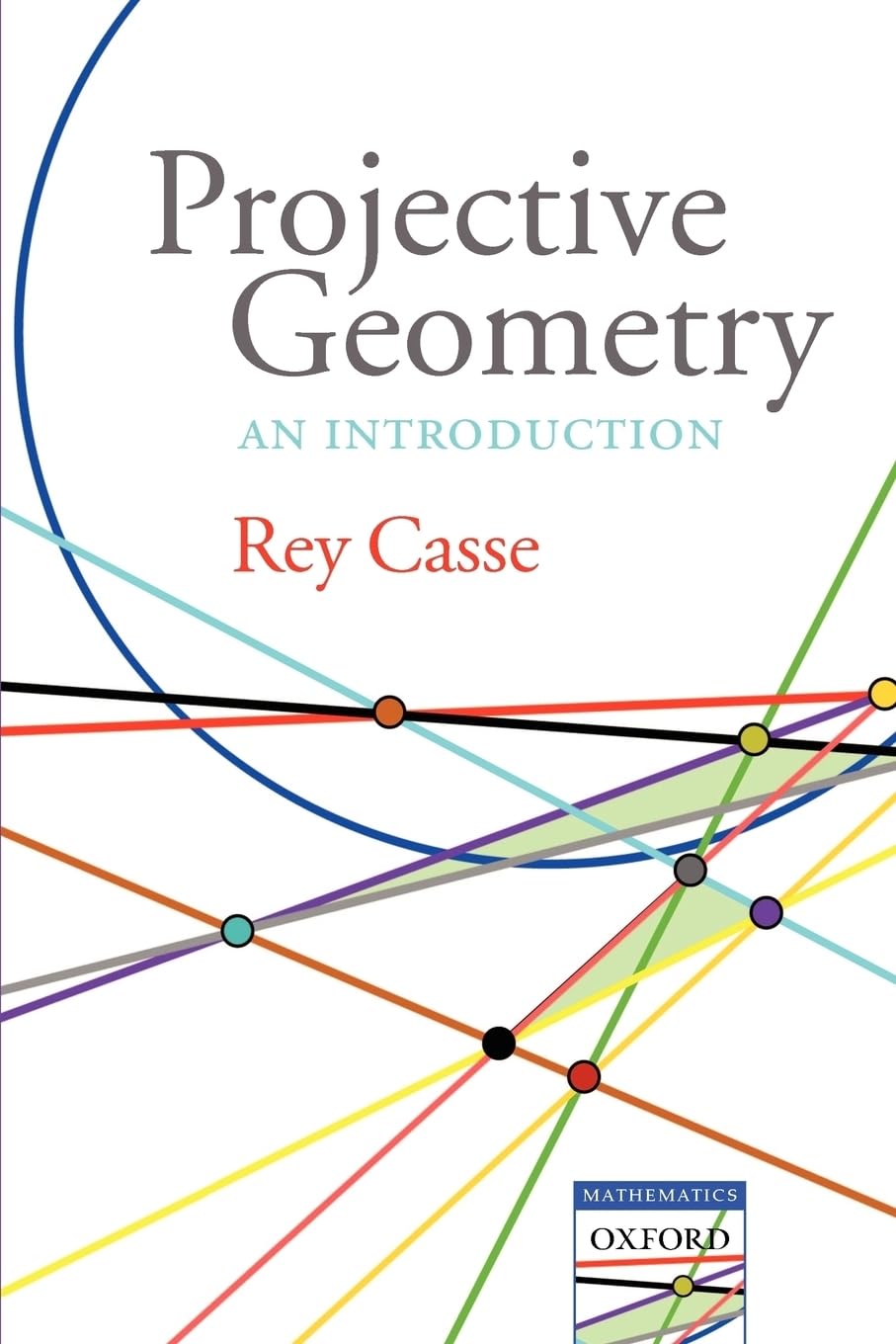
Projective Geometry: An Introduction by Rey Casse – A Comprehensive Mathematics Textbook for Undergraduate Students
Inclusive of all applicable taxes. FREE shipping on all orders.
Available Offers
- 🚚Free Delivery — Free shipping on all orders
- 💵Cash on Delivery — Pay when your order arrives
- ↩️15-Day Easy Returns — Hassle-free return policy
- 🔒Cash on Delivery — Pay safely when your order arrives
Check Delivery
Product Description
Introduction
Projective geometry is a fascinating branch of mathematics that explores the properties of geometric figures that remain invariant under projection. For Indian undergraduate students pursuing advanced mathematics, understanding this subject opens doors to deeper insights in algebraic geometry, computer vision, and theoretical physics. Projective Geometry: An Introduction by Rey Casse, published by OUP Oxford, offers a rigorous yet accessible entry point into this elegant field, blending theory with practical problem-solving.
Book Overview
This hardbound volume serves as a comprehensive guide for third- and fourth-year mathematics undergraduates. It assumes a working knowledge of linear algebra, elementary group theory, partial differentiation, finite fields, and coordinate geometry. The book systematically builds from foundational axioms to advanced concepts like non-Desarguesian planes and conics in PG(3, F). With numerous worked examples and exercises, it bridges the gap between abstract theory and concrete application, making it ideal for Indian university curricula that emphasize both depth and clarity.
Key Highlights
- Rigorous yet accessible: Clear explanations of axiomatic geometry and field planes PG(r, F) without compromising mathematical precision.
- Abundant practice material: Each chapter includes worked examples and end-of-section exercises to reinforce learning.
- Modern perspective: Covers non-Desarguesian planes and finite geometries, relevant to contemporary research and applications.
- Focus on coordination: Detailed treatment of coordinating a projective plane, a crucial skill for advanced study.
- Comprehensive coverage: From conics to quadrics in PG(3, F), ensuring a solid foundation for further specialization.
Inside the Book
The narrative begins with the axiomatic foundations of projective geometry, establishing the basic principles of incidence and duality. It then progresses to field planes and the projective space PG(r, F), where readers learn to work with coordinates over arbitrary fields. A significant portion is devoted to the coordination of a projective plane, explaining how geometric structures correspond to algebraic systems. The book also explores non-Desarguesian planes, which challenge classical assumptions, and concludes with an in-depth study of conics and quadrics in three-dimensional projective space. Each topic is illustrated with carefully chosen examples that clarify abstract ideas.
Key Topics
- Axiomatic projective geometry and incidence structures
- Field planes and the projective space PG(r, F)
- Coordinating a projective plane using algebraic methods
- Non-Desarguesian planes and their properties
- Conics in projective planes
- Quadrics in PG(3, F) and their classification
Reader Benefits
Students will develop a strong geometric intuition paired with algebraic rigor, enabling them to tackle advanced topics in algebraic geometry and topology. The worked examples serve as templates for solving complex problems, while the exercises challenge readers to apply concepts independently. Indian students preparing for competitive exams like the NBHM or JRF will find the book’s structured approach invaluable. Moreover, the emphasis on finite fields makes this text particularly relevant for those interested in coding theory and cryptography.
Learning Outcomes
By the end of this book, readers will be able to:
- Understand and apply the axioms of projective geometry to prove fundamental theorems.
- Work confidently with projective spaces over arbitrary fields, including finite fields.
- Coordinate a projective plane and derive algebraic representations.
- Distinguish between Desarguesian and non-Desarguesian planes.
- Analyze conics and quadrics using projective methods.
- Solve problems involving incidence, collineations, and polarities.
Who Should Read
This book is tailored for third- and fourth-year B.Sc. and M.Sc. mathematics students in Indian universities who have completed courses in linear algebra and abstract algebra. It is also suitable for self-learners with a strong background in coordinate geometry and finite fields. Teachers and researchers looking for a clear, example-driven reference on projective geometry will find it equally valuable.
About the Author
Rey Casse is a respected mathematician and educator with extensive experience in teaching geometry at the undergraduate level. His writing reflects a deep understanding of student challenges, combining theoretical depth with pedagogical clarity. He has contributed to the field through research and textbooks that make advanced geometry accessible to a wider audience.
About the Publisher
Oxford University Press (OUP) is a world-renowned academic publisher with a long history of producing high-quality mathematics texts. Their editions are known for rigorous editorial standards, durable binding, and clear typesetting—ideal for students who need a reliable reference throughout their academic journey.
Conclusion
Projective Geometry: An Introduction is an indispensable resource for Indian mathematics students seeking to master this beautiful subject. With its balanced mix of theory, examples, and exercises, it equips readers with the skills needed for advanced study and research. Order your copy from Bookshops.in today and add this essential hardcover to your library.
Quick Summary
Projective Geometry: An Introduction by Rey Casse is a lucid and accessible textbook tailored for third- and fourth-year mathematics undergraduates. The book systematically covers axiomatic geometry, field planes, and the coordination of projective planes, including non-Desarguesian planes. It also delves into conics and quadrics in PG(3, F), providing a solid foundation for further study in algebraic geometry. With numerous worked examples and exercises, readers can build confidence in understanding invariants under projection. The text assumes prior knowledge of linear algebra, elementary group theory, partial differentiation, and finite fields, making it ideal for advanced students. Published by OUP Oxford, this hardcover edition is a durable resource for Indian university libraries and personal collections. By purchasing from Bookshops.in, customers receive a genuine, high-quality print edition with reliable delivery across India.
Book Highlights
Book Specifications
| ISBN-13 | 9780199298860 |
| ISBN-10 | 0199298866 |
| Publisher | Oxford University Press |
| Language | English |
| Dimensions | 1.27 x 23.11 x 15.49 cm |
| Weight | 340 g |
| Category | Mathematics › Geometry |
| Genre | Non-fiction |
| Original Language | English |
Frequently Asked Questions
What is projective geometry?
Who is the author of this book?
What prerequisites are needed to read this book?
Is this book suitable for Indian undergraduate students?
Does the book include exercises?
What topics are covered in the book?
Is this a hardcover edition?
What is the ISBN of this book?
Can I use this book for self-study?
Is this book part of a series?
What is the price of this book?
Does the book cover finite fields?
Readers Also Search For
Customers Also Bought
Mathematics
Stereotype Spaces and Algebras: 73 (De Gruyter Expositions in Mathematics, 73)
Mathematics
Semigroups in Algebra, Geometry and Analysis: 20 (De Gruyter Expositions in Mathematics, 20)
Mathematics
Geometry from the Pacific Rim: Proceedings of the Pacific Rim Geometry Conference held at National University of Singapore, Republic of Singapore, ... 1994 (De Gruyter Proceedings in Mathematics)
Mathematics
First International Tainan-Moscow Algebra Workshop: Proceedings of the International Conference held at National Cheng Kung University Tainan, Taiwan, ... 1994 (De Gruyter Proceedings in Mathematics)
Mathematics
Differential Geometry - Proceedings of the VIII International Colloquium (English, Jesus A. Alvarez Lopez | Eduardo Garcia-Rio)
Mathematics
Mathematical Theory of Optimal Processes (Classics of Soviet Mathematics)
Related Products
View AllMathematics
Mathematical Theory of Optimal Processes (Classics of Soviet Mathematics)
Mathematics
Stereotype Spaces and Algebras: 73 (De Gruyter Expositions in Mathematics, 73)
Mathematics
Semigroups in Algebra, Geometry and Analysis: 20 (De Gruyter Expositions in Mathematics, 20)
Mathematics
Geometry from the Pacific Rim: Proceedings of the Pacific Rim Geometry Conference held at National University of Singapore, Republic of Singapore, ... 1994 (De Gruyter Proceedings in Mathematics)
Mathematics
First International Tainan-Moscow Algebra Workshop: Proceedings of the International Conference held at National Cheng Kung University Tainan, Taiwan, ... 1994 (De Gruyter Proceedings in Mathematics)
Mathematics