
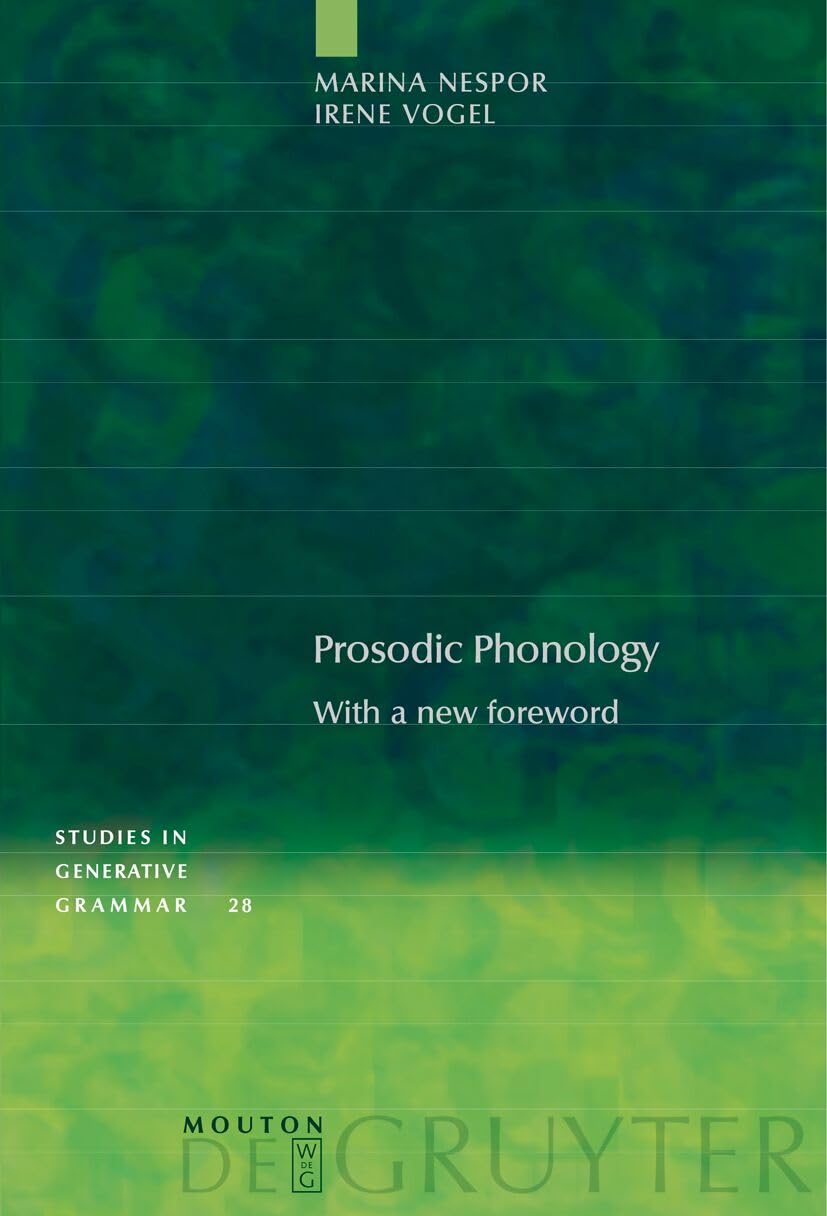
Prosodic Phonology: With a New Foreword by Marina Nespor – A Foundational Work on Phonological Constituents and Prosodic
Inclusive of all applicable taxes. FREE shipping on all orders.
Available Offers
- 🚚Free Delivery — Free shipping on all orders
- 💵Cash on Delivery — Pay when your order arrives
- ↩️15-Day Easy Returns — Hassle-free return policy
- 🔒Cash on Delivery — Pay safely when your order arrives
Check Delivery
Product Description
Introduction
For students and scholars of linguistics, Prosodic Phonology: With a New Foreword by Marina Nespor is an indispensable reference that has shaped the field for decades. Originally co-authored with Irene Vogel, this classic work remains the definitive guide to understanding how speech is organised into rhythmic and melodic units beyond the individual sound. Now available in a hardcover edition from de Gruyter Mouton, this book is essential for anyone serious about the structure of language.
Book Overview
This seminal volume presents a comprehensive framework for prosodic phonology, a subfield that examines how speech is divided into hierarchical units such as syllables, feet, phonological words, clitic groups, phonological phrases, intonational phrases, and utterances. Nespor provides robust cross-linguistic evidence for each constituent, drawing from languages as diverse as Italian, English, Dutch, Turkish, and many others. The new foreword contextualises the book’s lasting impact, making it relevant for contemporary research while preserving the original 1986 text.
Key Highlights
- Foundational text in prosodic phonology, cited continuously for over three decades
- New foreword by the author reflecting on developments in the field
- Cross-linguistic data from numerous languages supporting the prosodic hierarchy
- Experimental psycholinguistic evidence showing how prosodic structure aids sentence disambiguation
- Application to poetic meter, with detailed analysis of Dante’s Divine Comedy
Inside the Book
The book is organised into clearly defined chapters, each dedicated to a specific prosodic constituent. Nespor begins with the syllable and foot, then moves upward through the phonological word, clitic group, phonological phrase, intonational phrase, and finally the utterance. Each chapter presents formal definitions, diagnostics for identifying boundaries, and examples from a range of languages. A notable chapter on experimental phonology demonstrates how listeners use prosodic phrasing—not syntactic structure—to resolve ambiguities in sentences like “The old men and women stayed” versus “The old men, and women stayed.” The final chapter applies the prosodic hierarchy to the study of poetic meter, using Dante’s terza rima to show how linguistic rhythm and literary form intertwine.
Key Topics
- The prosodic hierarchy: from syllable to utterance
- Phonological phrasing and its relation to syntax
- The clitic group and its role in stress assignment
- Intonational phrasing and sentence interpretation
- Experimental evidence for prosodic constituency
- Prosodic phonology in poetry and metrical analysis
Reader Benefits
This book offers a rigorous yet accessible introduction to a core area of phonological theory. Readers will gain a clear understanding of how prosodic structures are defined, how they interact with syntax and morphology, and how they are realised in speech. The inclusion of experimental data bridges theory and empirical research, making it valuable for both linguists and psychologists. The new foreword provides a contemporary perspective, helping readers situate the classic text within current debates.
Learning Outcomes
By studying this book, readers will be able to identify and analyse prosodic constituents in any language, apply prosodic diagnostics to new data, evaluate the relationship between prosody and syntax, design simple perceptual experiments to test prosodic hypotheses, and analyse poetic meter using linguistic principles. These skills are foundational for advanced work in phonology, language acquisition, speech technology, and literary studies.
Who Should Read
This book is ideal for postgraduate students and researchers in linguistics, particularly those specialising in phonology, phonetics, and language typology. It is also highly relevant for scholars in cognitive science, psycholinguistics, and literary studies who wish to understand the sound structure of language. Advanced undergraduates with a solid background in phonology will also find it accessible and rewarding. Indian students of linguistics, in particular, will appreciate the multilingual data that includes examples from Indo-Aryan and Dravidian languages.
About the Author
Marina Nespor is a distinguished Italian linguist and Professor Emerita at the University of Bologna. She has made foundational contributions to phonology, prosody, and the relationship between language and music. Her work has influenced generations of linguists worldwide, and she continues to be an active voice in the field. The new foreword in this edition reflects her ongoing engagement with prosodic theory.
About the Publisher
de Gruyter Mouton is a premier academic publisher based in Berlin, specialising in linguistics, philosophy, and literary studies. With a history dating back to 1749, de Gruyter is known for publishing authoritative reference works and textbooks that set the standard in their disciplines. This edition of Prosodic Phonology continues that tradition of excellence.
Conclusion
Prosodic Phonology: With a New Foreword is not just a reprint; it is a reaffirmation of a classic. Whether you are a seasoned researcher or a student beginning your journey into phonology, this book offers the theoretical depth and empirical breadth you need. Its clear exposition, rich data, and enduring insights make it a must-have for any serious linguistics library. Add this hardcover edition to your collection and engage with the work that defined prosodic phonology.
Quick Summary
Prosodic Phonology by Marina Nespor is a seminal work in linguistics that systematically defines the prosodic constituents of language—from the smallest syllable to the full utterance. Originally co-authored with Irene Vogel and now reissued with a new foreword, this book remains the standard resource on prosodic hierarchy. It provides cross-linguistic evidence for each constituent and includes groundbreaking experimental psycholinguistic data showing that prosodic structure, not syntactic structure, predicts how listeners disambiguate sentences. A chapter on poetic phonology extends the theory to literary form. This book is ideal for graduate students, researchers, and faculty in phonology, psycholinguistics, and general linguistics. It is especially valuable for Indian readers seeking a deep understanding of phonological phrasing and intonation. By purchasing from Bookshops.in, you receive a genuine hardcover edition, supporting your academic journey with a trusted Indian bookstore.
Book Highlights
Book Specifications
| ISBN-13 | 9783110197891 |
| ISBN-10 | 3110197898 |
| Publisher | Mouton De Gruyter |
| Language | English |
| Dimensions | 15.6 x 2.39 x 23.39 cm |
| Weight | 658 g |
| Category | Language, Linguistics & Writing › Grammar |
| Genre | Nonfiction |
| Original Language | English |
Frequently Asked Questions
What is Prosodic Phonology about?
Who is the author of Prosodic Phonology?
Is this book suitable for beginners in linguistics?
Does the book include experimental data?
What languages are discussed in the book?
Is this a new edition or a reprint?
How is this book relevant to Indian students?
Does the book cover poetic phonology?
What is the binding of this book?
Can I use this book for research on prosody?
Is there a digital version available?
What is the ISBN of this book?
Why should I buy from Bookshops.in?
Readers Also Search For
Customers Also Bought

Journalism
Rock Critic Law (English, Michael Azerrad)
Journalism
What Is Sustainable Journalism?: Integrating the Environmental, Social, and Economic Challenges of Journalism

Journalism
The Power of Sports: Media and Spectacle in American Culture: 23 (Postmillennial Pop)

Journalism
Research Guide to People's Daily Editorials, 1949-1975

Vocabulary
Prince Edward Island Sayings (Heritage)
Vocabulary
Grammar Survival for Primary Teachers: A Practical Toolkit by Jo Shackleton
Related Products
View All
Language, Linguistics & Writing
Handbook of Color Psychology by Andrew J. Elliot
Language, Linguistics & Writing
The Language of Postcolonial Literatures (English, Ismail S. Talib)
Language, Linguistics & Writing
The Other Side of Language | by Gemma Corradi Fiumara | Routledge | by Gemma Corradi Fiumara | Routledge | by Gemma Corradi Fiumara | Routledge | by Gemma Corradi Fiumara | Routledge | by Gemma Corradi Fiumara | Routledge | by Gemma Corradi Fiumara | Routledge | by Gemma Corradi Fiumara | Routledge | by Gemma Corradi Fiumara | Routledge | by Gemma Corradi Fiumara | Routledge | by Gemma Corradi Fiumara | Routledge | by Gemma Corradi Fiumara | Routledge | by Gemma Corradi Fiumara | Routledge | by
Language, Linguistics & Writing
An Introduction to Cognitive Linguistics | by Friedrich Ungerer | Hans-Jorg Schmid | Routledge | by Friedrich Ungerer | Hans-Jorg Schmid | Routledge | by Friedrich Ungerer | Hans-Jorg Schmid | Routledge | by Friedrich Ungerer | Hans-Jorg Schmid | Routledge | by Friedrich Ungerer | Hans-Jorg Schmid | Routledge | by Friedrich Ungerer | Hans-Jorg Schmid | Routledge | by Friedrich Ungerer | Hans-Jorg Schmid | Routledge | by Friedrich Ungerer | Hans-Jorg Schmid | Routledge | by Friedrich Ungerer | Ha
Language, Linguistics & Writing
Nonsense and Other Senses: Regulated Absurdity in Literature
Language, Linguistics & Writing