
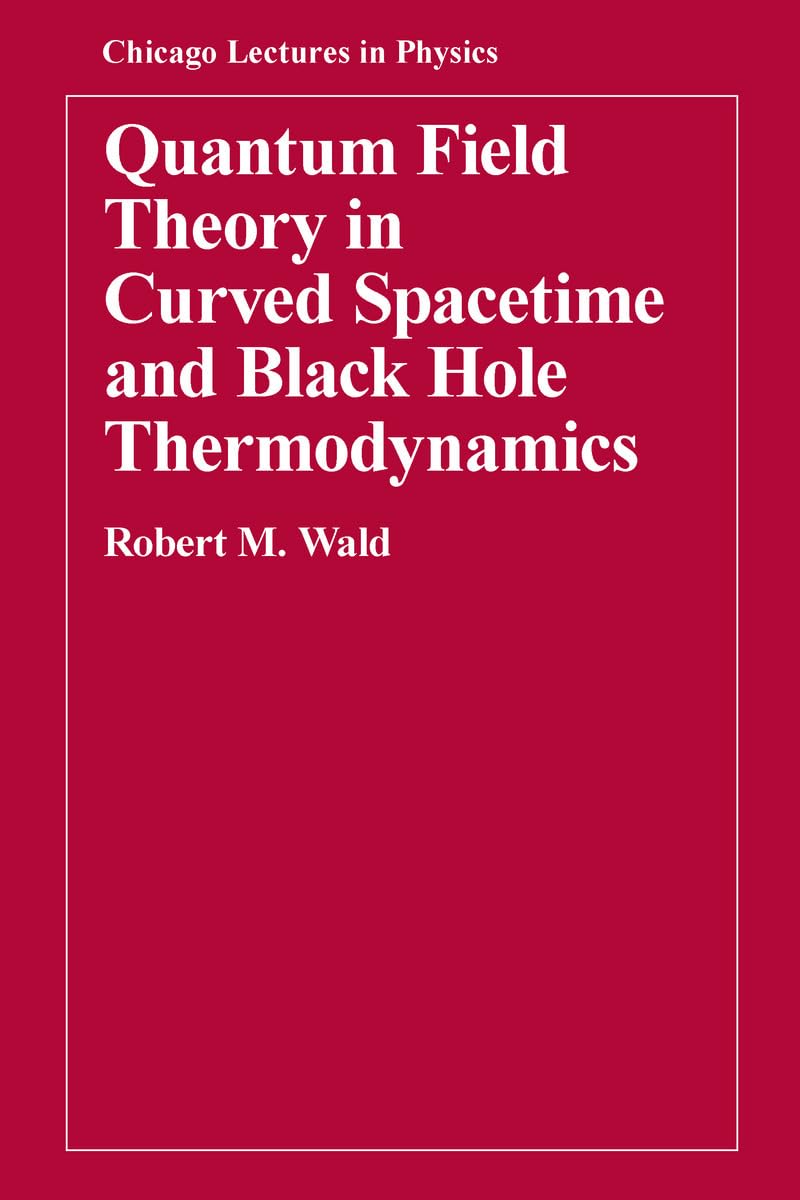
Quantum Field Theory in Curved Spacetime and Black Hole Thermodynamics by Robert M. Wald – A Foundational Text on QFT in
Inclusive of all applicable taxes. FREE shipping on all orders.
Available Offers
- 🚚Free Delivery — Free shipping on all orders
- 💵Cash on Delivery — Pay when your order arrives
- ↩️15-Day Easy Returns — Hassle-free return policy
- 🔒Cash on Delivery — Pay safely when your order arrives
Check Delivery
Product Description
Introduction
Quantum field theory in curved spacetime represents one of the most profound and intellectually rigorous frontiers of modern theoretical physics. Robert M. Wald's Quantum Field Theory in Curved Spacetime and Black Hole Thermodynamics is a seminal work that bridges the gap between general relativity and quantum mechanics, offering a rigorous yet accessible exploration of how quantum fields behave in the presence of gravity. For Indian students and researchers pursuing advanced studies in theoretical physics, this hardcover volume from the University of Chicago Press is an indispensable resource that has shaped the understanding of black hole physics and the thermodynamics of spacetime itself.
Book Overview
This book is not merely a textbook; it is a carefully crafted journey into the conceptual foundations of quantum field theory when gravity is no longer a fixed background but a dynamic participant. Wald begins with the familiar quantum harmonic oscillator and systematically builds up to the algebraic formulation of quantum field theory in curved spacetimes. The text then delves into the celebrated Unruh and Hawking effects, culminating in a comprehensive treatment of black hole thermodynamics. What sets this work apart is Wald's insistence on disentangling essential features—such as the algebraic structure of observables—from inessential ones like a particle interpretation, making it a masterclass in theoretical clarity.
Key Highlights
- Pedagogical progression from simple quantum systems to advanced curved-spacetime formalism
- Algebraic approach that clarifies the role of observers and particle detectors
- In-depth coverage of the Unruh effect, Hawking radiation, and black hole entropy
- Rigorous yet readable style suitable for advanced graduate students and researchers
- Comprehensive bibliography and references to original research
Inside the Book
The book is structured to guide the reader through a logical progression of ideas. Early chapters revisit the quantization of the harmonic oscillator and free fields in flat spacetime, establishing the necessary mathematical tools. Wald then introduces the concept of curved spacetime and the challenges it poses to conventional quantization. The middle sections develop the algebraic formalism, focusing on the role of the stress-energy tensor and the Hadamard condition. Later chapters are devoted to the Unruh effect—where an accelerating observer perceives a thermal bath of particles—and the Hawking effect, which predicts black hole evaporation. The final chapters provide a deep dive into black hole thermodynamics, including the laws of black hole mechanics and the statistical origin of black hole entropy.
Key Topics
- Quantum field theory in Minkowski and curved spacetimes
- Algebraic formulation of quantum fields and the GNS construction
- Unruh effect and its implications for the concept of particles
- Hawking radiation and black hole evaporation
- Laws of black hole thermodynamics and the Bekenstein-Hawking entropy
- Stress-energy tensor renormalization in curved spacetime
Reader Benefits
By studying this book, readers will gain a robust conceptual and mathematical foundation for one of the most active research areas in theoretical physics. Wald's clear exposition helps demystify complex ideas, allowing students to move beyond rote calculations to genuine understanding. The book also equips researchers with the tools needed to engage with current literature on quantum gravity, holography, and cosmology. For Indian academics preparing for competitive exams or pursuing PhDs in high-energy physics, this volume offers authoritative depth that complements standard coursework.
Learning Outcomes
After working through this text, readers will be able to: understand the limitations of particle interpretations in curved spacetime; apply algebraic methods to quantize fields in nontrivial backgrounds; derive the Unruh and Hawking effects from first principles; analyze black hole thermodynamics using both classical and quantum arguments; and critically evaluate modern proposals for quantum gravity. The book also strengthens mathematical skills in functional analysis, differential geometry, and operator algebras as applied to physics.
Who Should Read
This book is intended for advanced graduate students and researchers in theoretical physics, particularly those specializing in general relativity, quantum field theory, or black hole physics. It assumes familiarity with introductory general relativity and basic quantum field theory. Indian students enrolled in MSc or PhD programs in physics at institutions like IISc, IITs, IISERs, and central universities will find it an invaluable reference. Working physicists seeking to update their understanding of foundational issues in quantum gravity will also benefit greatly.
About the Author
Robert M. Wald is one of the world's foremost authorities on general relativity and black hole physics. A professor at the University of Chicago, he has made seminal contributions to the theory of black hole thermodynamics, quantum fields in curved spacetime, and the foundations of general relativity. His textbooks, including General Relativity, are considered classics in the field. Wald's writing is characterized by mathematical rigor combined with deep physical insight, making complex topics accessible without sacrificing precision.
About the Publisher
The University of Chicago Press is a prestigious academic publisher known for its high-quality monographs and textbooks in the sciences and humanities. Since its founding in 1890, it has published works by Nobel laureates and leading scholars worldwide. This hardcover edition reflects the press's commitment to durable, well-produced books that stand the test of time—ideal for the serious student or researcher's library.
Conclusion
Quantum Field Theory in Curved Spacetime and Black Hole Thermodynamics by Robert M. Wald is more than a textbook; it is a landmark contribution to theoretical physics. For anyone seeking to understand the deepest connections between quantum mechanics, gravity, and thermodynamics, this book remains an essential and rewarding read. Whether you are a graduate student in India embarking on research or a seasoned physicist revisiting foundational ideas, Wald's masterful exposition will illuminate the path forward.
Quick Summary
Quantum Field Theory in Curved Spacetime and Black Hole Thermodynamics by Robert M. Wald is a seminal textbook that provides a rigorous yet pedagogical introduction to quantum field theory in curved spacetime. Starting from the quantum harmonic oscillator, Wald builds up the theory in flat spacetime before extending it to curved backgrounds, culminating in an algebraic formulation that avoids reliance on particle interpretations. The book offers a comprehensive treatment of the Unruh effect and Hawking radiation, along with their implications for black hole thermodynamics. It is written for graduate students and researchers in theoretical physics, cosmology, and general relativity who already have a solid foundation in QFT and GR. Readers will gain a deep understanding of how quantum fields behave in the presence of gravity, how black holes emit radiation, and how acceleration affects quantum vacuum states. This book stands out for its clarity, mathematical precision, and focus on conceptual foundations. By purchasing from Bookshops.in, Indian customers get a premium hardcover edition at ₹3439 with reliable delivery and excellent customer service.
Book Highlights
Book Specifications
| ISBN-13 | 9780226870274 |
| ISBN-10 | 0226870278 |
| Publisher | University of Chicago Press |
| Language | English |
| Dimensions | 22.73 x 15.06 x 1.35 cm |
| Weight | 318 g |
| Category | Science & Mathematics › Astronomy & Astrophysics |
| Genre | Science & Mathematics |
| Reading Age | Adult |
| Original Language | English |
Frequently Asked Questions
What is the main subject of this book?
Who is Robert M. Wald?
Is this book suitable for beginners?
Does the book cover the Unruh effect?
What is the Hawking effect?
Is the algebraic formulation of QFT explained?
What is the price of this book in India?
Can I use this book for a course?
Does it include exercises?
What is the ISBN-13?
Is it available in hardcover?
What language is the book in?
How is this book different from other QFT texts?
Readers Also Search For
Related Products
View All
Science & Mathematics
Stereotype Spaces and Algebras: 73 (De Gruyter Expositions in Mathematics, 73)

Science & Mathematics
Elements of Pelagos Biology: With Focus on the Mediterranean Sea
Science & Mathematics
Mathematical Theory of Optimal Processes (Classics of Soviet Mathematics)
Science & Mathematics
Cambridge IGCSE and O Level Additional Mathematics by Val Hanrahan – Textbook for 0606/4037

Science & Mathematics
Squid - Superconducting Quantum Interference Devices and Their Applications: Proceedings of the International Conference on Superconducting Quantum Devices, Berlin-west, October 4-8, 1976

Science & Mathematics