
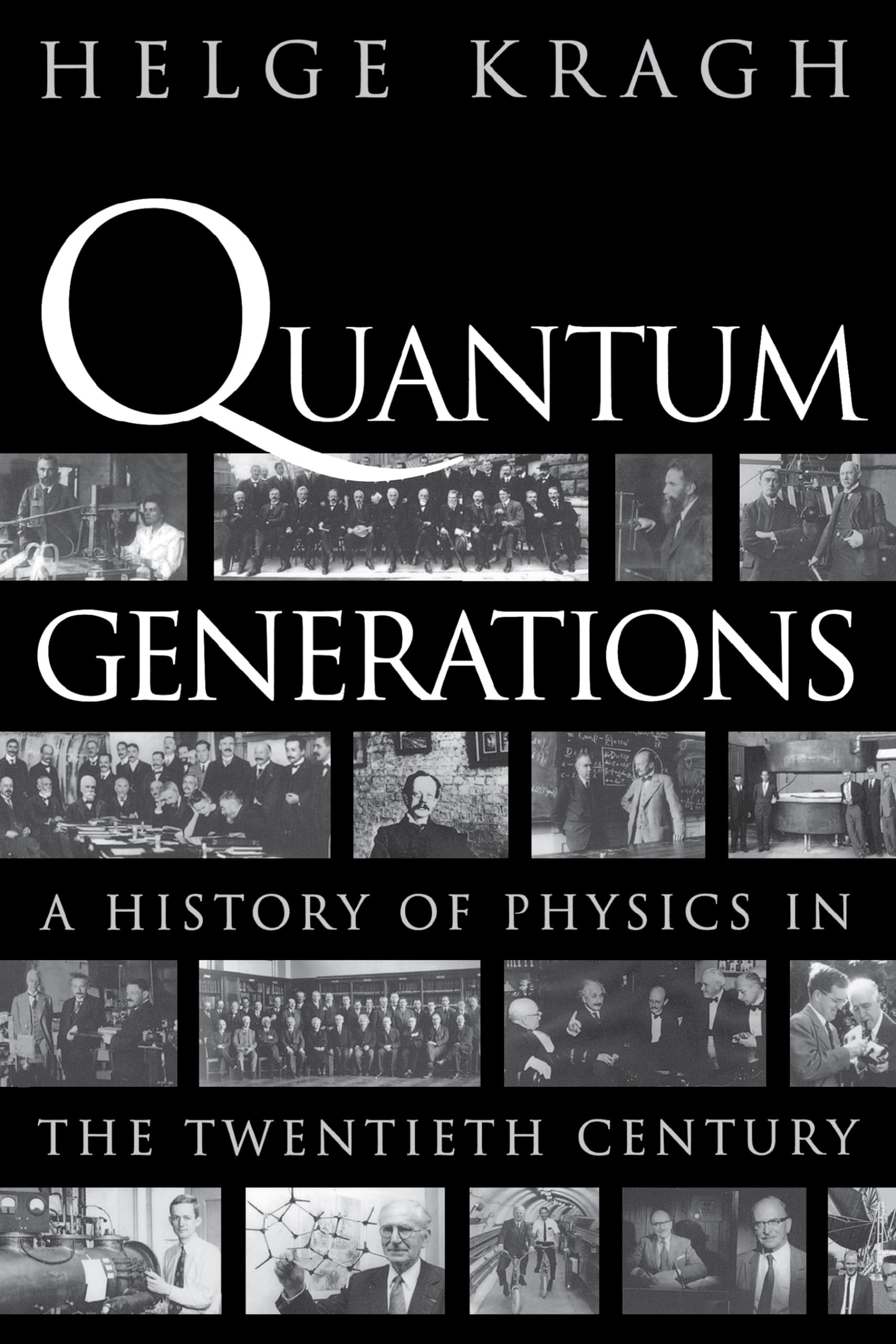
Quantum Generations: A History of Physics in the Twentieth Century by Helge Kragh – A Definitive Science Book for Indian
Inclusive of all applicable taxes. FREE shipping on all orders.
Available Offers
- 🚚Free Delivery — Free shipping on all orders
- 💵Cash on Delivery — Pay when your order arrives
- ↩️15-Day Easy Returns — Hassle-free return policy
- 🔒Cash on Delivery — Pay safely when your order arrives
Check Delivery
Product Description
Introduction
Few centuries have reshaped human understanding as profoundly as the twentieth, and at the heart of that transformation lies physics. From the first glimpse of X‑rays to the mind‑bending ideas of superstrings, the journey has been nothing short of extraordinary. For Indian students, researchers, and science enthusiasts, Quantum Generations: A History of Physics in the Twentieth Century by Helge Kragh offers a masterful, single‑volume narrative that captures the drama, the discoveries, and the people behind the science. Published by Princeton University Press, this hardcover edition is an essential addition to any serious library.
Book Overview
Quantum Generations is not just a chronology of breakthroughs—it is a thoughtful, critical history that places physics in its cultural, institutional, and intellectual context. Helge Kragh, a world‑renowned historian of science, weaves together the stories of relativity, quantum mechanics, cosmology, particle physics, and solid‑state physics. The book traces how these fields emerged, competed, and ultimately transformed our world—from the invention of radio and television to lasers, nuclear power, and computers. Written with clarity and depth, it is as rewarding for the curious layperson as for the seasoned physicist.
Key Highlights
- Comprehensive scope: Covers the entire twentieth century, from the discovery of X‑rays in 1895 to the rise of superstring theory in the 1990s.
- Authoritative yet accessible: Kragh’s narrative is rigorous but never dry, making complex ideas understandable without oversimplification.
- Rich in context: Explores the social, political, and philosophical forces that shaped physics—ideal for understanding science as a human endeavour.
- Balanced treatment: Gives due attention to both celebrated breakthroughs and lesser‑known but crucial developments.
- Perfect for Indian readers: The global perspective includes contributions from scientists worldwide, offering a complete picture beyond Euro‑centric narratives.
Inside the Book
Organised chronologically and thematically, the book moves through the key revolutions of the century. Early chapters cover the birth of quantum theory and relativity, the rise of nuclear physics, and the development of quantum mechanics. Later sections delve into the explosive growth of particle physics, the discovery of the expanding universe, and the solid‑state physics that powered the digital age. Each chapter is enriched with biographical sketches, institutional histories, and discussions of experimental and theoretical milestones. Kragh also addresses controversies, dead ends, and the human stories behind the equations.
Key Topics
- The discovery of X‑rays, radioactivity, and the electron
- Einstein’s theories of relativity and their experimental tests
- The birth and consolidation of quantum mechanics (Planck, Bohr, Heisenberg, Schrödinger)
- Nuclear fission, the atomic bomb, and the Cold War physics
- The Standard Model of particle physics and the search for unification
- Cosmology: from the Big Bang to cosmic microwave background radiation
- Solid‑state physics, semiconductors, and the transistor revolution
- The rise of astrophysics and the exploration of the universe
- Superstring theory and the frontiers of twenty‑first‑century physics
Reader Benefits
- Deepen your understanding of the physics that underpins modern technology—from smartphones to medical imaging.
- Gain perspective on how scientific ideas evolve, compete, and sometimes fail.
- Enhance your learning with a narrative that connects textbook formulas to real‑world discoveries and personalities.
- Build a strong foundation for advanced studies in physics, history of science, or science communication.
- Enjoy a well‑crafted story that reads like an intellectual adventure, not a dry reference work.
Learning Outcomes
After reading Quantum Generations, you will be able to trace the major threads of twentieth‑century physics from their origins to their modern forms. You will understand not only what was discovered, but also why and how those discoveries mattered. You will appreciate the interplay between theory and experiment, the role of institutions and funding, and the profound impact of physics on society. The book equips you with a coherent mental map of a century of science—an invaluable asset for students preparing for competitive exams, researchers seeking context, or anyone who wants to see the bigger picture.
Who Should Read
- Undergraduate and postgraduate students of physics, engineering, and the history of science.
- Teachers and professors looking for a reliable, engaging resource to supplement lectures.
- Science enthusiasts and curious readers who want to understand how modern physics came to be.
- JEE, NEET, and other competitive exam aspirants who wish to go beyond the syllabus and appreciate the story behind the formulas.
- Librarians and collectors building a quality science collection.
About the Author
Helge Kragh is one of the world’s foremost historians of physics. He has written extensively on the history of modern science, with a special focus on cosmology, quantum theory, and the social dimensions of physics. His work is known for its meticulous scholarship, balanced judgment, and engaging prose. Kragh’s deep expertise ensures that Quantum Generations is both authoritative and a pleasure to read.
About the Publisher
Princeton University Press is a prestigious academic publisher with a long tradition of bringing high‑quality works in science, history, and the humanities to a global audience. This hardcover edition reflects their commitment to durable binding, clear typography, and careful editing—making it a book that will last for generations.
Conclusion
Quantum Generations: A History of Physics in the Twentieth Century is more than a history—it is a gateway to understanding the intellectual revolution that defines our modern world. Whether you are a student in Mumbai, a researcher in Bengaluru, or a curious reader in Delhi, this book will enrich your mind and inspire your curiosity. Order your hardcover copy today from Bookshops.in and own a definitive account of the century that changed everything.
Quick Summary
Quantum Generations: A History of Physics in the Twentieth Century by Helge Kragh is a masterful chronicle of one of the most transformative periods in science. The book takes readers on a journey from the dawn of quantum mechanics and relativity to the rise of cosmology, particle physics, and solid-state physics. Kragh, a distinguished historian, weaves together scientific breakthroughs with the personal stories of physicists like Einstein, Bohr, and Feynman. This hardcover edition is perfect for Indian students preparing for university courses or competitive exams, as well as science enthusiasts who want to understand how physics shaped the modern world. Readers will learn about the theoretical foundations of modern technology, including lasers, nuclear power, and computers. By purchasing from Bookshops.in, India's premium online bookstore, you get a genuine imported edition with fast delivery and excellent customer service. This book is not just a history lesson—it is an inspiration for future scientists.
Book Highlights
Book Specifications
| ISBN-13 | 9780691095523 |
| ISBN-10 | 0691095523 |
| Publisher | Princeton Univ Pr |
| Language | English |
| Dimensions | 15.24 x 3.25 x 22.86 cm |
| Weight | 703 g |
| Country | USA |
| Category | Science & Mathematics › Physics |
| Genre | Science & Mathematics |
| Original Language | English |
Frequently Asked Questions
What is Quantum Generations about?
Who is the author of Quantum Generations?
Is this book suitable for Indian students?
What is the language of the book?
Is this a hardcover edition?
Does the book cover quantum mechanics only?
Can I use this book for competitive exams?
What is the ISBN of this book?
Is there a digital edition available?
What makes this book different from other physics histories?
Does the book include biographies of scientists?
Is the book suitable for beginners?
How can I order this book from Bookshops.in?
Readers Also Search For
Customers Also Bought
Mathematics
Stereotype Spaces and Algebras: 73 (De Gruyter Expositions in Mathematics, 73)
Mathematics
Semigroups in Algebra, Geometry and Analysis: 20 (De Gruyter Expositions in Mathematics, 20)
Mathematics
Geometry from the Pacific Rim: Proceedings of the Pacific Rim Geometry Conference held at National University of Singapore, Republic of Singapore, ... 1994 (De Gruyter Proceedings in Mathematics)
Mathematics
First International Tainan-Moscow Algebra Workshop: Proceedings of the International Conference held at National Cheng Kung University Tainan, Taiwan, ... 1994 (De Gruyter Proceedings in Mathematics)
Mathematics
Differential Geometry - Proceedings of the VIII International Colloquium (English, Jesus A. Alvarez Lopez | Eduardo Garcia-Rio)
Mathematics
Mathematical Theory of Optimal Processes (Classics of Soviet Mathematics)
Related Products
View All
Physics
The Quantum and Cosmic Codes of the Universe
Physics
Physics for You by Keith Johnson – GCSE Physics Textbook
Physics
Experimental Techniques in Nuclear Physics
Physics
Essential Physics I

Physics
Modern Foundations of Quantum Optics
Physics