
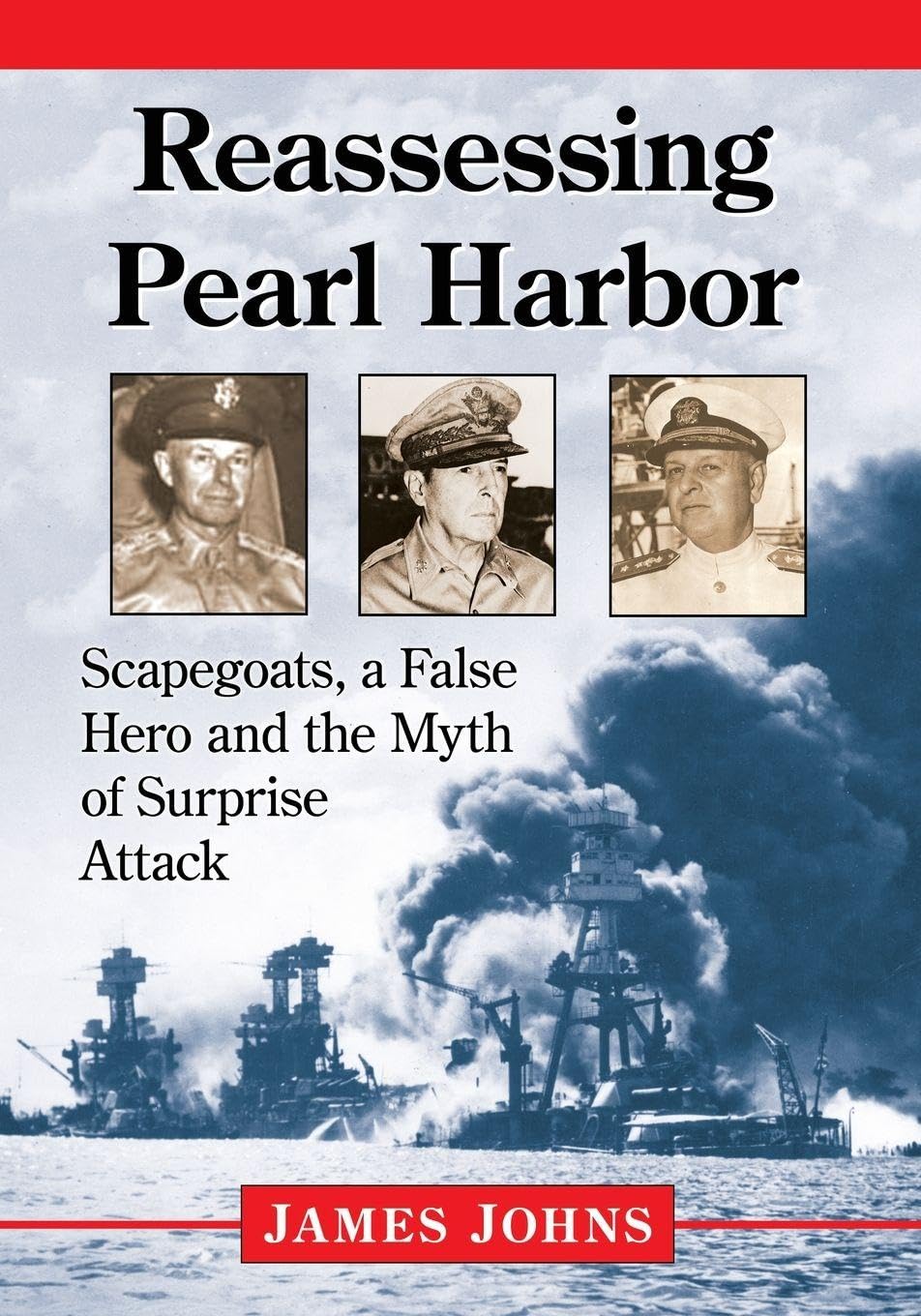
Reassessing Pearl Harbor: Scapegoats, a False Hero and the Myth of Surprise Attack by James Johns – A Deep Dive into the
Inclusive of all applicable taxes. FREE shipping on all orders.
Available Offers
- 🚚Free Delivery — Free shipping on all orders
- 💵Cash on Delivery — Pay when your order arrives
- ↩️15-Day Easy Returns — Hassle-free return policy
- 🔒Cash on Delivery — Pay safely when your order arrives
Check Delivery
Product Description
Introduction
Few events in modern history have been as thoroughly examined, yet as persistently shrouded in controversy, as the Japanese attack on Pearl Harbor on December 7, 1941. James Johns’ Reassessing Pearl Harbor: Scapegoats, a False Hero and the Myth of Surprise Attack challenges the standard narrative, peeling back decades of official accounts to ask uncomfortable questions. For Indian readers who have grown up with a keen interest in World War II history, military strategy, and the politics of blame, this hardcover volume from McFarland & Company offers a fresh, deeply researched perspective that reopens one of the twentieth century’s most debated episodes.
Book Overview
This meticulously argued work focuses on the fates of Admiral Husband Kimmel and General Walter Short, the two senior American commanders in Hawaii who were swiftly made scapegoats after the attack. Meanwhile, General Douglas MacArthur—who suffered a similar defeat in the Philippines just hours later—was awarded the Medal of Honor. Johns systematically examines the evidence to answer critical questions: Were Kimmel and Short incompetent officers or convenient sacrifices to protect higher authorities? And was the attack truly a surprise, or did the Roosevelt administration have prior knowledge that was deliberately withheld? The book does not merely rehash old debates; it presents new archival findings and logical reasoning that will compel readers to rethink long-held assumptions.
Key Highlights
- Original Analysis: A fresh examination of the decisions made in Washington, Honolulu, and Manila in the days leading up to December 7.
- Contrasting Fates: Detailed comparison of how Kimmel and Short were disgraced while MacArthur was celebrated for a similar failure.
- Myth-Busting: Systematic deconstruction of the official narrative that the attack was a complete surprise.
- Archival Research: Draws on recently declassified documents and personal correspondence to support its arguments.
- Balanced Perspective: Avoids sensationalism, presenting evidence in a calm, scholarly manner suitable for serious readers.
Inside the Book
The book is structured around a central thesis: that the blame placed on Kimmel and Short was disproportionate and politically motivated. Johns walks readers through the chain of command, the intelligence failures, and the confusing signals that preceded the attack. He examines the role of code-breaking, the movement of Japanese carriers, and the warnings that never reached Pearl Harbor. Each chapter builds a case that the disaster was not the result of local incompetence alone, but of systemic failures and deliberate choices made in Washington. The narrative is gripping, reading at times like a courtroom drama, as Johns presents evidence and cross-examines historical witnesses.
Key Topics
- The scapegoating of Admiral Kimmel and General Short
- General MacArthur’s controversial Medal of Honor
- The myth of a complete surprise attack
- Intelligence failures and intercepted communications
- Political maneuvering within the Roosevelt administration
- The Pacific theatre command structure in 1941
- Lessons for military accountability and leadership
Reader Benefits
This book is not just for professional historians. It offers valuable insights for anyone interested in leadership, accountability, and how governments manage crises. Indian readers, in particular, will appreciate the parallels with other historical episodes where scapegoating has shaped national narratives. The book sharpens critical thinking skills by showing how official stories can be incomplete or misleading. It also provides a deeper understanding of World War II’s Pacific theatre, a region that directly involved India and its neighbours. Reading this volume will equip you with arguments and evidence to challenge simplistic versions of history.
Learning Outcomes
After reading Reassessing Pearl Harbor, you will be able to: identify the key figures and decisions that led to the disaster; explain why Kimmel and Short were treated differently from MacArthur; evaluate the evidence for and against the surprise attack theory; understand how political pressures can distort military justice; and apply these lessons to contemporary debates about leadership and accountability. The book also enhances your ability to critically analyse primary sources and secondary accounts.
Who Should Read
- Students of military history and World War II
- Readers interested in leadership and organisational failure
- Indian scholars and enthusiasts of Pacific theatre history
- Anyone curious about conspiracy theories and official narratives
- Book club members looking for a thought-provoking non-fiction title
- Professionals in defence, intelligence, or public administration
About the Author
James Johns is a historian and independent researcher with a long-standing focus on the Pacific War and the politics of military command. He has spent years combing through archives in the United States and Japan, uncovering documents that challenge conventional wisdom. His writing is known for its clarity, rigorous sourcing, and willingness to ask difficult questions without descending into speculation. Reassessing Pearl Harbor is the culmination of his decades-long investigation into the events surrounding December 7, 1941.
About the Publisher
McFarland & Company is a respected academic and trade publisher based in the United States, known for producing authoritative works on history, military studies, and popular culture. Their titles are widely used by universities and serious readers worldwide. This hardcover edition is printed on quality paper with a durable binding, making it a lasting addition to any personal or institutional library. Bookshops.in is proud to offer this premium volume to Indian readers who demand the best in historical scholarship.
Conclusion
Reassessing Pearl Harbor: Scapegoats, a False Hero and the Myth of Surprise Attack is a must-read for anyone who believes that history should be questioned, not just memorised. James Johns has written a compelling, evidence-based work that restores nuance to a story often reduced to simple heroes and villains. Whether you are a student, a teacher, or a lifelong learner, this book will change the way you think about one of the most consequential days of the twentieth century. Order your copy today from Bookshops.in and discover the truth behind the myth.
Quick Summary
Reassessing Pearl Harbor: Scapegoats, a False Hero and the Myth of Surprise Attack by James Johns is a meticulously researched work of military history that challenges the traditional narrative of December 7, 1941. The book focuses on the fates of Admiral Husband Kimmel and General Walter Short, who were relieved of command after the attack, and contrasts their treatment with General Douglas MacArthur, who received the Medal of Honor for his defense of the Philippines despite a similar lack of preparedness. Johns argues that Kimmel and Short were made scapegoats for broader failures in Washington, and that the Roosevelt administration promoted the 'myth of surprise' to unify the nation and deflect criticism. This book is ideal for Indian students and readers interested in World War II, military leadership, and the politics of historical memory. It offers a balanced, evidence-based analysis that encourages critical thinking. By purchasing from Bookshops.in, you get a premium hardcover edition with fast delivery across India, perfect for building a serious history library.
Book Highlights
Book Specifications
| ISBN-13 | 9781476668277 |
| ISBN-10 | 1476668272 |
| Publisher | McFarland Publishing |
| Language | English |
| Dimensions | 17.78 x 1.17 x 25.4 cm |
| Weight | 408 g |
| Country | India |
| Category | Americas › United States |
| Genre | History |
| Reading Age | Adult |
| Original Language | English |
Frequently Asked Questions
What is Reassessing Pearl Harbor about?
Who is the author James Johns?
Is this book only for American readers?
Does the book support conspiracy theories?
What makes this book different from other Pearl Harbor books?
Is the book based on primary sources?
What is the price in India?
Is it available in paperback?
What is the rating?
Is the book suitable for academic research?
Does the book cover the Japanese perspective?
Readers Also Search For
Related Products
View All
History
The Information Revolution: Transforming the World Through Technology (World History)
History
Human Nature and the French Revolution: From the Enlightenment to the Napoleonic Code: 3 (Polygons: Cultural Diversities and Intersections, 3)
History
The Unmaking of Home in Contemporary Art (Cultural Spaces)

History
Handbook to Life in Medieval and Early Modern Japan | by William E. Deal | Oxford University Press | by William E. Deal | Oxford University Press | by William E. Deal | Oxford University Press | by William E. Deal | Oxford University Press | by William E. Deal | Oxford University Press | by William E. Deal | Oxford University Press | by William E. Deal | Oxford University Press | by William E. Deal | Oxford University Press | by William E. Deal | Oxford University Press | by William E. Deal | Ox

History
The Narrators of Barbarian History (A.D. 550-800) | by Walter Goffart | University of Notre Dame Press | by Walter Goffart | University of Notre Dame Press | by Walter Goffart | University of Notre Dame Press | by Walter Goffart | University of Notre Dame Press | by Walter Goffart | University of Notre Dame Press | by Walter Goffart | University of Notre Dame Press | by Walter Goffart | University of Notre Dame Press | by Walter Goffart | University of Notre Dame Press | by Walter Goffart | Univ

History