
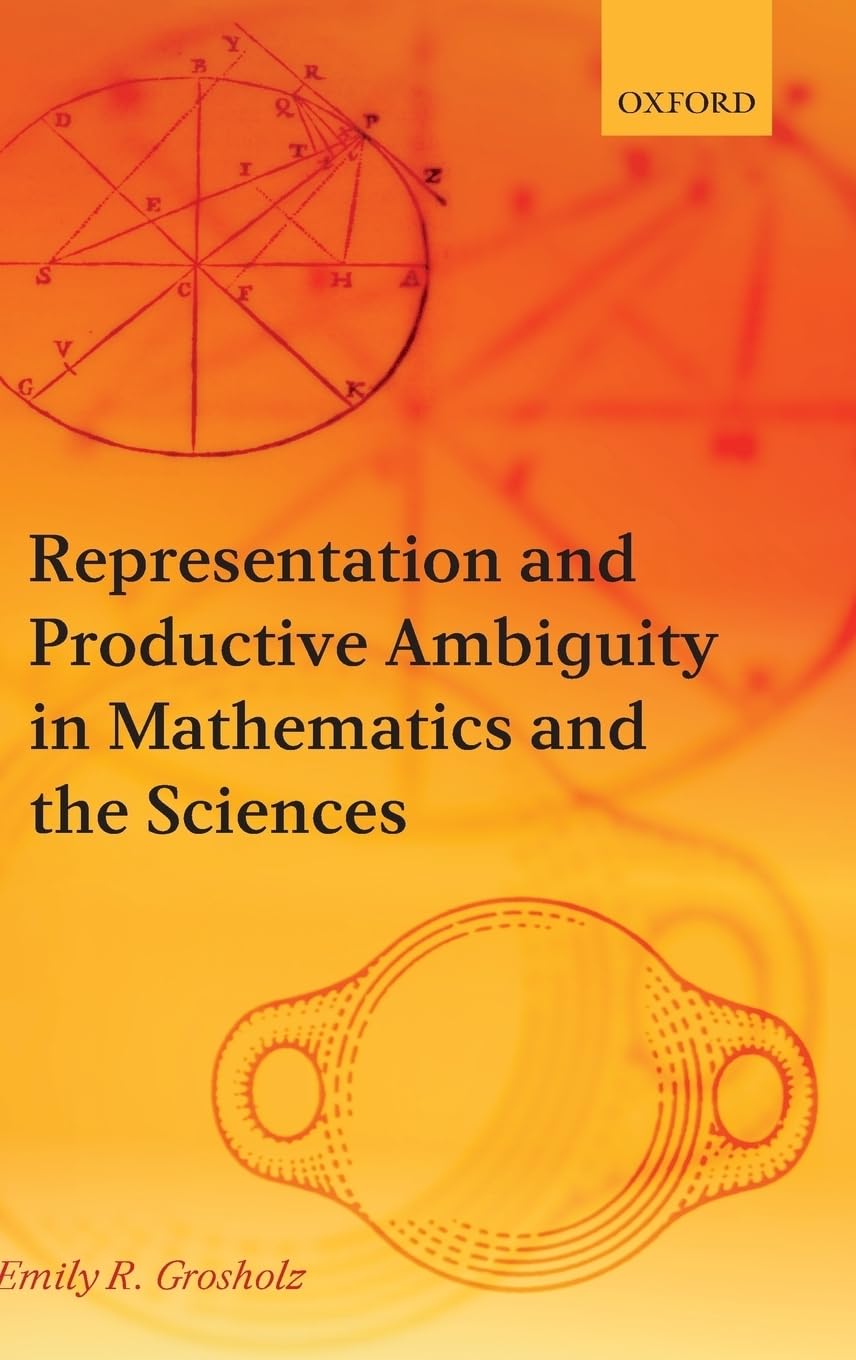
Representation and Productive Ambiguity in Mathematics and the Sciences by Emily R. Grosholz – A Philosophical Investiga
Inclusive of all applicable taxes. FREE shipping on all orders.
Available Offers
- 🚚Free Delivery — Free shipping on all orders
- 💵Cash on Delivery — Pay when your order arrives
- ↩️15-Day Easy Returns — Hassle-free return policy
- 🔒Cash on Delivery — Pay safely when your order arrives
Check Delivery
Product Description
Introduction
In the vast landscape of scientific and mathematical literature, few books dare to challenge the very foundations of how we think about reasoning and discovery. Representation and Productive Ambiguity in Mathematics and the Sciences by Emily R. Grosholz is a rare intellectual treasure that invites readers to explore the subtle interplay between clarity and ambiguity in formal thought. This is not a dry textbook but a profound meditation on how mathematicians and scientists actually make progress—by using multiple modes of representation and embracing ambiguity as a creative force. For Indian students and scholars who grapple with complex quantitative disciplines, this book offers a fresh perspective on problem-solving that transcends rote learning.
Book Overview
Published by OUP Oxford, this hardcover volume presents a rigorous yet accessible investigation into the nature of demonstration in mathematics and science. Grosholz argues that reductive methods succeed not because they simplify but because they multiply and juxtapose different ways of representing a problem. Drawing on case studies from ancient Greece to the present day—with special attention to the seventeenth and twentieth centuries—she shows how iconic, symbolic, and indexical signs work together to create meaning. The book covers mechanics, topology, algebra, logic, and chemistry, making it a truly interdisciplinary work. At its heart lies a Leibnizian notion of 'analysis' as the search for conditions of intelligibility, where discovery and justification become two sides of the same rational coin.
Key Highlights
- Original Thesis: Challenges the conventional view that ambiguity is an obstacle, showing how it can be productive in mathematical and scientific reasoning.
- Wide Historical Scope: Explores demonstrations from ancient Greek geometry to modern chemical theories, with a focus on the transformative eras of the 17th and 20th centuries.
- Interdisciplinary Approach: Bridges mathematics, physics, chemistry, logic, and philosophy, offering insights for multiple fields.
- Emphasis on Representation: Argues that effective problem-solving depends on using multiple representations—visual, symbolic, and indexical—simultaneously.
- Leibnizian Framework: Revives the concept of 'analysis' as a method for understanding how formal experience emerges from rational inquiry.
Inside the Book
The book is structured around a series of detailed case studies that illustrate Grosholz's central argument. Readers will encounter the geometrical demonstrations of ancient Greek mathematicians, the algebraic innovations of the 17th century, and the topological insights of the 20th century. Each chapter examines a specific problem or theory, showing how the juxtaposition of different representational systems—such as diagrams, equations, and natural language—enables mathematicians and scientists to discover new truths. The author also delves into the role of iconic signs (like geometric figures) alongside symbolic and indexical ones, offering a semiotic perspective that enriches our understanding of formal reasoning. The concluding chapters extend these ideas to logic and chemistry, demonstrating the universality of productive ambiguity.
Key Topics
- Geometrical demonstration and its evolution from Euclid to modern times
- The role of diagrams and visual representations in mathematical proof
- Productive ambiguity in algebraic notation and symbolic logic
- Case studies in mechanics: from Galileo to Newton and beyond
- Topology and the interplay of spatial and algebraic reasoning
- Chemical structures and the ambiguity of molecular representation
- Leibniz's concept of analysis as a method for discovery and justification
- Semiotics of mathematical and scientific signs: iconic, symbolic, and indexical
Reader Benefits
- Deepens Understanding: Gain a nuanced appreciation of how mathematical and scientific knowledge is created, not just applied.
- Enhances Problem-Solving Skills: Learn to leverage multiple representations and tolerate ambiguity as a tool for breakthrough thinking.
- Historical Perspective: See how great minds from different eras tackled complex problems, offering lessons for contemporary research.
- Interdisciplinary Insight: Ideal for readers who want to connect ideas across mathematics, physics, chemistry, and philosophy.
- Critical Thinking: Develop a more reflective approach to reasoning that goes beyond formulaic methods.
Learning Outcomes
By engaging with this book, readers will be able to: identify and analyze the role of representation in mathematical and scientific arguments; recognize how ambiguity can be harnessed productively rather than avoided; apply the concept of Leibnizian analysis to their own problem-solving; appreciate the historical development of demonstrative practices; and critically evaluate the relationship between discovery and justification in formal sciences. These outcomes are valuable for anyone pursuing advanced studies or research in quantitative disciplines.
Who Should Read
This book is essential for graduate students and researchers in mathematics, philosophy of science, logic, and history of science. It is also highly recommended for advanced undergraduate students in these fields, as well as for scholars in cognitive science and semiotics who study representation. Indian readers preparing for competitive examinations or pursuing research in pure or applied sciences will find the book's emphasis on creative reasoning a refreshing departure from standard curricula. Teachers and educators looking to enrich their pedagogy with historical and philosophical depth will also benefit greatly.
About the Author
Emily R. Grosholz is a distinguished professor of philosophy, mathematics, and African American studies at Penn State University. She is a prolific author and editor, known for her work on the history and philosophy of mathematics, as well as for her poetry. Her interdisciplinary expertise allows her to bridge the gap between technical formalism and humanistic inquiry, making complex ideas accessible to a broad audience. Grosholz's unique perspective—combining rigorous scholarship with creative insight—shines through every page of this book.
About the Publisher
OUP Oxford is one of the world's oldest and most respected academic publishers, known for producing authoritative works in science, mathematics, and the humanities. With a legacy spanning over five centuries, OUP Oxford ensures that each title meets the highest standards of scholarly excellence. This hardcover edition reflects the publisher's commitment to quality, making it a durable addition to any serious reader's library.
Conclusion
Representation and Productive Ambiguity in Mathematics and the Sciences is not just a book—it is an invitation to rethink the very nature of reasoning. Emily R. Grosholz masterfully demonstrates that the most powerful discoveries often emerge from the creative tension between clarity and ambiguity, between different modes of representation. For Indian students and scholars who aspire to move beyond memorization and into genuine understanding, this book offers a transformative intellectual journey. Whether you are a mathematician, a scientist, a philosopher, or simply a curious mind, this work will change how you see the relationship between symbols, diagrams, and the truths they reveal. Add this thought-provoking volume to your collection and experience the beauty of productive ambiguity firsthand.
Quick Summary
Representation and Productive Ambiguity in Mathematics and the Sciences by Emily R. Grosholz is a profound exploration of how demonstration works in mathematics and science. The book argues that representation and ambiguity are not obstacles but essential tools for discovery. Through detailed case studies spanning from ancient Greece to the 20th century, Grosholz shows how reductive methods actually multiply modes of representation, making problems more intelligible. She uses Leibnizian analysis to frame discovery and justification as two sides of the same coin. This work is ideal for graduate students, researchers, and academics in philosophy, mathematics, physics, chemistry, and history of science. Readers will gain a fresh perspective on the creative process behind scientific breakthroughs. By purchasing from Bookshops.in, Indian readers get access to a premium hardcover edition with reliable delivery and customer support.
Book Highlights
Book Specifications
| ISBN-13 | 9780199299737 |
| ISBN-10 | 0199299730 |
| Publisher | Clarendon Pr |
| Language | English |
| Dimensions | 23.62 x 2.54 x 16 cm |
| Weight | 658 g |
| Category | Philosophy › Epistemology |
| Genre | Non-fiction |
| Reading Age | Adult |
| Original Language | English |
Frequently Asked Questions
What is the main argument of the book?
Who is Emily R. Grosholz?
Is this book suitable for beginners?
What historical periods are covered?
Does the book include case studies?
What is Leibnizian analysis?
How does the book relate to modern science?
Is the book only about mathematics?
What makes this book unique?
Can I use this book for my research?
Does it discuss geometry?
Is the book available in hardcover?
Where can I buy it in India?
Readers Also Search For
Customers Also Bought

Philosophy
Latin American Philosophy: Currents, Issues, Debates by Eduardo Mendieta

Philosophy
Al-Farabi's Short Commentary on Aristotle's Prior Analytics by Nicholas Rescher – Philosophy
Philosophy
Poetics of Imagining: Modern to Post-modern by Richard Kearney
Philosophy
The Metaphysics of Extrinsic Properties: 11 (Metaphysical Research, 11)
Philosophy
Dialogues on Metaphysics and on Religion by Nicolas Malebranche – Philosophy
Philosophy
Metaphysics and Truthmakers: 18 (Philosophische Analyse / Philosophical Analysis, 18)
Related Products
View AllPhilosophy
Latin American Philosophy: Currents, Issues, Debates by Eduardo Mendieta
Philosophy
Al-Farabi's Short Commentary on Aristotle's Prior Analytics by Nicholas Rescher – Philosophy
Philosophy
Poetics of Imagining: Modern to Post-modern by Richard Kearney
Philosophy
The Metaphysics of Extrinsic Properties: 11 (Metaphysical Research, 11)
Philosophy
Dialogues on Metaphysics and on Religion by Nicolas Malebranche – Philosophy
Philosophy