
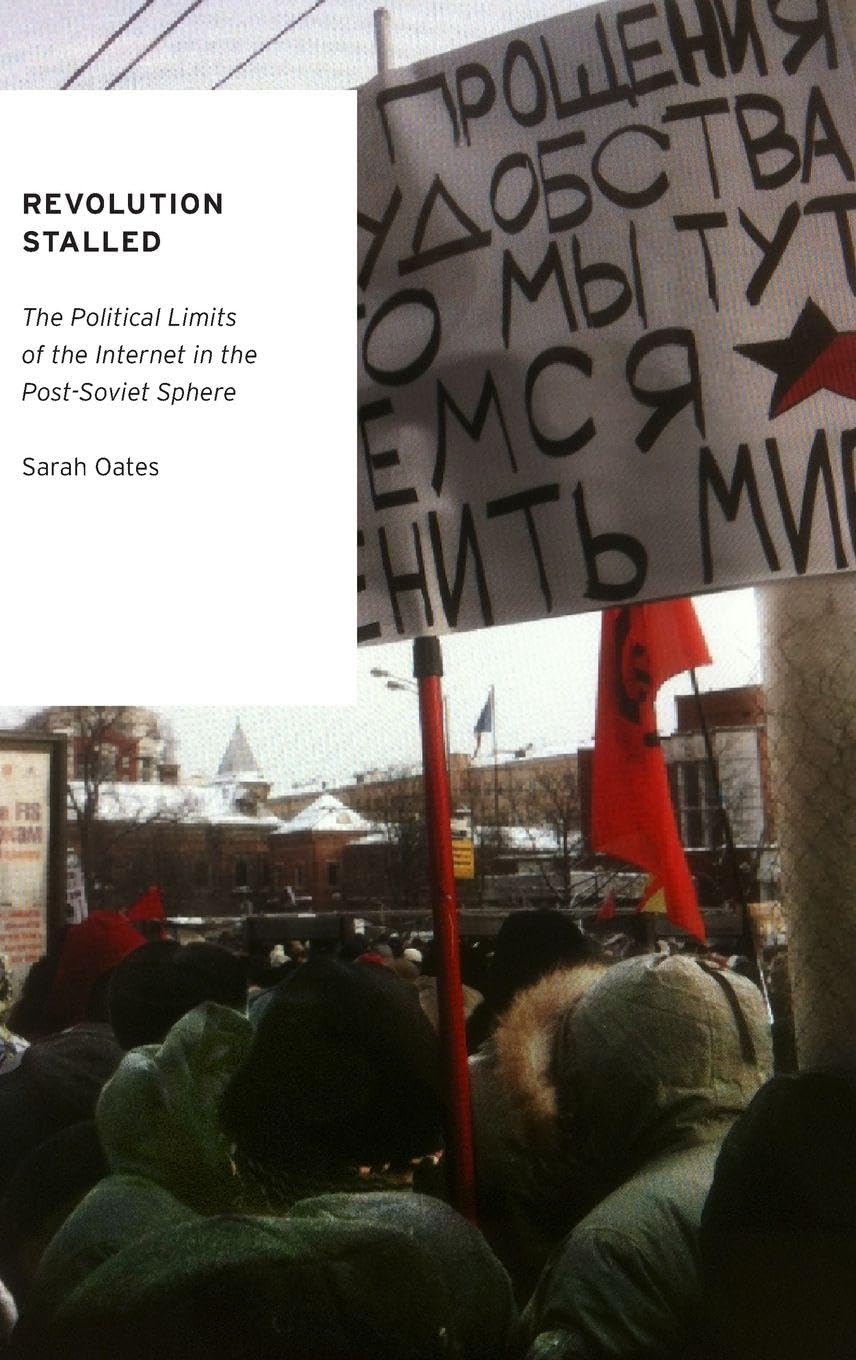
Revolution Stalled: The Political Limits of the Internet in the Post-Soviet Sphere by Sarah Oates – Understanding Digita
Inclusive of all applicable taxes. FREE shipping on all orders.
Available Offers
- 🚚Free Delivery — Free shipping on all orders
- 💵Cash on Delivery — Pay when your order arrives
- ↩️15-Day Easy Returns — Hassle-free return policy
- 🔒Cash on Delivery — Pay safely when your order arrives
Check Delivery
Product Description
Introduction
In an age where the internet is often hailed as a liberating force, Revolution Stalled: The Political Limits of the Internet in the Post-Soviet Sphere offers a timely and critical examination of how digital tools function under authoritarian regimes. Written by Sarah Oates, a leading scholar of post-Soviet media, this hardcover volume challenges the simplistic notion that online connectivity automatically leads to democratic change. For Indian readers, students, and researchers interested in the politics of technology, this book provides a nuanced framework to understand why some digital movements succeed while others fizzle out.
Book Overview
This book delves into the complex relationship between the internet and political change, focusing on Russia and the broader post-Soviet region. Oates argues that while social media and online platforms can create moments of protest, they are often co-opted or controlled by state actors. The title Revolution Stalled captures the central paradox: the same tools that empower citizens can also be used by governments to monitor, manipulate, and suppress dissent. Through detailed case studies and theoretical insights, the book reveals the structural and political limits of digital activism.
Key Highlights
- Original Research: Based on years of fieldwork and analysis of Russian internet protests, including the 2011–2012 election rallies.
- Five-Factor Framework: Introduces a unique model examining content, community, catalysts, control, and co-optation in online politics.
- Comparative Perspective: Places the Russian experience alongside global examples from the Arab Spring to Eastern Europe.
- Critical Approach: Moves beyond techno-optimism to explore how authoritarian regimes adapt and survive in the digital age.
Inside the Book
The book is structured around five key components that Oates identifies as critical to understanding the internet's political impact. Each chapter unpacks one element: how online content is shaped, how communities form and fragment, what triggers mobilization, how states exert control, and how dissent is co-opted. Rich with examples from Russian social media platforms, blogospheres, and state-run media, the narrative is both scholarly and accessible. Readers will find detailed discussions of the role of platforms like VKontakte and LiveJournal, as well as the Kremlin's strategies to manage online narratives.
Key Topics
- Political communication in non-free regimes
- State surveillance and internet censorship
- Social media and collective action
- Digital activism and its limitations
- Post-Soviet media systems and political culture
- Comparative authoritarian resilience
Reader Benefits
This book equips readers with a critical lens to evaluate news about internet-driven protests worldwide. It helps students and scholars move beyond simplistic narratives of 'Twitter revolutions' to understand the deeper political, economic, and social forces at play. For Indian readers, the insights are particularly relevant given the country's vibrant digital sphere and ongoing debates about internet regulation, data privacy, and state control. The book offers a sophisticated vocabulary to discuss these issues without falling into either utopian or dystopian extremes.
Learning Outcomes
- Understand why the internet often fails to topple authoritarian governments.
- Identify the five key factors that determine whether online activism translates into real-world change.
- Analyze the Russian internet landscape as a case study for broader global trends.
- Critically assess media coverage of digital protests and revolutions.
- Develop a framework to evaluate the political potential of new communication technologies.
Who Should Read
This book is ideal for students of political science, media studies, sociology, and international relations. Researchers focusing on comparative politics, authoritarianism, and digital media will find it indispensable. It is also valuable for journalists, policy analysts, and activists who want a deeper understanding of how the internet interacts with power. Indian readers with an interest in the politics of technology, surveillance, and free speech will find the analysis both thought-provoking and applicable to local contexts.
About the Author
Sarah Oates is a Professor and Senior Scholar at the University of Maryland's Philip Merrill College of Journalism. She has spent decades researching media and politics in the former Soviet Union, with a particular focus on Russia. Her work has been widely published in leading academic journals, and she is the author of several books on media and democracy. Oates brings a rare combination of deep regional knowledge and rigorous theoretical grounding to this study.
About the Publisher
Oxford University Press (OUP) is a prestigious academic publisher with a global reputation for excellence. The OUP US branch produces authoritative works in the humanities, social sciences, and sciences. This hardcover edition reflects OUP's commitment to high-quality scholarship, with durable binding and clear typesetting suitable for long-term study and reference.
Conclusion
Revolution Stalled is an essential read for anyone who wants to move beyond hype and understand the real political limits of the internet. By dissecting the Russian experience, Sarah Oates provides a sobering yet insightful analysis that resonates far beyond the post-Soviet sphere. For Indian readers grappling with questions of digital freedom and state power, this book offers a rigorous and accessible guide to one of the most pressing issues of our time.
Quick Summary
Revolution Stalled: The Political Limits of the Internet in the Post-Soviet Sphere by Sarah Oates is a critical examination of the internet's capacity to challenge authoritarian regimes, with a focus on Russia. The book dissects five key components—content, community, catalysts, control, and co-optation—to reveal how the online sphere interacts with political change. It goes beyond simplistic notions of 'virtual' politics, offering a nuanced analysis of how states can co-opt digital tools to maintain control. This work is ideal for political science and media students, researchers, and anyone interested in digital activism, censorship, and the limits of internet freedom. Readers will learn about real-world protests, state strategies, and the complex relationship between technology and democracy. By purchasing from Bookshops.in, Indian readers gain access to a premium edition of this thought-provoking book, delivered with care.
Book Highlights
Book Specifications
| ISBN-13 | 9780199735952 |
| ISBN-10 | 0199735956 |
| Publisher | Oxford Univ Pr on Demand |
| Language | English |
| Dimensions | 23.62 x 2.79 x 16.26 cm |
| Weight | 445 g |
| Category | Words, Language & Grammar › Communication |
| Genre | Non-fiction |
| Original Language | English |
Frequently Asked Questions
What is Revolution Stalled about?
Who is the author of Revolution Stalled?
What are the five key components discussed in the book?
Is this book relevant to Indian readers?
What time period does the book cover?
Does the book discuss social media platforms?
What is the main argument of Revolution Stalled?
Is this book suitable for undergraduate students?
What makes this book different from other internet politics books?
Does the book cover the Middle East protests?
What is the binding of this book?
What is the price of Revolution Stalled?
Can I buy this book from Bookshops.in?
Readers Also Search For
Customers Also Bought
Related Products
View All
Reference
Discourses of the Developing World: Researching Properties, Problems, and Potentials of the Developing World (Cultural Discourse Studies Series)
![Buy Language in the Context of Use: Discourse and Cognitive Approaches to Language: 37 (Cognitive Linguistics Research [CLR], 37) — BookShops.in](/book-covers/language-in-the-context-of-use-english-andrea-tyler-or-yiyoung-kim-or-mari-takad-img-0.jpg)
Reference
Language in the Context of Use: Discourse and Cognitive Approaches to Language: 37 (Cognitive Linguistics Research [CLR], 37)
Reference
Elements Of Fractional Distillation
Reference
Oxford Handbook of the Septuagint by Law Salvesen – Biblical Studies

Reference
Retellings: The Bible in Literature, Music, Art and Film

Reference