
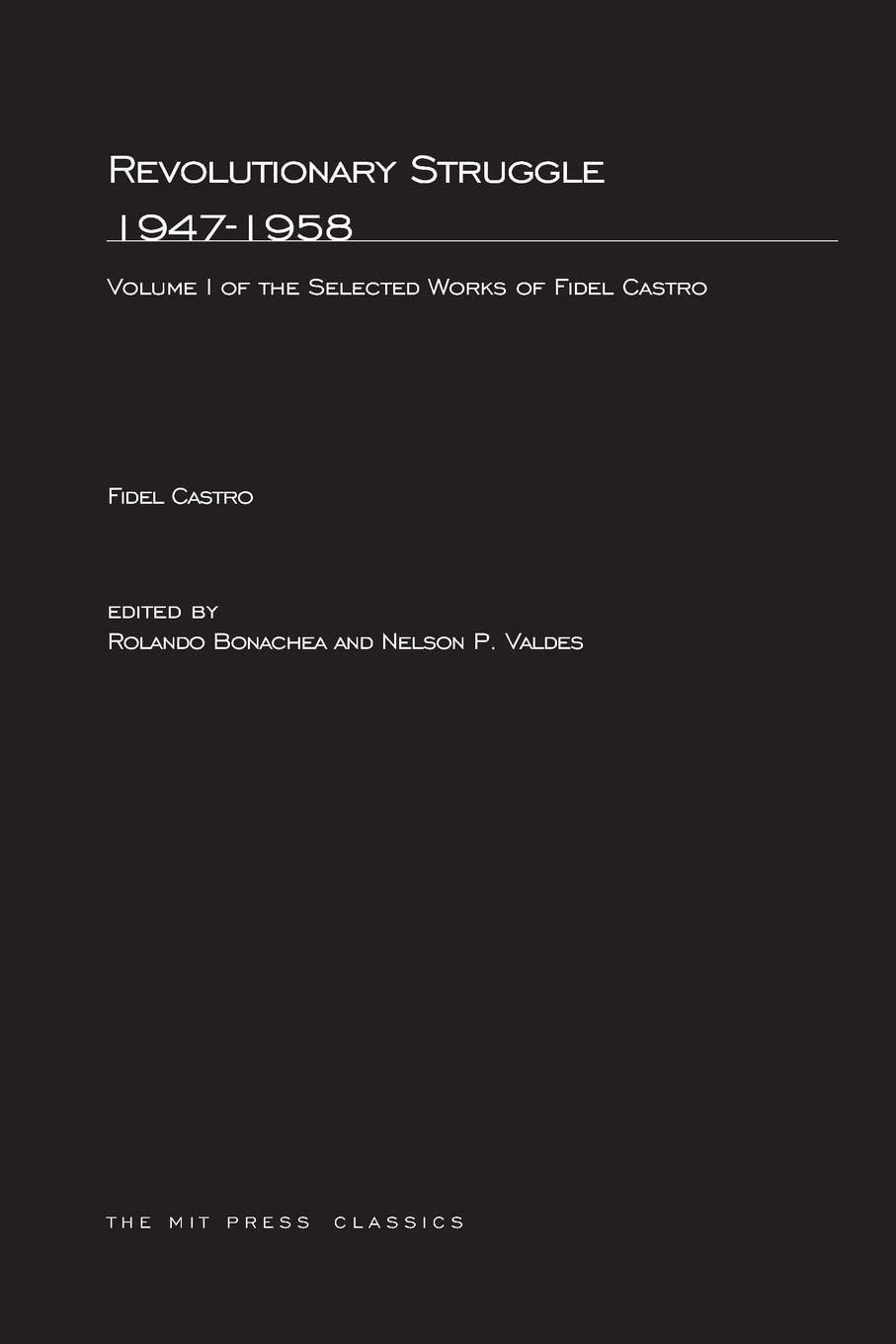
Revolutionary Struggle, 1947-1958: Selected Works of Fidel Castro – A Definitive Collection of Castro’s Early Writings a
Inclusive of all applicable taxes. FREE shipping on all orders.
Available Offers
- 🚚Free Delivery — Free shipping on all orders
- 💵Cash on Delivery — Pay when your order arrives
- ↩️15-Day Easy Returns — Hassle-free return policy
- 🔒Cash on Delivery — Pay safely when your order arrives
Check Delivery
Product Description
Introduction
Revolutionary Struggle, 1947-1958: Selected Works of Fidel Castro offers Indian readers an unprecedented window into the early political evolution of one of the twentieth century's most transformative figures. Published by MIT Press, this hardcover volume presents Castro's own words from his youth to the triumph of the Cuban Revolution. For students of political science, history, and Latin American studies, this book is an essential primary source that captures the raw energy, ideological ferment, and strategic thinking that shaped a revolutionary leader.
Book Overview
This first volume of the Selected Works of Fidel Castro spans the critical decade from 1947 to 1958, covering Castro's emergence as a student activist, his involvement in the Bogotazo riots, his exile in Mexico, the famous Moncada Barracks attack, his trial and imprisonment, and the guerrilla war that finally ousted the Batista regime. The collection includes letters, articles, interviews, press releases, proclamations, and decrees, many of which have never before been compiled in a single volume. An extensive editorial introduction provides historical context, linking each document to the broader currents of Cuban and global politics.
Key Highlights
- Comprehensive primary source collection: Over 100 documents from Castro's formative years, carefully selected and annotated.
- Detailed editorial framework: An extensive introduction by leading scholars places each text in its historical and political context.
- Rare and inaccessible materials: Includes early writings, underground pamphlets, and revolutionary decrees that are difficult to find elsewhere.
- Research-oriented bibliography: A complete bibliography of Castro's works through 1958 serves as a valuable tool for academic research.
- Hardcover edition: Durable binding makes this a lasting addition to any serious library.
Inside the Book
The volume is organized chronologically, tracing Castro's intellectual and political journey. It begins with his early student writings at the University of Havana, where he first articulated his anti-imperialist and social justice ideas. The book then moves through his participation in the Caribbean Legion, his legal defense after the Moncada attack (the famous 'History Will Absolve Me' speech), his time in Mexican exile, and the Sierra Maestra campaign. Each document is accompanied by footnotes explaining references, events, and personalities. The editors' introduction alone runs over sixty pages, offering a masterclass in the history of the Cuban revolutionary movement.
Key Topics
- Cuban political history (1940s–1950s): The collapse of democracy and rise of the Batista dictatorship.
- Revolutionary ideology: Castro's early synthesis of nationalism, Marxism, and anti-imperialism.
- Guerrilla warfare strategy: The tactical and operational thinking behind the Sierra Maestra campaign.
- Legal and political rhetoric: Castro's use of courts, media, and public platforms to build a revolutionary movement.
- Cold War context: How Cuba's struggle intersected with U.S. hegemony and global decolonization.
- Comparative revolutionary studies: Parallels with other anti-colonial and socialist movements in Asia, Africa, and Latin America.
Reader Benefits
- Authentic voice: Read Castro's own words, not filtered through secondary interpretations.
- Historical depth: Understand the roots of the Cuban Revolution and its long-term consequences.
- Critical thinking skills: Analyze primary sources and develop your own interpretations of complex events.
- Academic excellence: Ideal for writing research papers, dissertations, or preparing for competitive examinations.
- Global perspective: Broaden your understanding of twentieth-century revolutionary movements beyond India.
Learning Outcomes
By studying this volume, readers will be able to: trace the evolution of Castro's political thought from liberal reformism to revolutionary socialism; evaluate the role of leadership, ideology, and strategy in successful insurgencies; analyze the relationship between domestic Cuban politics and international Cold War dynamics; and critically assess primary historical documents for bias, context, and reliability. Students will gain a nuanced understanding of how revolutions are built, sustained, and justified.
Who Should Read
This book is indispensable for undergraduate and postgraduate students of history, political science, international relations, and Latin American studies. It will also appeal to researchers focusing on revolutionary theory, guerrilla warfare, or Cold War history. Journalists, activists, and general readers with a serious interest in understanding the ideological foundations of modern Cuba will find this collection both enlightening and challenging. Indian readers, in particular, will discover fascinating parallels with the anti-colonial and socialist movements that shaped the subcontinent.
About the Author
Fidel Castro (1926–2016) was a Cuban revolutionary, lawyer, and politician who led the Cuban Revolution and served as Prime Minister and later President of Cuba. His writings and speeches are foundational texts for understanding twentieth-century socialism, anti-imperialism, and the politics of the Global South. This volume captures his voice before he assumed state power, revealing the intellectual and strategic formation of a leader who would reshape hemispheric politics.
About the Publisher
MIT Press, the publishing arm of the Massachusetts Institute of Technology, is renowned for its rigorous academic standards and commitment to publishing works that bridge science, technology, and society. This volume is part of their prestigious series on revolutionary movements and political thought, ensuring authoritative editing and scholarly integrity.
Conclusion
Revolutionary Struggle, 1947-1958 is more than a historical document—it is a masterclass in political transformation. For Indian students and scholars seeking to understand how ideas become movements and how movements change the world, this book offers unparalleled insight. Whether you are researching Cold War history, studying revolutionary theory, or simply curious about one of the most iconic figures of the modern era, this hardcover collection belongs on your shelf. Order your copy today from Bookshops.in and journey into the crucible of revolution.
Quick Summary
Revolutionary Struggle, 1947-1958: Selected Works of Fidel Castro is a meticulously compiled volume from MIT Press that gathers Fidel Castro’s most significant early writings—letters, articles, interviews, press releases, proclamations, and decrees—from the late 1940s until the triumph of the Cuban Revolution in 1959. This book is an essential primary source for anyone studying the ideological and strategic evolution of one of the 20th century’s most iconic revolutionary figures. The extensive editors' introduction provides crucial historical context, making the documents accessible to both scholars and general readers. Readers will gain a firsthand understanding of Castro's rhetorical style, his political philosophy, and the grassroots movement that overthrew the Batista regime. Ideal for Indian students of history, political science, and Latin American studies, this hardcover edition offers durable quality for repeated reference. By purchasing from Bookshops.in, you support a trusted Indian bookstore dedicated to delivering premium academic titles across the country.
Book Highlights
Book Specifications
| ISBN-13 | 9780262520270 |
| ISBN-10 | 0262520273 |
| Publisher | Mit Pr |
| Language | English |
| Dimensions | 15.24 x 2.29 x 22.86 cm |
| Weight | 680 g |
| Country | India |
| Category | Americas › United States |
| Genre | Nonfiction |
| Reading Age | Adult |
| Original Language | Spanish |
Frequently Asked Questions
What time period does this book cover?
Is this the complete works of Fidel Castro?
What types of documents are included?
Does the book include an introduction?
Is this book suitable for Indian students?
What is the language of the book?
Are there any illustrations or maps?
Can I use this book for academic citations?
Does the book cover Castro's later years?
Is the binding durable?
What is the price in Indian Rupees?
Where can I buy this book in India?
Does the book include a bibliography?
Readers Also Search For
Related Products
View All
History
The Information Revolution: Transforming the World Through Technology (World History)
History
Human Nature and the French Revolution: From the Enlightenment to the Napoleonic Code: 3 (Polygons: Cultural Diversities and Intersections, 3)
History
The Unmaking of Home in Contemporary Art (Cultural Spaces)

History
Handbook to Life in Medieval and Early Modern Japan | by William E. Deal | Oxford University Press | by William E. Deal | Oxford University Press | by William E. Deal | Oxford University Press | by William E. Deal | Oxford University Press | by William E. Deal | Oxford University Press | by William E. Deal | Oxford University Press | by William E. Deal | Oxford University Press | by William E. Deal | Oxford University Press | by William E. Deal | Oxford University Press | by William E. Deal | Ox

History
The Narrators of Barbarian History (A.D. 550-800) | by Walter Goffart | University of Notre Dame Press | by Walter Goffart | University of Notre Dame Press | by Walter Goffart | University of Notre Dame Press | by Walter Goffart | University of Notre Dame Press | by Walter Goffart | University of Notre Dame Press | by Walter Goffart | University of Notre Dame Press | by Walter Goffart | University of Notre Dame Press | by Walter Goffart | University of Notre Dame Press | by Walter Goffart | Univ
History