
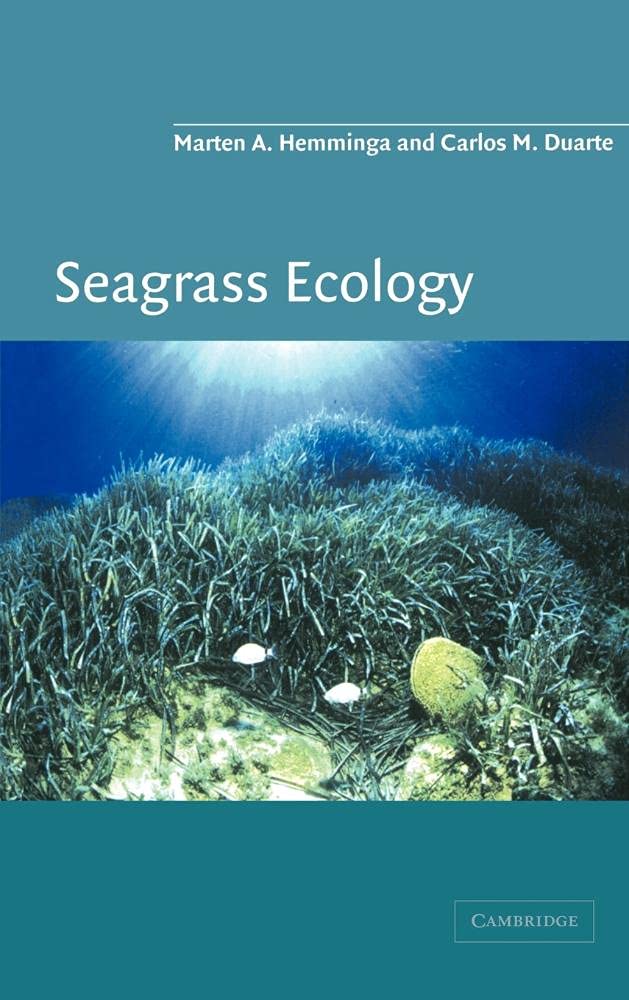
Seagrass Ecology: Understanding the Vital Role of Seagrasses in Coastal Ecosystems
Inclusive of all applicable taxes. FREE shipping on all orders.
Available Offers
- 🚚Free Delivery — Free shipping on all orders
- 💵Cash on Delivery — Pay when your order arrives
- ↩️15-Day Easy Returns — Hassle-free return policy
- 🔒Cash on Delivery — Pay safely when your order arrives
Check Delivery
Product Description
Introduction
Seagrasses form some of the most productive and ecologically vital ecosystems on our planet, yet they remain largely unseen beneath the waves. In Seagrass Ecology, author Marten Hemminga presents a comprehensive and accessible exploration of these underwater flowering plants, their habitats, and their critical role in coastal environments. Published by Cambridge University Press, this hardcover volume is an essential addition to the library of any marine biology student, researcher, or coastal manager in India and around the world.
Book Overview
This authoritative text offers a thorough entry point into the study of seagrass ecosystems. It bridges the gap between foundational knowledge and cutting-edge research, covering everything from the basic biology and distribution of seagrasses to their complex interactions with marine fauna, nutrient cycling, and the pressing challenges of human impact. With extensive references guiding readers to deeper studies, the book serves both as a textbook for advanced students and as a reference for professionals working in coastal conservation and management.
Key Highlights
- Comprehensive coverage of seagrass biology, ecology, and ecosystem services in one volume.
- Extensive literature references for those wishing to pursue specialized research topics.
- Global perspective with relevance to Indian coastal ecosystems, including the Gulf of Mannar, Chilika Lake, and the Andaman Islands.
- Hardcover edition from Cambridge University Press, built for long-term academic use.
- Clear, structured chapters that progress from fundamental concepts to advanced ecological processes.
Inside the Book
The book is organized into logically flowing chapters that first introduce the reader to the taxonomy and global distribution of seagrasses. It then delves into the physiological adaptations that allow these plants to thrive in submerged, saline environments. Subsequent sections explore primary production, decomposition, and the intricate food webs that depend on seagrass beds. Special attention is given to the role of seagrasses as nursery habitats for commercially important fish and crustaceans, as well as their function as carbon sinks—a topic of growing importance in climate change discussions.
Key Topics
- Seagrass biology and taxonomy: Understanding different species and their morphological adaptations.
- Ecosystem dynamics: Nutrient cycling, sediment stabilization, and primary productivity.
- Faunal interactions: Grazing, predation, and the role of seagrass beds in marine food chains.
- Human impacts and management: Eutrophication, coastal development, and conservation strategies.
- Global and regional perspectives: Case studies from temperate and tropical waters, including the Indian subcontinent.
Reader Benefits
Readers will gain a deep, integrated understanding of how seagrass ecosystems function and why they are indispensable to coastal health. The book equips students with the foundational knowledge needed to pursue advanced research, while providing practitioners with actionable insights for conservation planning. The extensive bibliography saves time for researchers looking for primary sources, and the clear writing style makes complex ecological concepts accessible to non-specialists.
Learning Outcomes
- Identify major seagrass species and their global distribution patterns.
- Explain the physiological and ecological adaptations of seagrasses to marine life.
- Analyze the role of seagrass meadows in carbon sequestration and coastal protection.
- Evaluate human threats to seagrass ecosystems and propose science-based management solutions.
- Apply ecological principles to real-world conservation scenarios in Indian coastal zones.
Who Should Read
This book is ideal for undergraduate and postgraduate students of marine biology, ecology, and environmental science in Indian universities. It is equally valuable for researchers entering the field of seagrass ecology, as well as coastal zone managers, conservation officers, and NGO professionals working on marine habitat restoration. Anyone with a serious interest in the hidden meadows beneath our oceans will find this book a rewarding read.
About the Author
Marten Hemminga is a distinguished marine ecologist with decades of research experience in seagrass ecosystems. His work has contributed significantly to the understanding of nutrient dynamics, plant-animal interactions, and the conservation of coastal vegetation. Hemminga's clear, evidence-based writing style reflects his commitment to making complex science accessible to a broad audience.
About the Publisher
Cambridge University Press is one of the world's oldest and most respected academic publishers. With a legacy of over four centuries, Cambridge University Press is synonymous with rigorous peer review, scholarly excellence, and high-quality production. This hardcover edition reflects the publisher's commitment to durable, lasting resources for the academic community.
Conclusion
Seagrass Ecology is more than a textbook—it is a gateway to understanding one of the most undervalued ecosystems on Earth. For Indian students and professionals seeking to engage with marine conservation, this book provides the scientific grounding and practical perspective needed to make a difference. Whether you are studying the coastlines of Tamil Nadu or the lagoons of Lakshadweep, this volume will deepen your appreciation for the seagrass meadows that sustain our seas.
Quick Summary
Seagrass Ecology by Marten Hemminga is a foundational text that explores the ecology of seagrasses, the flowering plants that form critical habitats in coastal waters worldwide. The book provides a comprehensive overview of seagrass distribution, species diversity, ecosystem functions, and the myriad ways human activities impact these fragile environments. It is designed as an entry point for students of marine biology and as a reference for established researchers entering the field. Readers will learn about seagrass growth, reproduction, nutrient cycling, interactions with fauna, and the ecosystem services they provide, such as carbon sequestration and shoreline stabilization. The book also addresses pressing conservation issues, including habitat loss, pollution, and climate change, and outlines management and restoration strategies. Written in clear, accessible language and supported by extensive references, this volume bridges the gap between introductory texts and specialized research papers. For Indian readers, the principles and case studies are directly relevant to coastal ecosystems like the Gulf of Mannar, Chilika Lake, and the Andaman Islands. Buying from Bookshops.in ensures you receive a genuine hardcover copy with prompt delivery and reliable service across India.
Book Highlights
Book Specifications
| ISBN-13 | 9780521661843 |
| ISBN-10 | 0521661846 |
| Publisher | Cambridge University Press |
| Language | English |
| Dimensions | 15.88 x 1.91 x 23.5 cm |
| Weight | 610 g |
| Category | Biology & Life Sciences › Biology |
| Genre | Science & Mathematics |
| Original Language | English |
Frequently Asked Questions
What is Seagrass Ecology about?
Who is the author of Seagrass Ecology?
Is this book suitable for Indian students?
What topics are covered in the book?
Does the book include case studies from India?
Is this a textbook or a reference book?
Can I use this book for my PhD research?
What is the price of Seagrass Ecology?
Is the book available in hardcover?
Does the book cover seagrass restoration?
What is the ISBN of this book?
Why should I buy from Bookshops.in?
Readers Also Search For
Customers Also Bought
Mathematics
Stereotype Spaces and Algebras: 73 (De Gruyter Expositions in Mathematics, 73)

Mathematics
Semigroups in Algebra, Geometry and Analysis: 20 (De Gruyter Expositions in Mathematics, 20)

Mathematics
Geometry from the Pacific Rim: Proceedings of the Pacific Rim Geometry Conference held at National University of Singapore, Republic of Singapore, ... 1994 (De Gruyter Proceedings in Mathematics)

Mathematics
First International Tainan-Moscow Algebra Workshop: Proceedings of the International Conference held at National Cheng Kung University Tainan, Taiwan, ... 1994 (De Gruyter Proceedings in Mathematics)

Mathematics
Differential Geometry - Proceedings of the VIII International Colloquium (English, Jesus A. Alvarez Lopez | Eduardo Garcia-Rio)

Mathematics
Mathematical Theory of Optimal Processes (Classics of Soviet Mathematics)
Related Products
View All
Biology
Evolution: What the Fossils Say and Why It Matters by Donald R. Prothero
Biology
From Taxonomy to Phylogenetics – Life and Work of Willi Hennig
Biology
The Marine Biology of the South China Sea
Biology
Genetics Meets Metabolomics: from Experiment to Systems Biology
Biology
The Elements of Natural or Experimental Philosophy: 2
Biology